Sant’Antonio di Ranverso

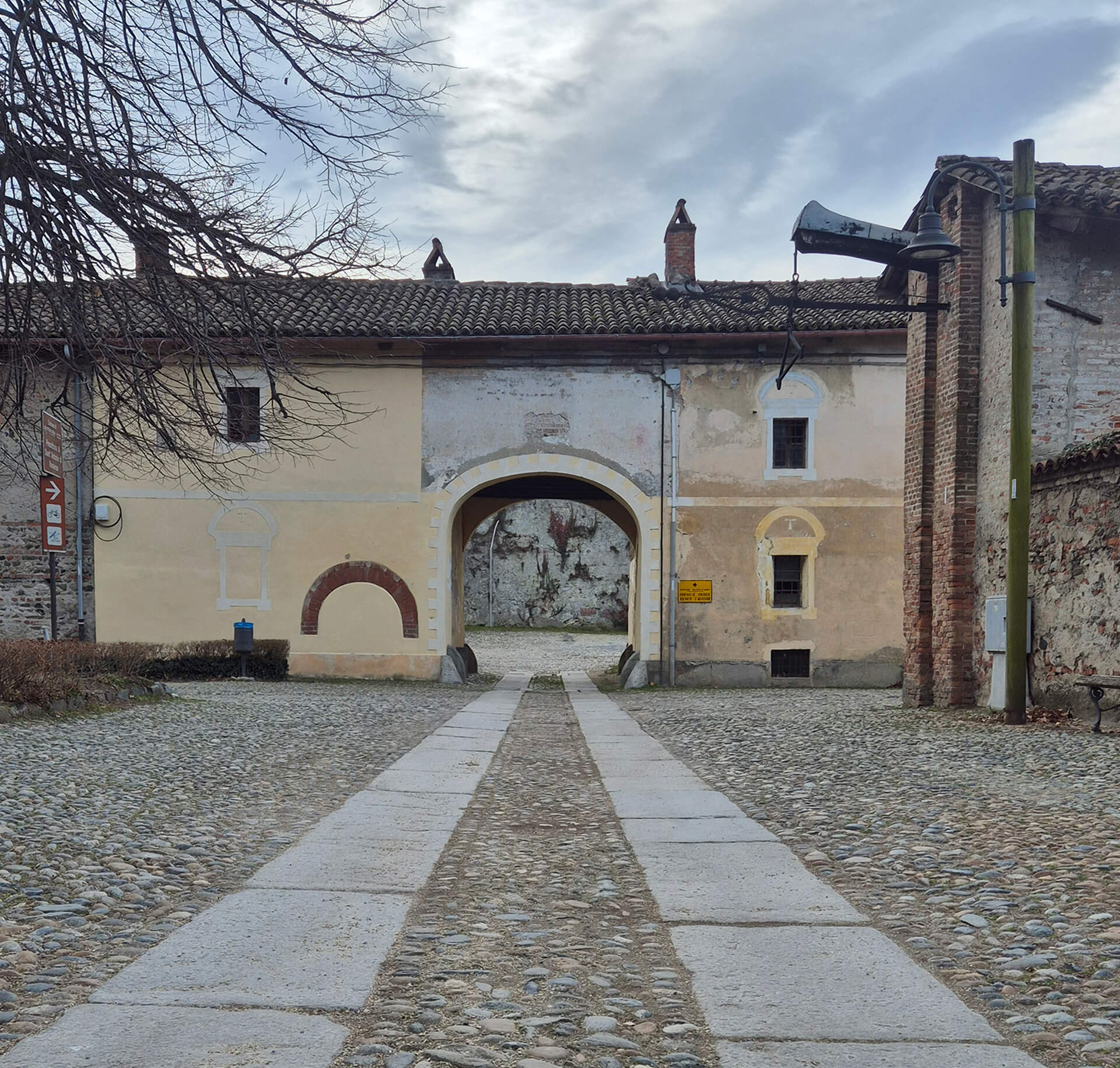
Fotografia di un edificio storico con accesso ad arco inserito in un contesto di corte pavimentata, caratterizzato da architettura tradizionale in muratura intonacata e copertura a falde con manto in coppi. Il prospetto principale è semplice e simmetrico, con un grande portale centrale ad arco ribassato che costituisce il passaggio verso uno spazio interno, probabilmente un cortile o un secondo recinto.

La facciata presenta tracce di stratificazioni e interventi nel tempo, visibili nelle differenze di intonaco, nelle aperture tamponate e nelle cornici decorative parzialmente conservate. Ai lati del portale si riconoscono elementi architettonici dipinti o modellati nell’intonaco, come finte cornici e archi decorativi, che suggeriscono una configurazione originaria più articolata. Le piccole finestre con contorno sagomato e la presenza di camini sul tetto indicano un edificio di impianto antico, probabilmente legato a funzioni rurali, militari o di servizio.

In primo piano è visibile una pavimentazione in ciottoli con percorso centrale in lastre di pietra, che conduce direttamente all’arco di ingresso e rafforza l’asse di simmetria della composizione. Ai lati sono presenti muri in pietra e mattoni, elementi metallici e corpi illuminanti, che testimoniano adattamenti contemporanei all’uso attuale dell’area.

L’immagine documenta lo stato di conservazione dell’edificio e il rapporto tra architettura storica e spazio aperto, evidenziando la permanenza dei caratteri originari nonostante le trasformazioni e gli interventi successivi.

Sant’Antonio di Ranverso

The project involves the restoration and repurposing of the “Ospedaletto” and “Cascina Bassa” preceptories of Sant’Antonio di Ranverso, with the aim of preserving their historical features while enhancing their functional performance. The work includes structural consolidation, the repair of walls and decorated surfaces, the careful renovation of wooden floors and roofs with tile coverings, the restoration of terracotta floors, historic windows, and doors, the installation of new low-impact systems, and improved accessibility. Simultaneously, the external areas have been redesigned with rationalized pathways, reduced paved surfaces, and enhanced green spaces, thereby restoring the complex’s role as a center for hospitality, dining, and cultural activities in keeping with the surrounding historic agricultural landscape.

Turin, 2025 – Works in progress
Client: Mauriziano Order Foundation
Value of works: 4.000.000 €
Architectural project: Giovanni Durbiano
External Areas Project: Marco Ferrari
Structural and building services engineering: MCM Ingegneria srl
Building subject to protection under Legislative Decree no. 42/2004
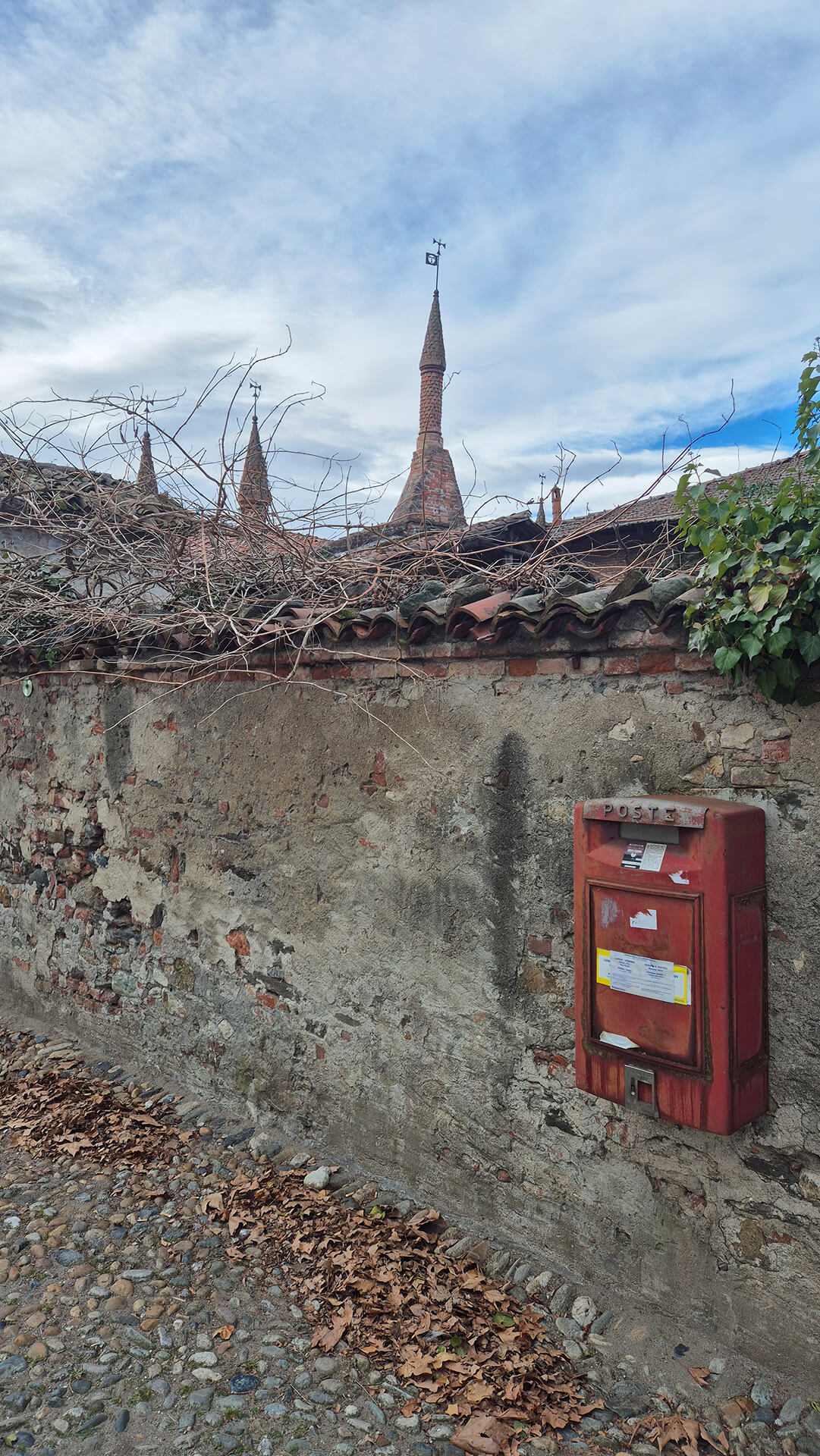
Photograph of a historic perimeter wall made of a mix of brick and stone masonry, characterized by deteriorated plaster and gaps that reveal the original texture. The top of the wall is protected by a covering of terracotta tiles, over which grows spontaneous vegetation and dead branches, a sign of limited maintenance and progressive surface degradation. In the foreground, an external cobblestone pavement with dead leaves is visible, suggesting a courtyard or a historic path paved with traditional materials. On the right side of the wall, a red metal mailbox is mounted, showing signs of wear and discoloration, testifying to the contemporary adaptation of an ancient space to functions still in use. Beyond the wall, one can glimpse tiled roofs and several conical brick turrets with metal weathervanes, architectural elements that point to a historic complex of religious, rural, or fortified character. The presence of spires and traditional roofs suggests a building of ancient origin, likely subject to transformations over time. The image documents the material and conservation state of the wall structures, highlighting the stratification of the materials, the signs of aging, and the relationship between historical elements and more recent additions. This is useful for understanding the current state of the building and for any restoration or redevelopment interventions.

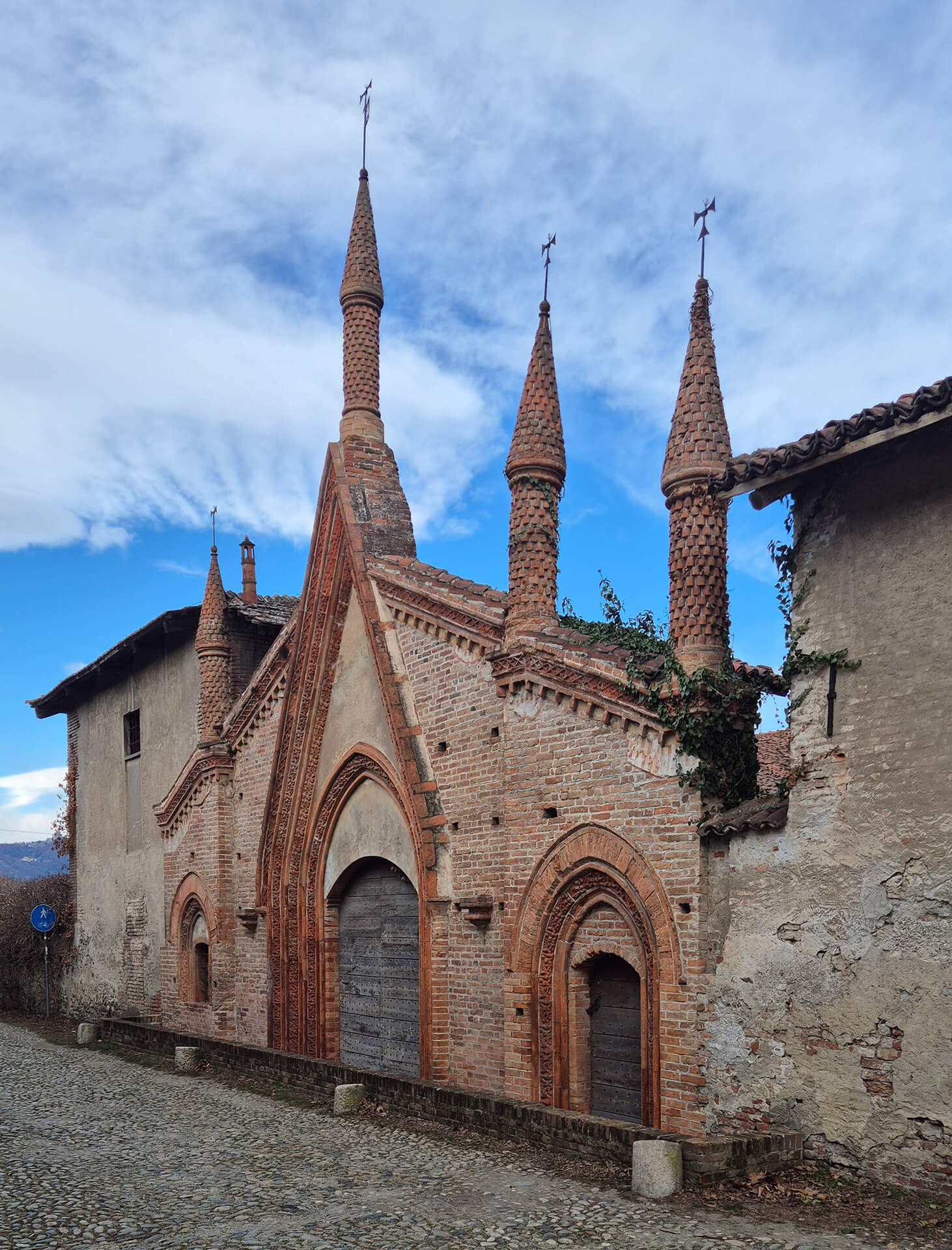
Photograph of a historic brick building with Gothic-style decorative features, located within a rural or ancient village setting and overlooking a cobblestone pavement. The façade is defined by an exposed brick façade with a central pointed-arch portal, framed by a richly decorative splay made of shaped terracotta elements, highlighting the architecture's Neo-Gothic roots. The composition is accentuated by the presence of slender vertical brick pinnacles, placed at the corners and partitions of the façade, terminating in metal weathervane elements. These slender elements give the building a strong vertical development and an ornamental character typical of late-19th-century eclectic architecture. To the sides of the main portal are secondary openings, also with pointed arches, now closed by wooden doors, suggesting an original configuration with multiple entrances or side chapels. The brickwork shows signs of aging and alterations over time, with gaps, stucco, and patches of deteriorated plaster on adjacent buildings, which appear seamlessly adjacent to the main building. The roof is made of pitched tiles, while the presence of wild vegetation along the walls indicates a state of conservation that is not fully under control. The surrounding context, characterized by plastered walls, traditional flooring, and ancient buildings, contributes to the creation of a stratified historical environment. The image documents the architectural and material characteristics of the building, highlighting the decorative terracotta, the artisanal quality of the finishes, and the current state of conservation. These elements are useful for understanding the building's historical and architectural features and for potential restoration projects.

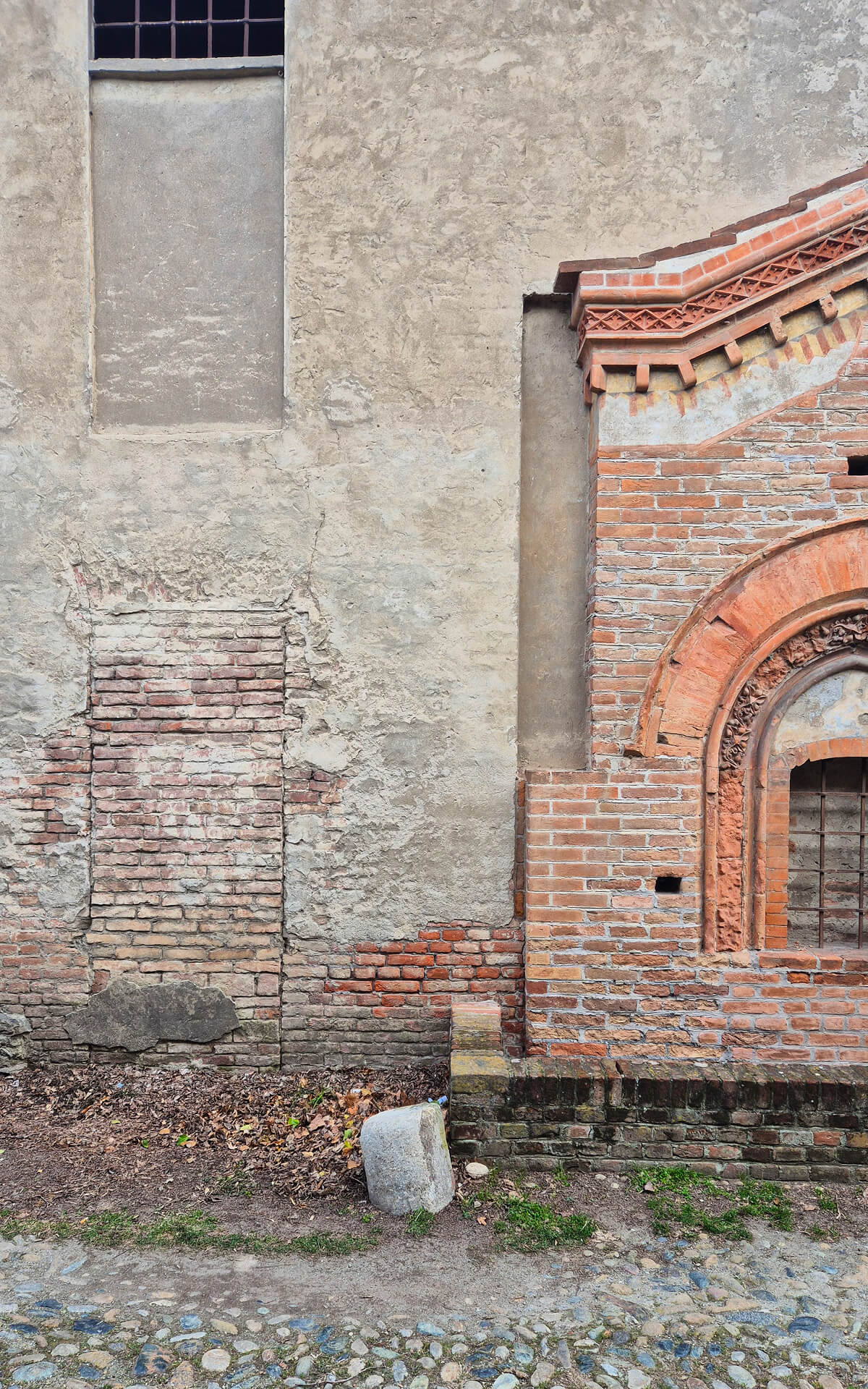
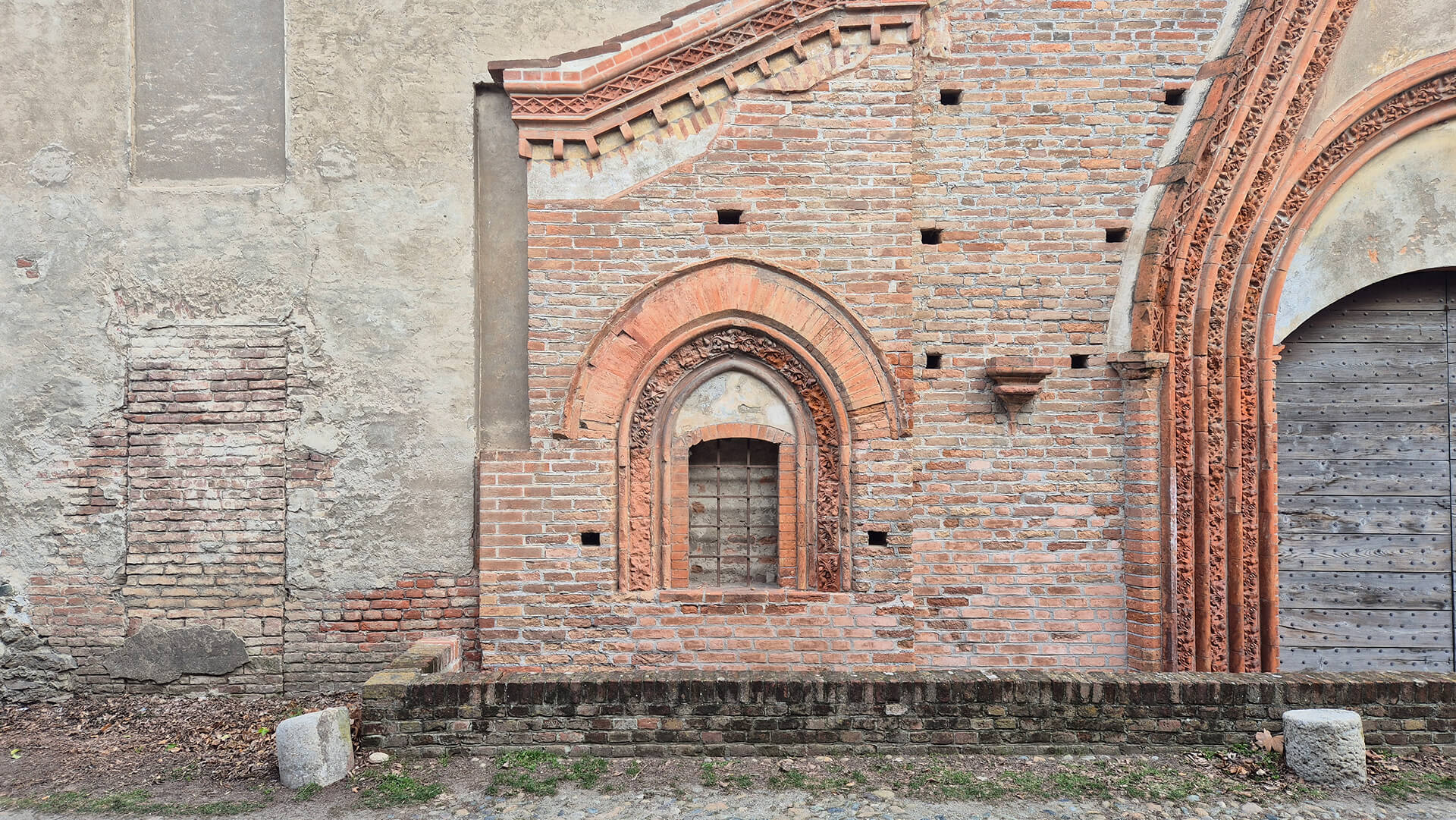
Close-up detail of a historic wall highlighting the construction stratification and material condition of a brick and plaster façade. The image shows the meeting of two different buildings: on the left, a severely deteriorated plastered wall, with large portions of the cladding having fallen away, exposing the brickwork, and on the right, an architectural element in exposed brick with Gothic-style decorations. The brick section features a small pointed-arch opening framed by shaped terracotta elements, with an ornamental motif in the archway and an upper cornice decorated with serrated bands and moldings. This decorative arrangement, created with great artisanal care, contrasts with the adjacent plastered surface, which is poorer and marked by subsequent interventions, infilling, and repairs that testify to changes over time. In the left section, a brick infill from a previous opening is clearly visible, recognizable by the difference in texture and the rectangular shape inserted into the masonry. The presence of cracks, flaking plaster, efflorescence, and color discontinuities indicates an advanced state of surface decay, useful for understanding the construction phases and subsequent interventions. At the base of the wall, contact with the ground and an external cobblestone paving is visible, while small stone fragments and accumulations of leaves indicate a poorly maintained exterior. The image has documentary value for analyzing the current state, highlighting materials, construction techniques, stratifications, and conservation conditions useful for potential restoration.

Detail of historic masonry clearly demonstrating the coexistence of different construction techniques and successive phases of intervention. The wall is primarily made of mixed masonry of pebbles, irregular stones, and bricks, bonded with lime-based mortar, typical of rural and utility buildings. The upper section features a heterogeneous texture composed of irregularly arranged stone fragments and river pebbles, while the central section features a vertical brick infill, likely the closure of a previous opening, likely a door or a larger window. The infill is recognizable by its different texture and the more regular arrangement of the bricks, which stand out clearly from the surrounding facing. The presence of different mortars, flaking plaster, and chromatic discontinuities allow us to discern the various construction phases and functional adaptations of the building over time. On the left side, a small segmental brick opening with a metal grille is visible, likely used as a ventilation or light window for a utility room. On the right, a green-painted metal door appears, set in a recess surrounded by plastered masonry, marked by rising damp, biological colonization, and moss along the base. The lower layer of masonry shows severe deterioration, with erosion of the joints, loss of material, and the presence of spontaneous vegetation, indicative of persistent damp conditions. Contact with the ground and the external cobblestone paving accentuates the deterioration, making the image particularly significant for analyzing the state of conservation, construction stratification, and transformations undergone by the structure over time.

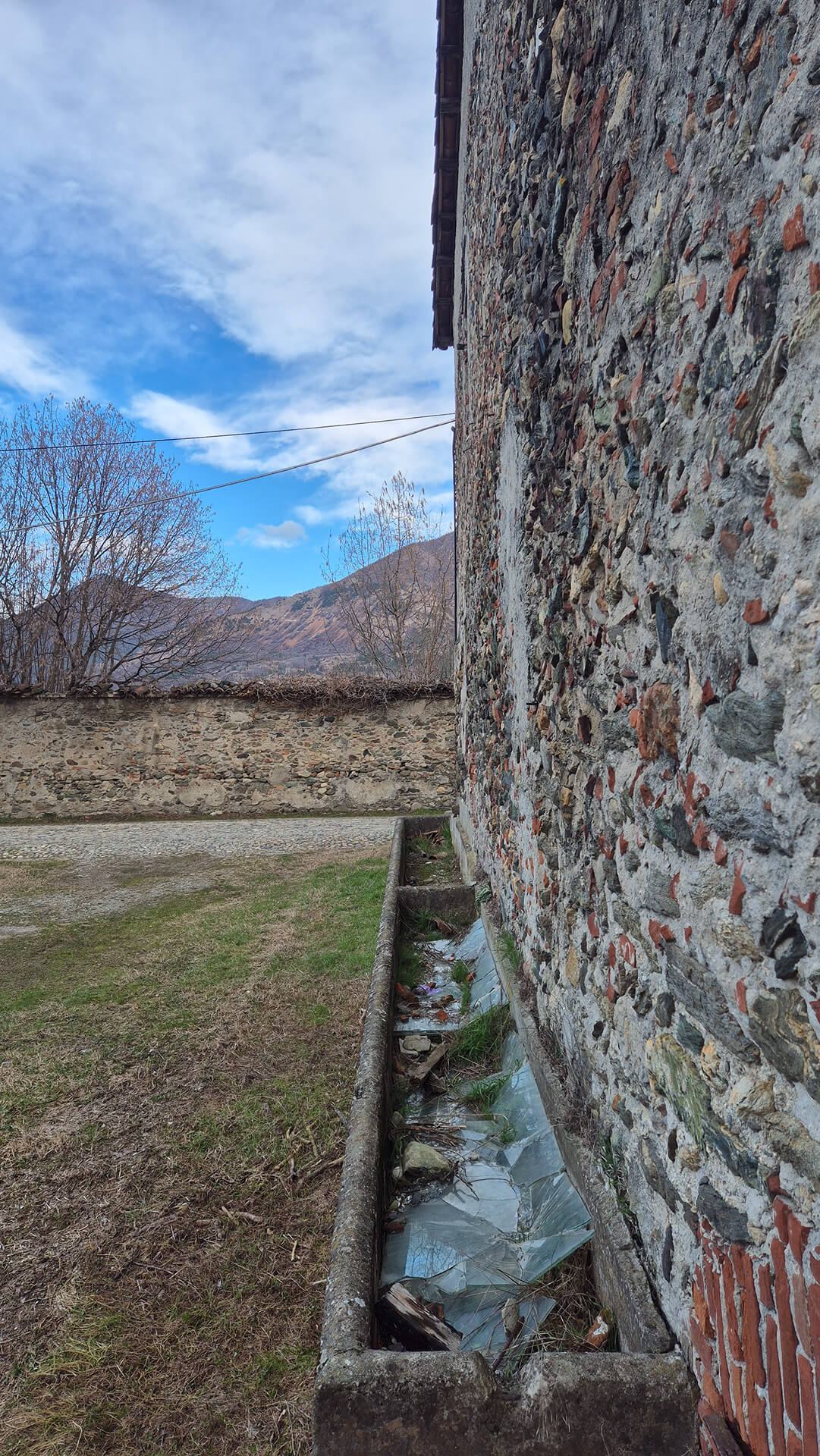
Close-up perspective view of a historic perimeter wall made of mixed stone, cobblestone, and brick masonry, bonded with lime mortar, a construction method typical of rural and utility buildings. The shot follows the wall lengthwise, highlighting the irregular texture of the facing, composed of stone elements of various sizes with brick inserts, distributed without regular order and with very uneven joints. At the base of the wall is a concrete drainage channel, built against the foot of the wall, intended for rainwater drainage and to protect the foundation from stagnant humidity. Inside the channel, fragments of glass, debris, and spontaneous vegetation are visible, signs of poor maintenance that can promote rising damp and material degradation. The foundation shows discoloration, erosion of the joints, and the presence of moss and deposits, indicators of persistent capillary damp and exposure to atmospheric agents. The continuity of the masonry and the absence of plaster clearly reveal the original construction technique, characterized by a simple yet functional structure, marked by marked irregularities and the use of local materials. In the background, the surrounding wall of the same complex is visible, constructed using a similar technique, delimiting an open space of earth and grass, while beyond the fence, the hilly landscape can be glimpsed. The image has documentary value for analyzing the state of conservation, the traditional masonry techniques, and the deterioration caused by humidity and lack of maintenance, all of which are crucial elements in the survey and restoration project.

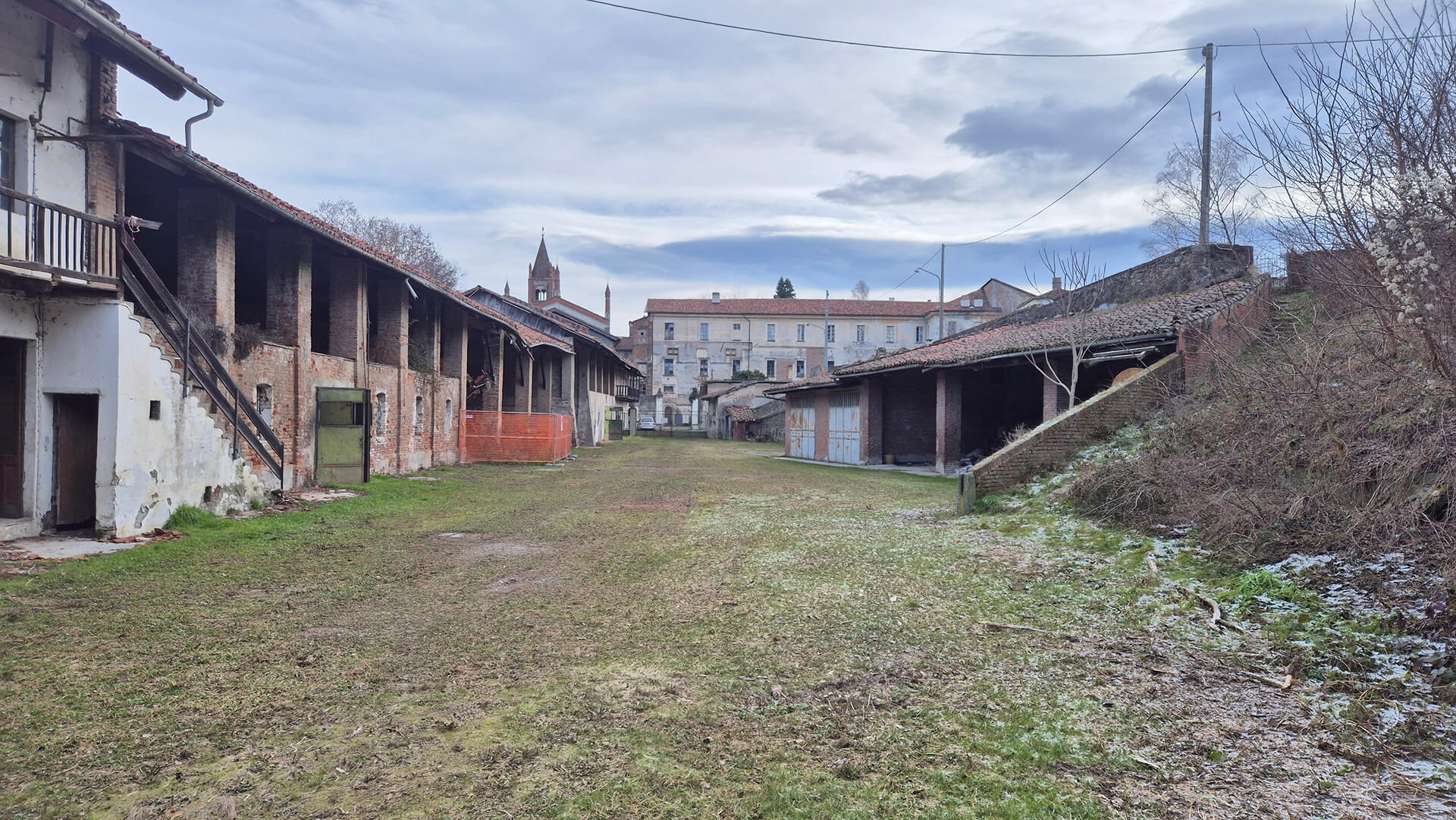
Overall view of an open space within a historic rural complex, configured as a rectangular courtyard bordered by porticoed buildings and service buildings, constructed primarily of mixed brick and stone masonry with pitched tile roofs. The image clearly shows the typical layout of a farmhouse or agricultural complex, with buildings arranged along the long sides of the courtyard and open spaces originally intended for production and service activities. On the left side is a two-story building with a continuous loggia on the upper floor, supported by masonry pillars, and an external iron and wood staircase. The walls feature large sections of deteriorated plaster, leaving the brickwork exposed, highlighting the uneven state of preservation and the presence of partial maintenance work. On the ground floor are service rooms and driveways, some closed with metal frames. On the right side is a lower building, characterized by open porticoes and garages or storage areas, with a sloping roof and simple structure, likely intended for tool sheds or stables. The continuity of the façades and the parallel arrangement of the buildings define a large central space, now a lawn, which retains its function as a maneuvering and distribution area. The courtyard is partly grassy and partly unpaved, showing signs of dampness and poor maintenance. In the background, a building of greater architectural value, likely residential or institutional, can be glimpsed, closing off the space. A brick bell tower also emerges in the background, a feature that places the complex within a stratified historical context, whether rural or peri-urban. The image is significant for understanding the original typological layout, the state of conservation, and the functional transformations of the complex, useful for preliminary survey analyses, restoration, or redevelopment projects.

Front view of a historic perimeter wall made of mixed stone, cobblestone, and brick masonry, featuring a segmental arch framed in solid bricks, which forms the main entrance to an internal courtyard. The arch is constructed of radially arranged bricks and supported by brick piers, contrasting with the more irregular surrounding wall, composed of heterogeneous stone materials bonded with lime mortar. Inside the opening is a two-leaf metal gate, painted green and topped with vertical elements with decorative spikes, which allows for closure of the entrance while maintaining visual permeability to the interior space. A prohibition sign on the gate warns of the dangerous condition of the building beyond the fence, indicating the complex's state of abandonment or uninhabitability. Through the opening, a glimpse of the internal courtyard can be seen, with its longitudinally arranged porticoed buildings, confirming the typology of a rural or service complex organized around a central space. The surrounding wall shows widespread signs of surface degradation, with mortar loss in the joints, erosion of materials, and spontaneous vegetation growth along the top, signs of prolonged exposure to the elements and poor maintenance. In the foreground, the terrain is partly grassy and partly unpaved, with debris and loose stones, while stone elements and residual structures that may be from previous constructions are visible to the sides of the entrance. The image clearly documents the fencing system, the traditional construction technique, and the state of conservation of the complex, making it useful for architectural survey analyses, historical-constructive studies, and preliminary assessments for restoration or repurposing projects.

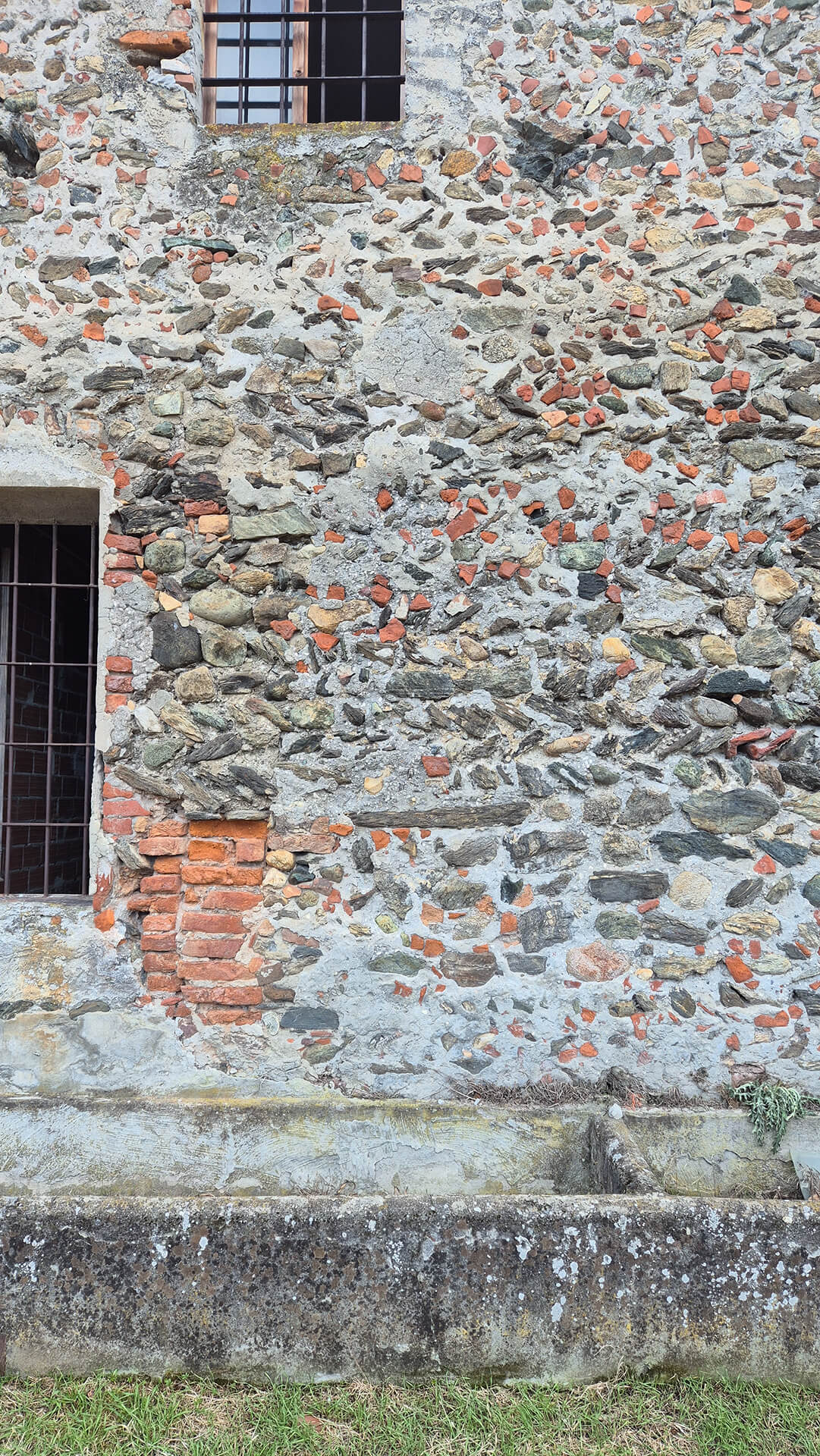
Detail of a historic mixed masonry façade composed of rubble, river pebbles, and brick fragments, bonded with lime mortar, characterized by an irregular texture and strong material heterogeneity. The facing clearly demonstrates a humble construction technique, constructed with recycled materials arranged irregularly, with large and uneven joints, typical of rural and utility buildings. Two overlapping openings with metal grilles are visible, set in spaces surrounded by brick and stone, which highlight subsequent modifications to the original masonry. Around the lower window, solid brick additions are noted, arranged more regularly, likely due to consolidation work or a change in the size of the space. The difference in color and texture between the bricks and the rest of the wall clearly demonstrates the different construction phases. The wall surface shows widespread signs of deterioration, including eroded joints, flaking mortar, discoloration, and small cracks, due to exposure to atmospheric agents and the presence of humidity. At the base of the wall is a concrete drainage channel, built against the base of the masonry, which collects rainwater and protects the foundation from stagnant humidity. Deposits, biological colonization, and surface alterations are also visible in this area. The image is significant for analyzing the state of conservation, the traditional masonry technique, and the transformations undergone over time, highlighting stratifications, infill, and subsequent interventions—elements essential for understanding the historical and construction history and for any restoration or consolidation interventions.

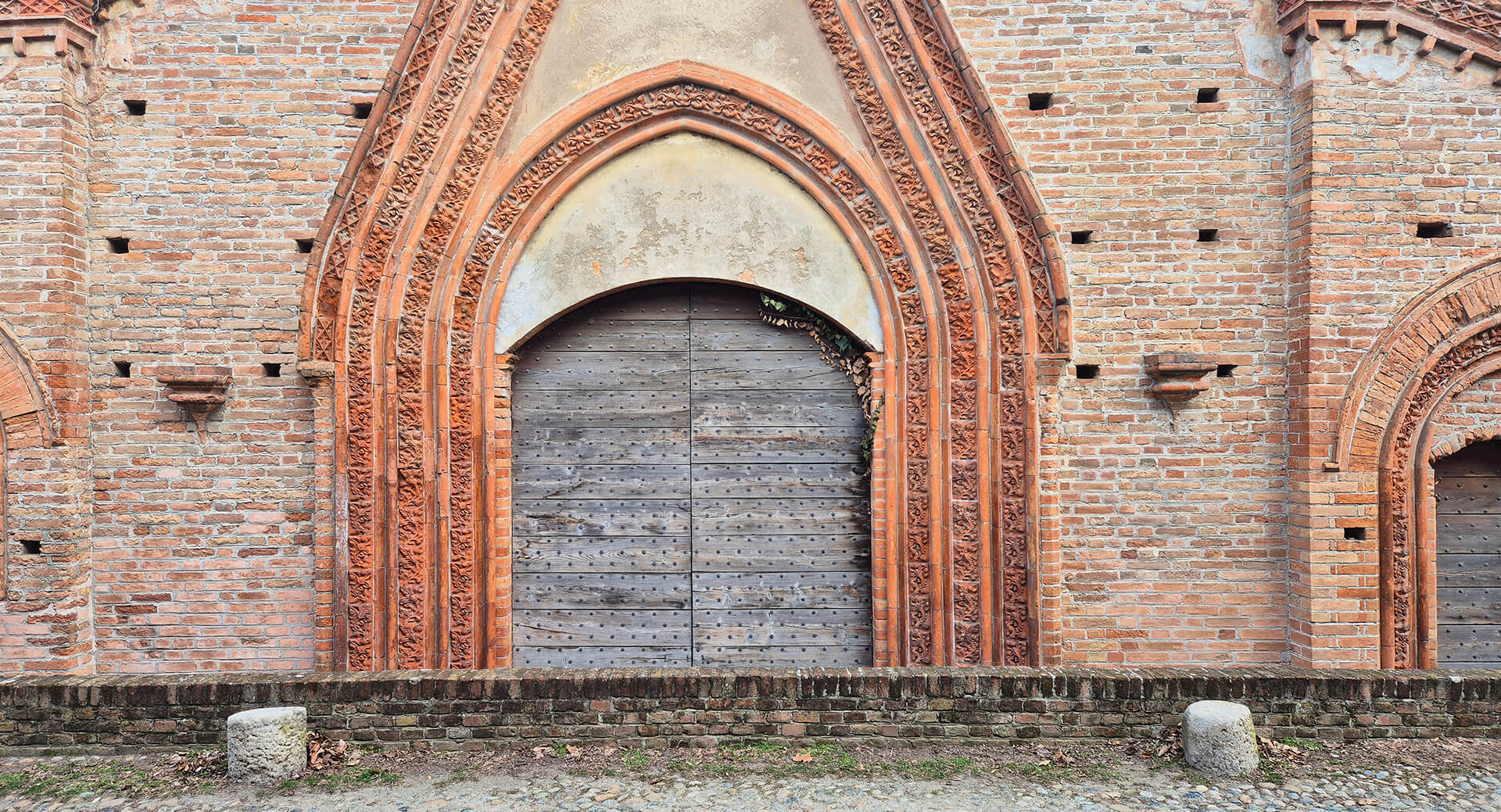
Front detail of the exposed brick façade of a historic Neo-Gothic building, characterized by pointed arches with richly decorated terracotta moldings. The image shows a central portal with a pointed archivolt composed of multiple concentric arches, crafted with shaped elements and decorated with vegetal and geometric motifs, demonstrating particularly fine craftsmanship. The portal is closed by a double wooden door, made of vertical planks reinforced with metal nails, set within a frame set back from the façade. Above the arch is a plastered section, likely the result of a later intervention or the loss of the original cladding, which interrupts the continuity of the brick facing. The surrounding masonry is made of solid bricks arranged in regular courses, with small holes and recesses that may be related to original scaffolding or removed construction elements. To the sides of the portal, protruding brick corbels and decorative moldings contribute to the symmetrical composition of the façade. In the foreground, a low brick wall separates the building from the cobblestone-paved outdoor space. The wall surface shows signs of discoloration, erosion of the joints, and surface deposits consistent with prolonged exposure to the elements. The image clearly documents the stylistic characteristics, construction quality, and state of preservation of the terracotta decorations, elements of particular interest for historical-architectural analysis and potential conservative restoration work.

Detail of the decorated brick façade of a historic building with neo-Gothic features, clearly highlighting the overlapping of different construction phases and the relationship between an older plastered structure and a later exposed brickwork of greater architectural quality. At the center of the image, a small pointed-arch opening is visible, framed by several terracotta arches shaped with vegetal and geometric ornamental motifs, crafted with remarkably precise modeling. The arch is set within a brick wall frame arranged in regular courses, contrasting with the adjacent plastered and severely deteriorated wall on the left, where traces of subsequent infill and renovations are evident, recognizable by the different textures and colors of the materials. Above the opening, a decorative terracotta frame with denticulated motifs and moldings follows the sloping roof and emphasizes the architectural composition of the façade. The quality of the workmanship and the richness of the ornamental decoration indicate a representative intervention, likely subsequent to the more modest masonry visible on the left. On the right, part of the main portal appears, also featuring a pointed arch with a decorated lintel, closed by a wooden door, confirming the stylistic unity of the brickwork. In the foreground, a low brick retaining wall separates the façade from the cobblestone-paved exterior. At the base of the walls, discoloration, joint erosion, and surface deposits due to humidity and exposure to the elements are evident. The image allows for a clear understanding of the construction layers, the differences in materials, and the state of conservation, making it particularly significant for historical-architectural analysis and for planning conservative restoration interventions.

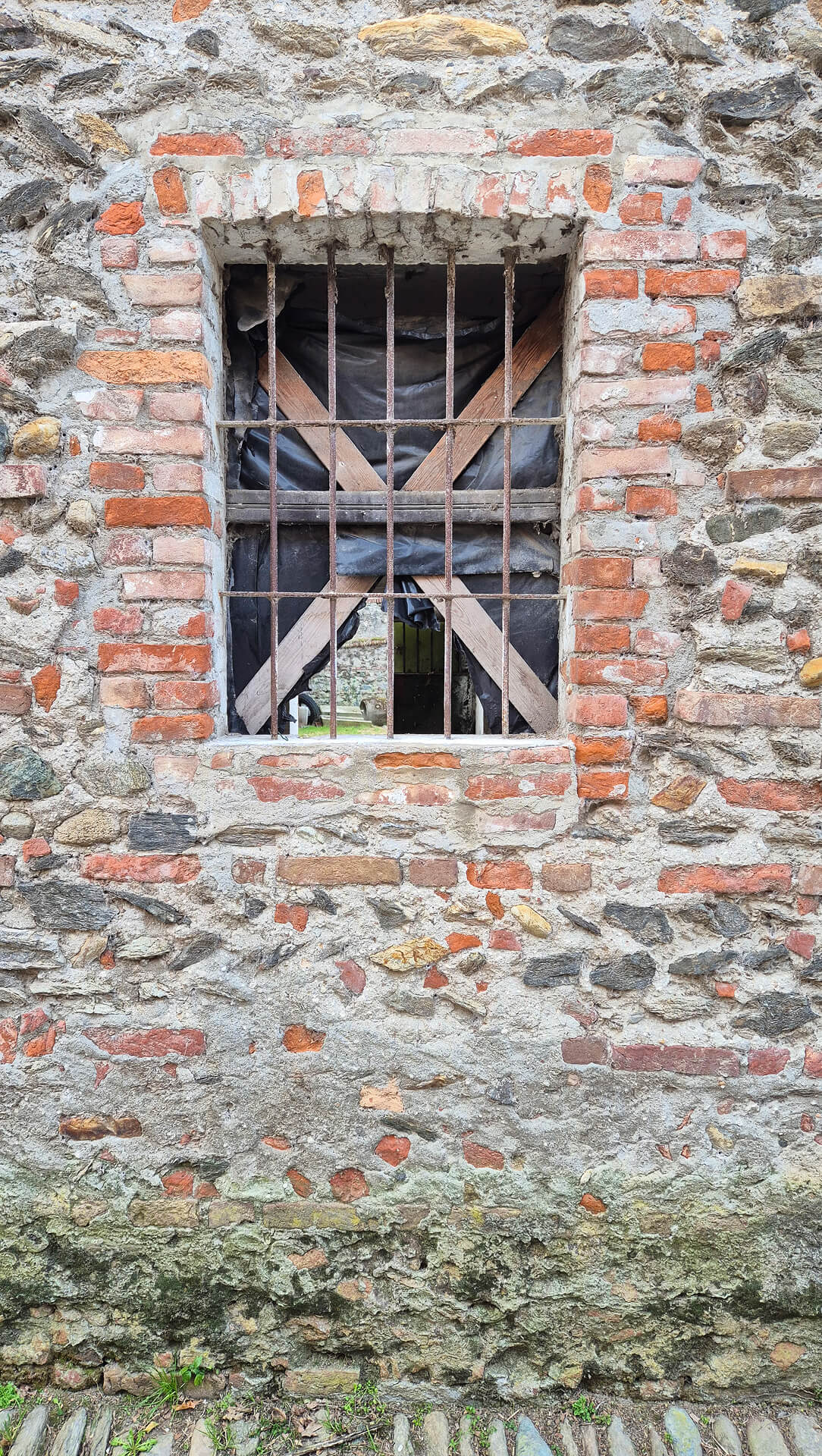
Close-up detail of a window opening set in historic mixed masonry, consisting of irregular stones, pebbles, and brick fragments bonded with lime mortar, with evident signs of surface decay and subsequent interventions. The opening features a frame of solid bricks arranged more regularly than the surrounding facing, indicating a different construction phase or a reconstruction of the opening compared to the original masonry. The upper part of the window is closed by a segmental brick arch, made with radially arranged elements, while the lateral jambs show additions and replacements of bricks, recognizable by differences in color and texture. Inside the opening, there is a vertical metal grate, heavily oxidized, indicating its function as a security or ventilation system for the space behind it. Behind the grate, wooden elements arranged in a cross and a protective sheet are visible, signs of a temporary closure or a state of abandonment. The wall surface shows widespread signs of deterioration, including erosion of joints, loss of mortar, disintegration of materials, and the presence of moisture in the base layer, where encrustations, biological colonization, and deposits due to direct contact with the ground are observed. At the base of the wall, an external cobblestone pavement, typical of courtyard spaces, is visible, contributing to water stagnation and worsening the deterioration. The image is particularly significant for understanding the traditional construction technique, the masonry stratifications, and the state of conservation, providing useful information for diagnostic analyses, material surveys, and preliminary assessments prior to restoration or consolidation interventions.

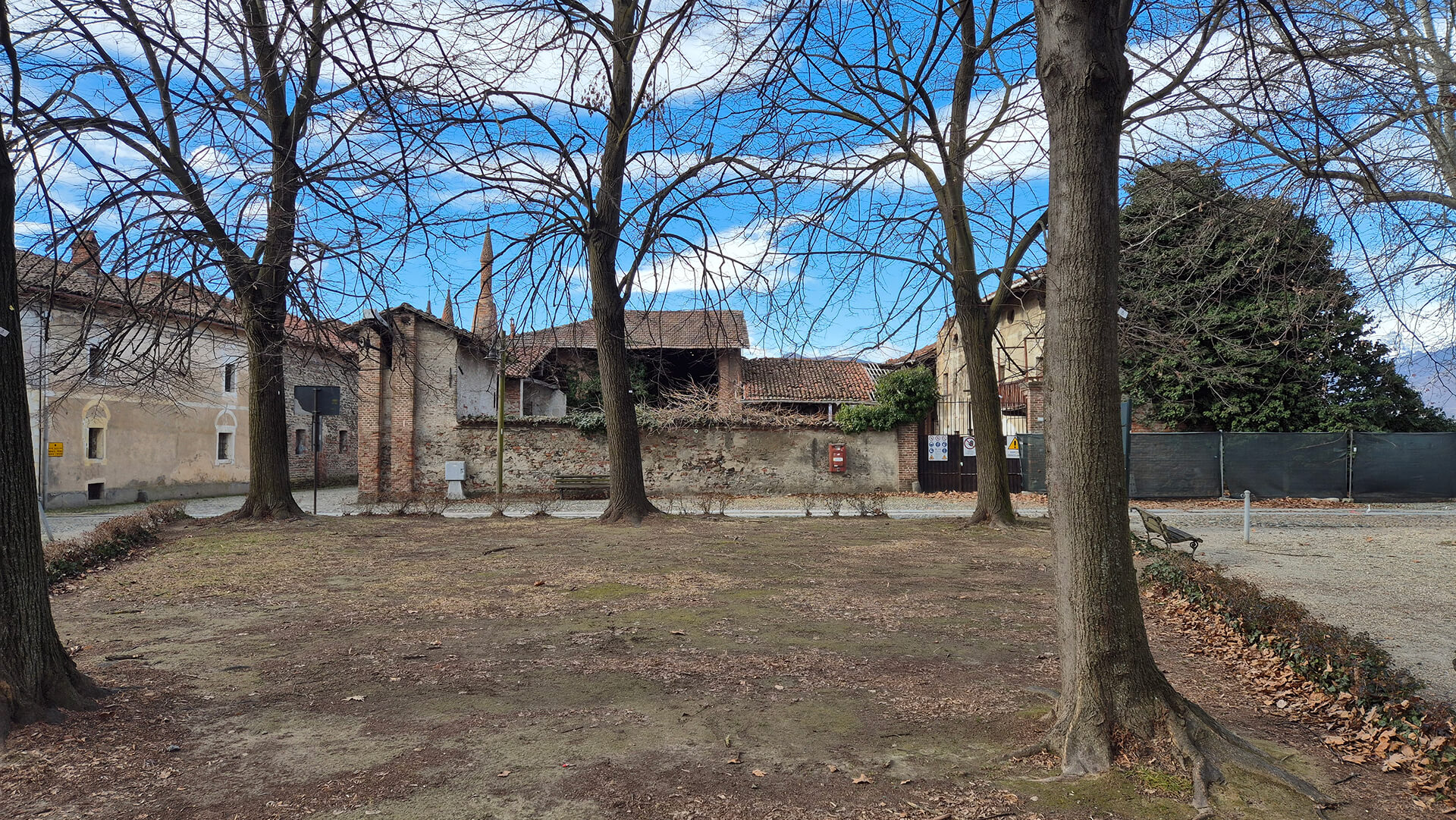
Overall view of a tree-lined open space located in front of a historic rural building complex, bordered by a mixed masonry boundary wall and buildings with pitched tile roofs. In the foreground, a flat, unpaved green area develops, characterized by hard-packed soil with dead leaves and exposed roots. It is occupied by rows of tall trees, defining an external space likely used as a rest area or buffer zone between the road and the complex. In the background, the continuous, low-height perimeter wall of stone and brick separates the public space from the internal courtyard. At the center of the wall, a driveway with a metal gate is visible, while functional elements such as mailboxes, signage, and information panels are located along the fence, indicating the current partial or controlled use of the area. Beyond the wall, the complex's main buildings emerge, consisting of buildings of varying ages and construction quality, with plastered or exposed brick walls, porticoes, and traditional tiled roofs. Between the roofs, one can glimpse the decorative brick turrets, already noted in other details, which help identify the building of greatest architectural value within the complex. The presence of mature trees, street furniture, and unpaved surfaces suggests that the space in front has over time served as a square or small public garden, while maintaining a direct connection with the original historic structure. The image is useful for understanding the relationship between the open space, the surrounding wall, and the building complex, highlighting the environmental context, the general state of conservation, and the relationships between the public area and the historic structure—elements essential for urban planning analysis, architectural surveys, and restoration or redevelopment hypotheses.

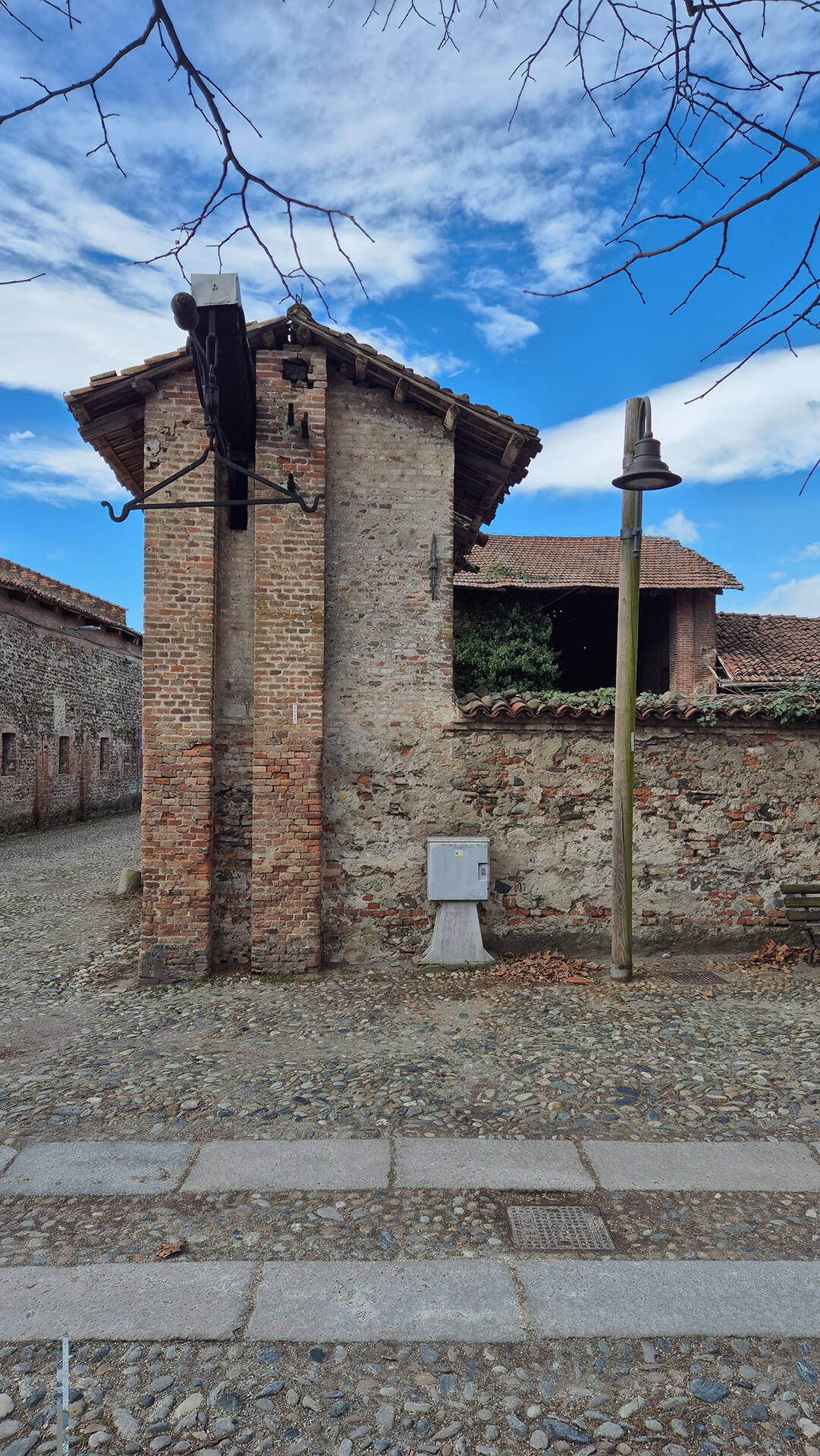
Front view of a masonry architectural element belonging to the historic complex's access or service system, consisting of a vertical brick structure leaning against the perimeter wall made of mixed stone and brick masonry bonded with mortar. The volume is narrow and tall, topped by a small pitched roof with a wooden frame and tile covering, in continuity with the traditional roofing of the surrounding buildings. On the façade, there is a protruding metal structure fixed to the masonry, composed of brackets and a horizontal arm, likely a remnant of an ancient lighting, signaling, or functional support system linked to the complex's access. The masonry texture clearly shows layered interventions, with sections of regular brickwork alternating with sections of irregular masonry, indicative of subsequent modifications and repairs. The surrounding wall behind, partly plastered and partly left exposed, delimits the internal courtyard, from which emerge tiled roofs and rural or service volumes, attributable to the complex's original layout. In the foreground, the paving is cobblestone with stone slab inserts, typical of the historic layout of courtyards and adjacent spaces. On the right, a contemporary lamppost and a bench are visible, evidence of the area's current public or semi-public use. The image clearly illustrates the relationship between the perimeter wall, access elements, and service structures, highlighting the state of preservation of the historic walls, the presence of modern additions, and the material continuity between the complex's various buildings. These aspects are important for architectural analysis, documentation of the existing state, and assessments of restoration or functional recovery.

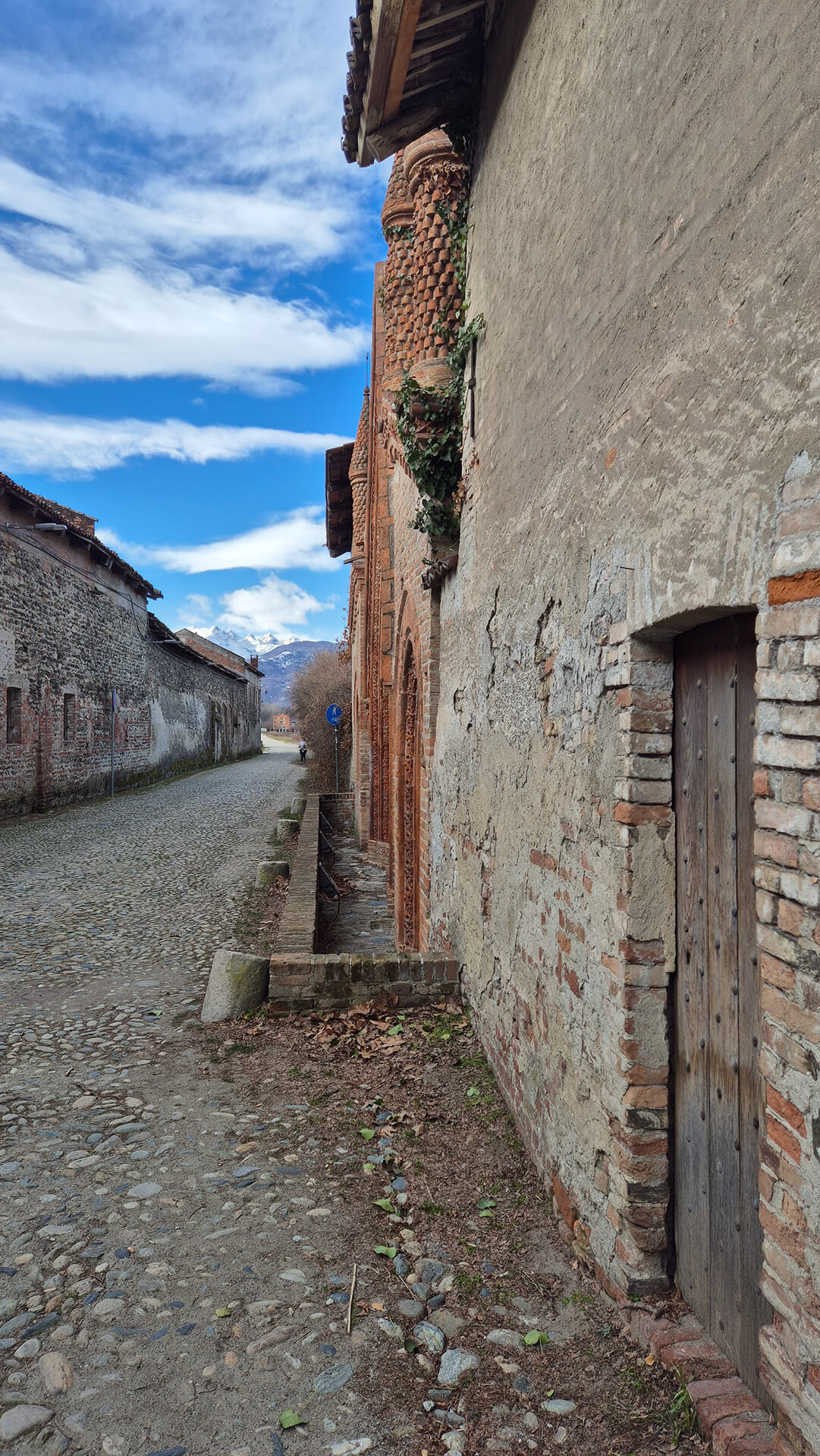
Perspective view along a historic cobbled road, flanked by buildings belonging to the rural and religious complex already documented in previous images. In the foreground, on the right, a plastered wall is visible with evident signs of surface decay, plaster gaps, and portions of exposed brickwork. This wall features a secondary door with a brick architrave and wooden doorknocker, likely a service entrance to internal rooms. Proceeding along the wall, the side elevation of the decorated brick building is visible, characterized by pilasters, cornices, and cylindrical turrets in shaped bricks—ornamental elements in the neo-Gothic style already observed in other views. A small masonry drainage channel, intended for rainwater disposal, runs along the base of the façade, separating the building from the road and testifying to its original rural or convent-like layout. On the opposite side of the road stands a long building constructed of mixed stone and brick masonry, with small, regular openings. It was likely originally intended for agricultural or storage purposes, and contributes to the definition of a narrow, linear, historic roadway, preserved with its traditional paving and the absence of invasive modern developments. In the background, the hilly and mountainous landscape can be glimpsed, placing the complex in a peripheral or urban fringe context, while the presence of signage and cycle/pedestrian paths indicates a current use of the area compatible with public use. The image is significant for understanding the relationship between the decorated building, the surrounding wall, the historic road system, and the landscape context, highlighting the construction stratification, the state of conservation of the wall surfaces, and the permanence of the original layout. These elements are useful for architectural analysis, surveys of the existing structure, and assessments of restoration or redevelopment.

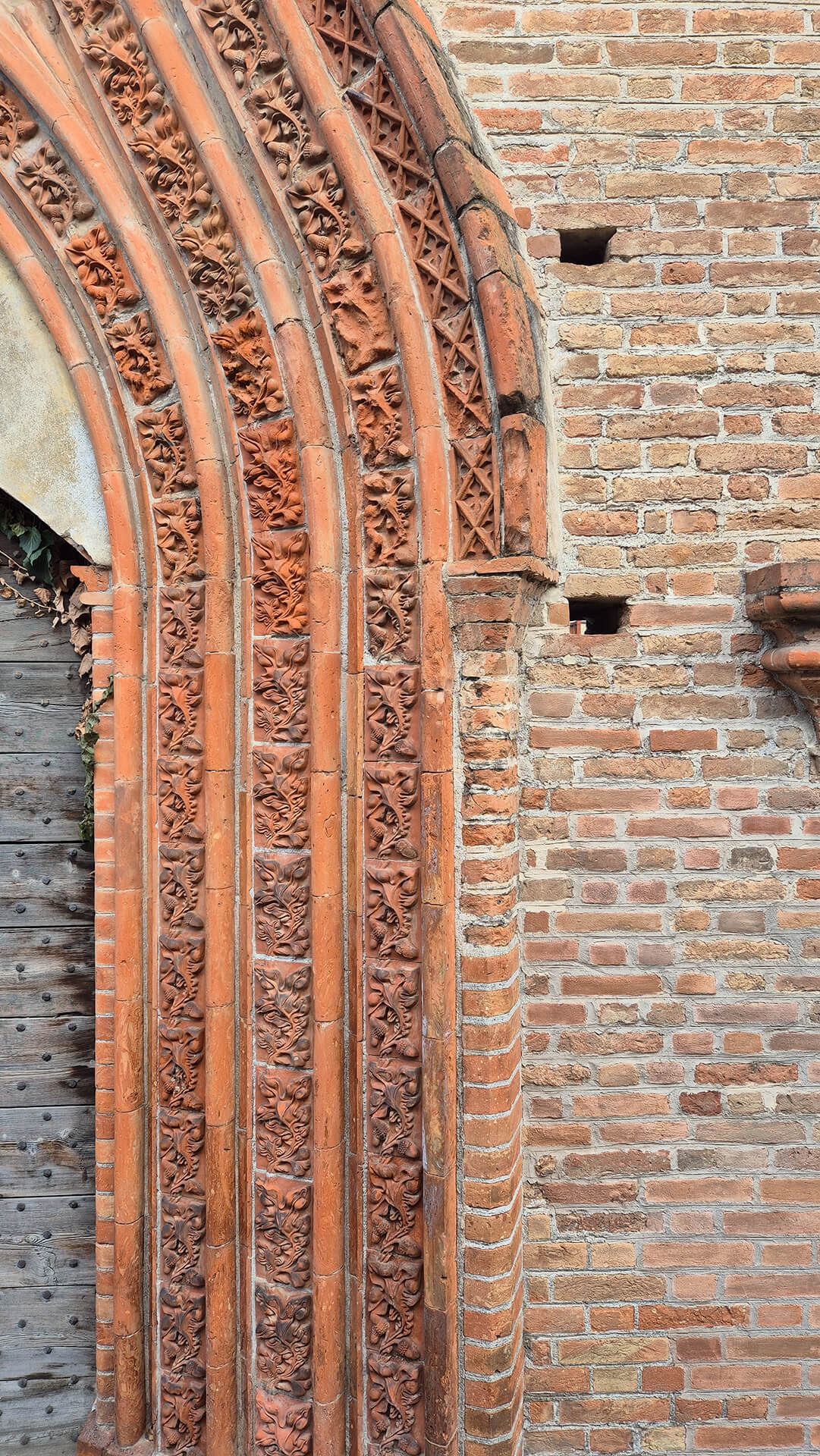
Close-up detail of the decorated brick portal of the neo-Gothic building, showing the splay of the pointed arch composed of multiple concentric rings made from shaped terracotta elements. The decorative bands feature repeated phytomorphic and geometric motifs, modeled in relief on the individual bricks, demonstrating the fine craftsmanship and strong ornamental intent typical of eclectic architecture of the late 19th and early 20th centuries. The arch frames a double wooden door, made of vertical planks reinforced with metal rivets, set within a deep architectural opening that accentuates the sculptural effect of the splay. The terracotta surface displays chromatic variations between red, orange, and brown, due both to the firing of the material and to aging and surface deposits. To the right of the portal, a brick wall extends in regular courses, with small quadrangular through-holes, likely used for scaffolding or anchoring systems during construction, still visible in their original texture. The junction between the decorated section and the simpler masonry highlights the difference between the monumental entrance area and the secondary surfaces of the building. The overall state of preservation appears fair, with slight erosion of the terracotta reliefs, cracks in the mortar joints, and surface deposits, but the ornamental details are well legible. The image is particularly significant for analyzing the decorative language, the shaped brick construction techniques, and the craftsmanship of the portal, elements useful for historical-architectural studies, detailed surveys, and conservative restoration evaluations.

Detail of the exposed brickwork with a decorated arch opening, part of the façade of the historic neo-Gothic building, already documented in the previous images. The shot highlights the lateral portion of a window or niche with a splayed pointed arch, constructed with multiple concentric terracotta arch surrounds, some smooth and others decorated with relief plant motifs, obtained using prefabricated shaped elements. The ornamental work displays remarkable craftsmanship, with repeated modules forming a continuous band of plant motifs, inserted between molded brick profiles. The decoration is framed by a masonry of regular courses of solid bricks, with visible mortar joints and varying colors due to the aging of the material and the different firing of the bricks. Next to the arch are quadrangular holes running through the masonry, likely housings for scaffolding beams or temporary structural elements used during construction, still visible in the original texture and not subsequently filled in. The presence of these cavities, along with variations in the brick layout, testifies to the building's construction phases and traditional construction techniques. A metal grate is visible inside the opening, suggesting a secondary or ventilation function, while the overall state of preservation reveals slight erosion of the terracotta reliefs, surface deposits, and small discontinuities in the joints, without, however, compromising the legibility of the decorative elements. The image is useful for analyzing the shaped brick construction details, the masonry texture, and the decorative techniques—fundamental elements for historical-architectural studies, detailed surveys, and evaluations of conservative restoration interventions.

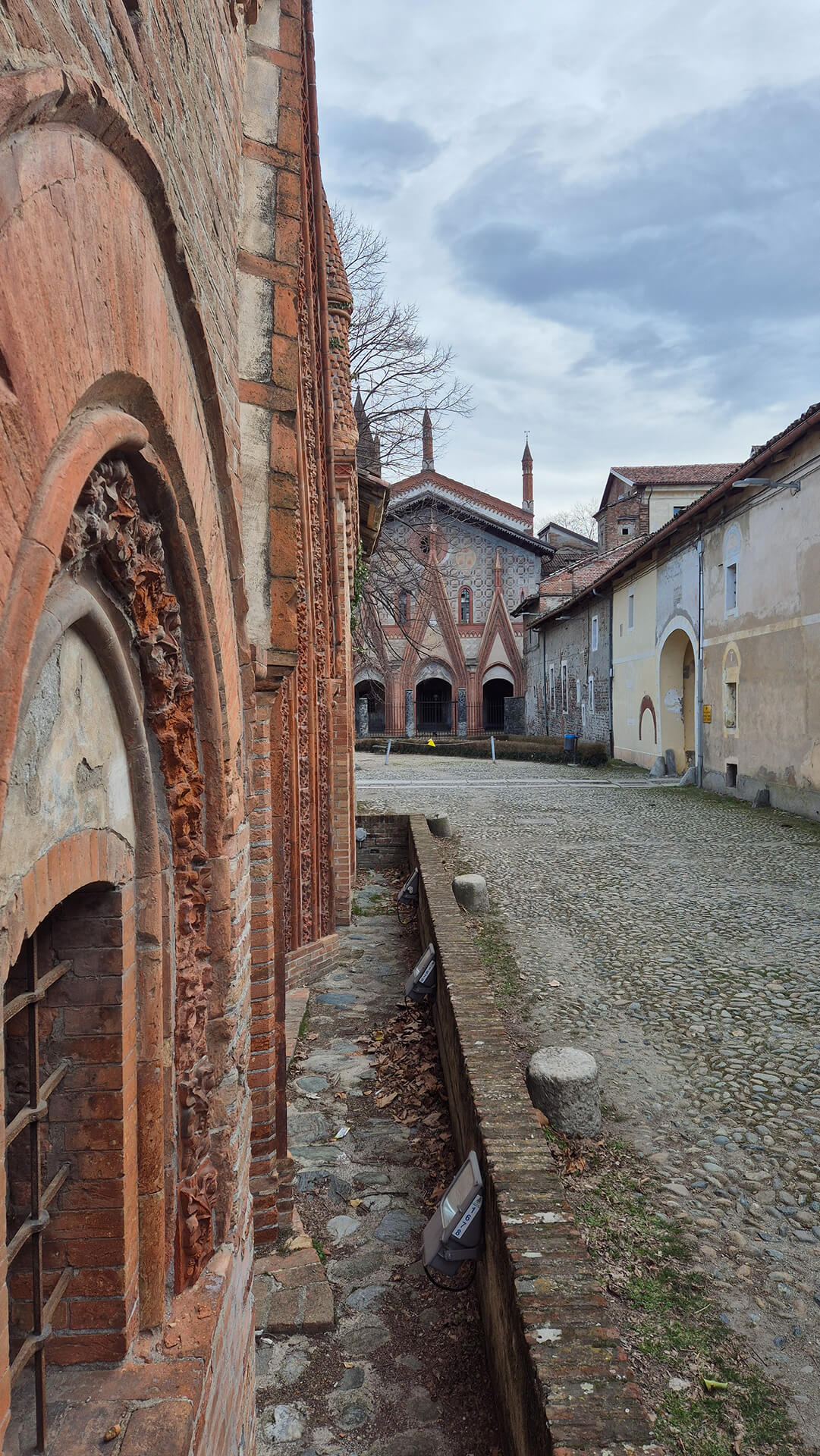
Perspective view along the side of the decorated brick building, with a low angle view that highlights the succession of splayed pointed arch openings and the richness of the terracotta ornamentation, consisting of multiple molded arches and bands decorated with relief plant motifs. The masonry is made of exposed brick with regular courses, interrupted by shaped elements and pilasters that vertically punctuate the façade, confirming the building's neo-Gothic character. A masonry drainage channel, slightly lowered than the courtyard level, runs along the base of the façade and intended for rainwater disposal. This element separates the building from the external cobblestone paving and testifies to the area's original purpose as a rural or convent courtyard. Contemporary lighting fixtures are also visible along the edge of the channel, indicating the space's current use for visitor or development purposes. The shot opens onto the internal cobblestone courtyard, bordered by buildings of various periods and construction types: on the right, plastered buildings with segmental arches can be seen, while in the background, the main façade of the monumental building emerges, characterized by brick decorations, pointed-arch porticoes, and slender turrets, elements already observed in previous details. The presence of wall surfaces with different finishes—exposed brick, weathered plaster, stone inserts—highlights the historical stratification of the complex, likely consisting of an original core of architectural value flanked by service buildings constructed in later periods. The image is particularly useful for interpreting the relationship between the decorated façade, internal courtyard, and secondary buildings, highlighting the complex's spatial configuration, traditional construction techniques, and the state of conservation of the surfaces—elements essential for historical-architectural analysis, surveys of the existing structure, and assessments of restoration or repurposing.

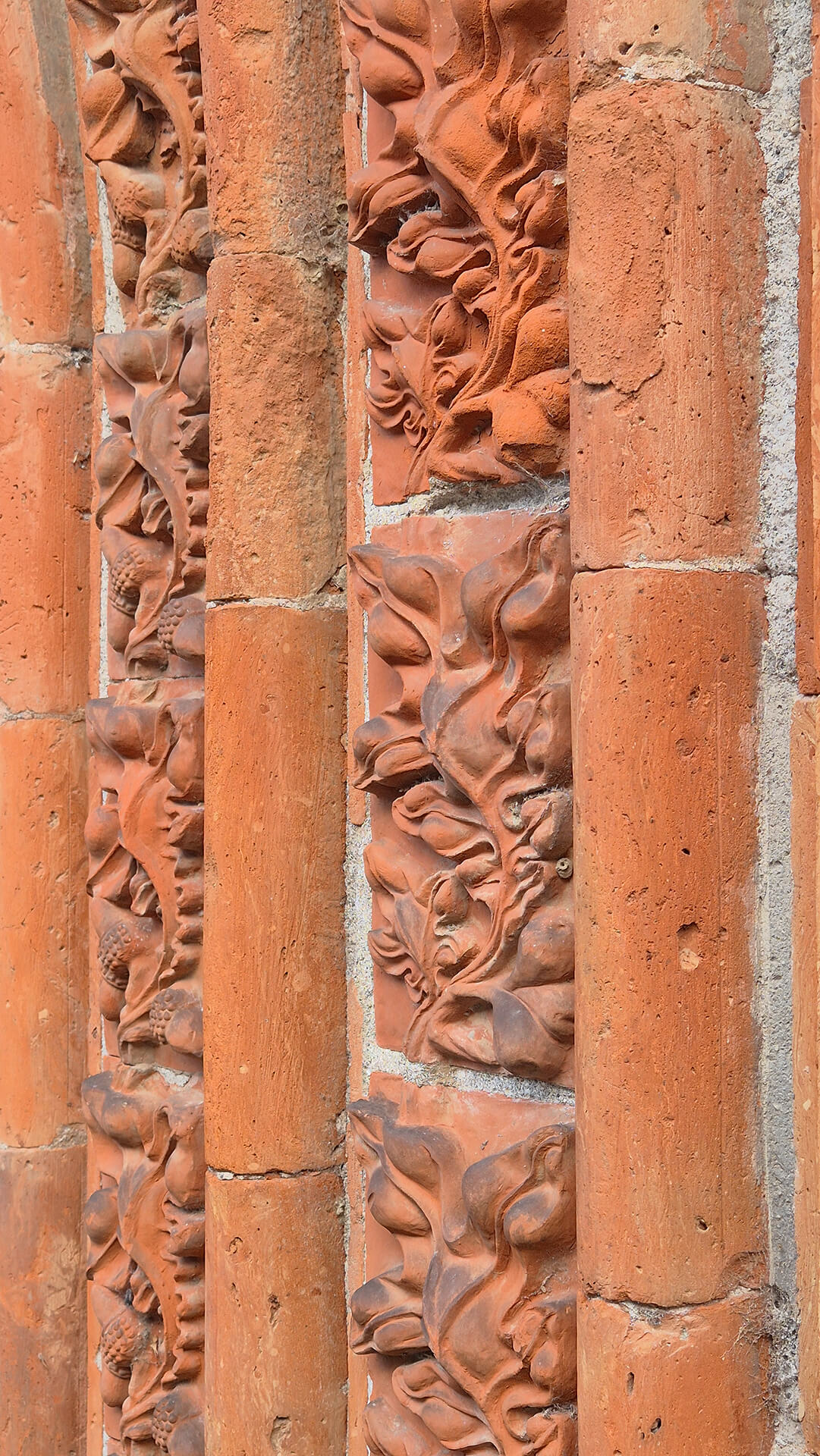
Close-up detail of the decorative brickwork on the splay of a portal or ogival window of the neo-Gothic building, showing the ornamental bands made of terracotta elements modeled in relief with phytomorphic motifs. The individual decorative modules depict stylized leaves, vines, and fruits arranged in a vertical sequence, inserted between thin cylindrical columns also made of brick, which rhythmically punctuate the surface and contribute to the sculptural definition of the archivolt. The columns, composed of overlapping cylindrical ashlars, have slightly irregular and porous surfaces, with color variations from orange-red to brown, due both to the firing of the material and to oxidation and surface deposits. Between the decorative elements, the partially eroded mortar joints are visible, revealing the construction technique based on the assembly of prefabricated terracotta pieces and subsequent installation. The state of conservation reveals abrasions, small gaps, and rounded reliefs, especially in the most protruding areas, as well as microcracks and discontinuities in the joints, consistent with exposure to atmospheric agents and the age of the artifact. Despite this, the quality of the modeling remains clearly perceptible, highlighting remarkable precision in craftsmanship. The image is particularly significant for studying the ornamental terracotta detail, the prefabrication techniques, and the modular composition of the decorative apparatus, providing useful information for historical-architectural analyses, material surveys, and conservative restoration assessments of the building.

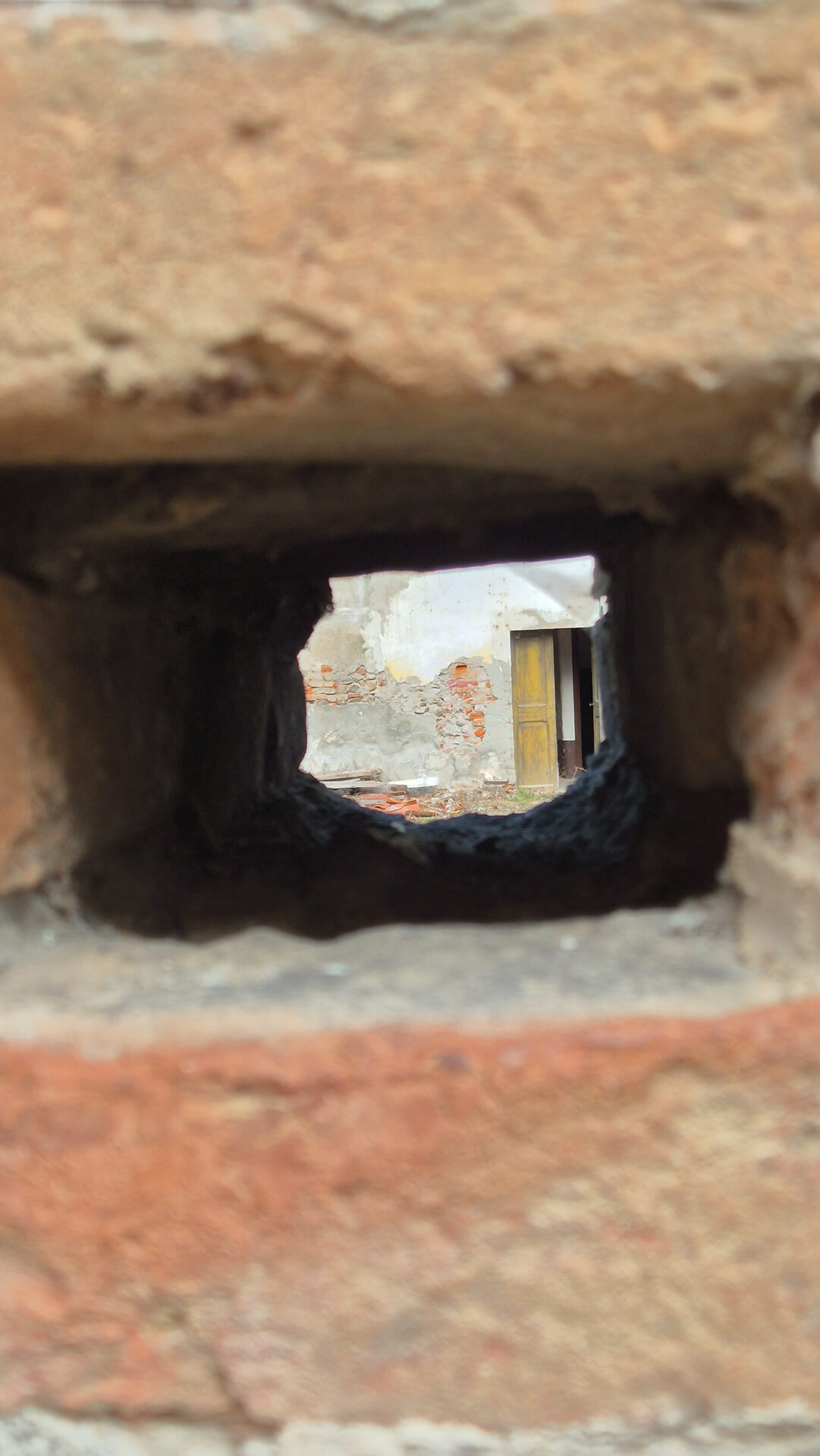
Close-up detail of a rectangular through-hole cut into the brickwork, likely originally intended to house scaffolding beams or temporary structural elements used during the building's construction. The shot is taken from the outside inward, highlighting the thickness of the masonry and the irregular finish of the blackened and worn internal surfaces, a sign of long-term exposure to the elements and possible prolonged use as a wooden frame. Through the opening, a glimpse of the complex's internal courtyard is visible, with deteriorated plastered walls, exposed brickwork, and a wooden door, elements that confirm the building's historic and stratified nature. The presence of gaps in the plaster and exposed masonry highlights signs of detachment and wear, typical of structures not recently restored. The edges of the hole are irregular and slightly rounded, with eroded mortar joints and worn bricks, indicating a structure constructed using traditional techniques and not finished for display, but intended for temporary construction. The substantial thickness of the wall suggests a load-bearing masonry of considerable mass, consistent with rural, convent, or utility buildings. The image is useful for understanding the construction details of the masonry, historical construction techniques, and the state of conservation of the materials, providing important information for stratigraphic analyses, architectural surveys, and conservation intervention evaluations.

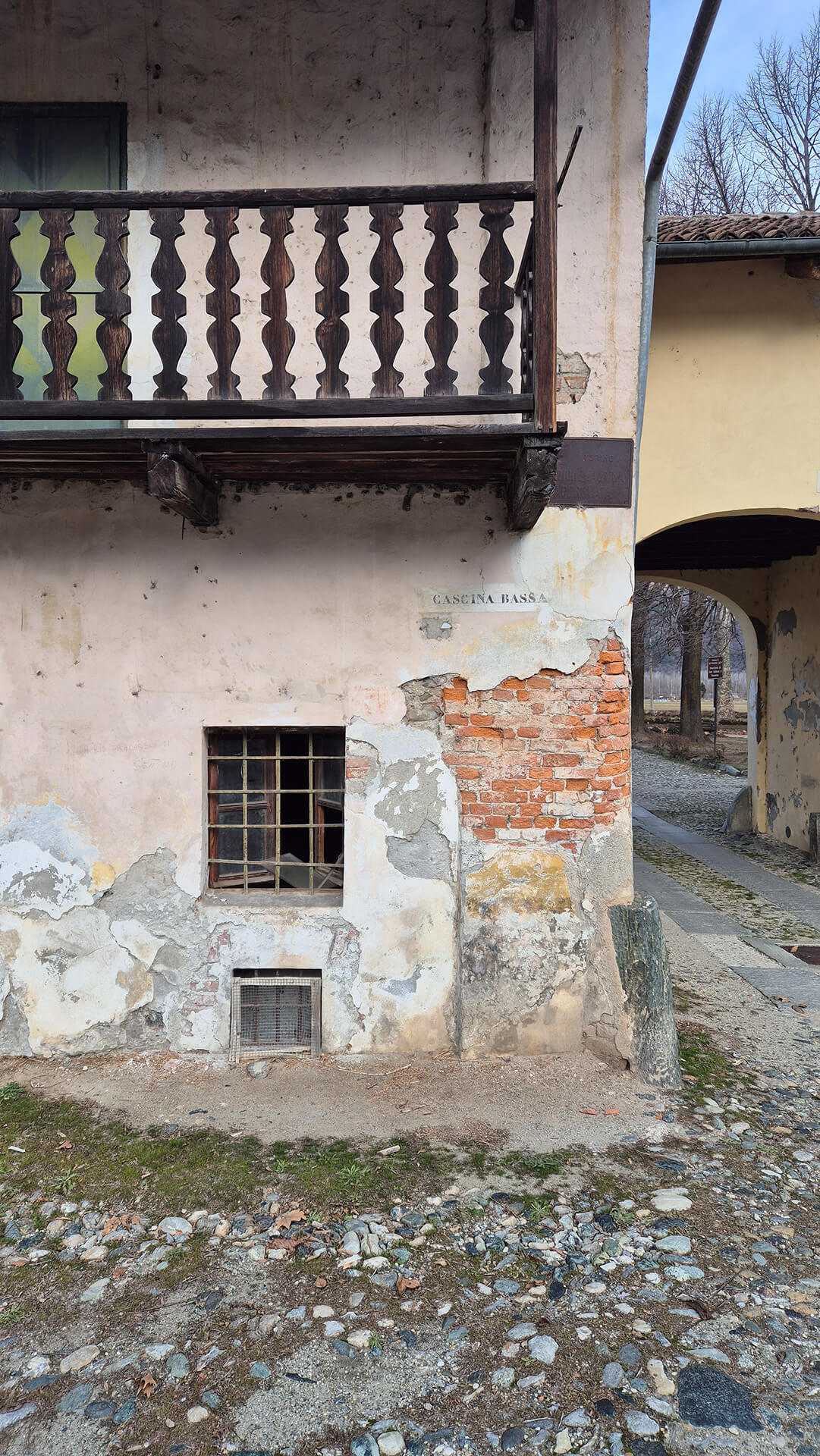
Front view of a portion of a historic rural building with a wooden balcony, part of the previously documented building complex. The building features load-bearing plastered masonry with large gaps that expose the underlying brickwork. On the upper floor, there is a wooden balcony with a shaped parapet, supported by protruding wooden brackets, typical of traditional Piedmontese rural architecture. It was likely originally used as a utility space or a connecting space between rooms on the first floor. The wall surface shows evident signs of deterioration, with widespread flaking plaster, efflorescence, rising damp, and exposed portions of irregular brickwork, revealing the original construction technique. On the ground floor, there is a small window with a metal grille, flanked by a low-set ventilation opening, suggesting the presence of utility rooms or a basement. The writing "CASCINA BASSA" is visible on the wall, a toponymic indication confirming the rural nature of the complex and its articulation into multiple buildings with specific names. On the right side, a vaulted passageway with a segmental arch connects the internal courtyard with the external space, defining a distribution system typical of historic farmhouses, organized around enclosed courtyards. The paving in front consists of hard-packed earth and pebbles, in keeping with the traditional layout of the courtyard, while the overall state of preservation suggests a building not recently restored, but still retaining its original features. The image is significant for the analysis of the secondary rural structure, the traditional construction techniques, the state of deterioration of the plaster, and the organization of the farmhouse around courtyard spaces and vaulted passageways. These elements are useful for architectural surveys, historical-typological studies, and conservation assessments.

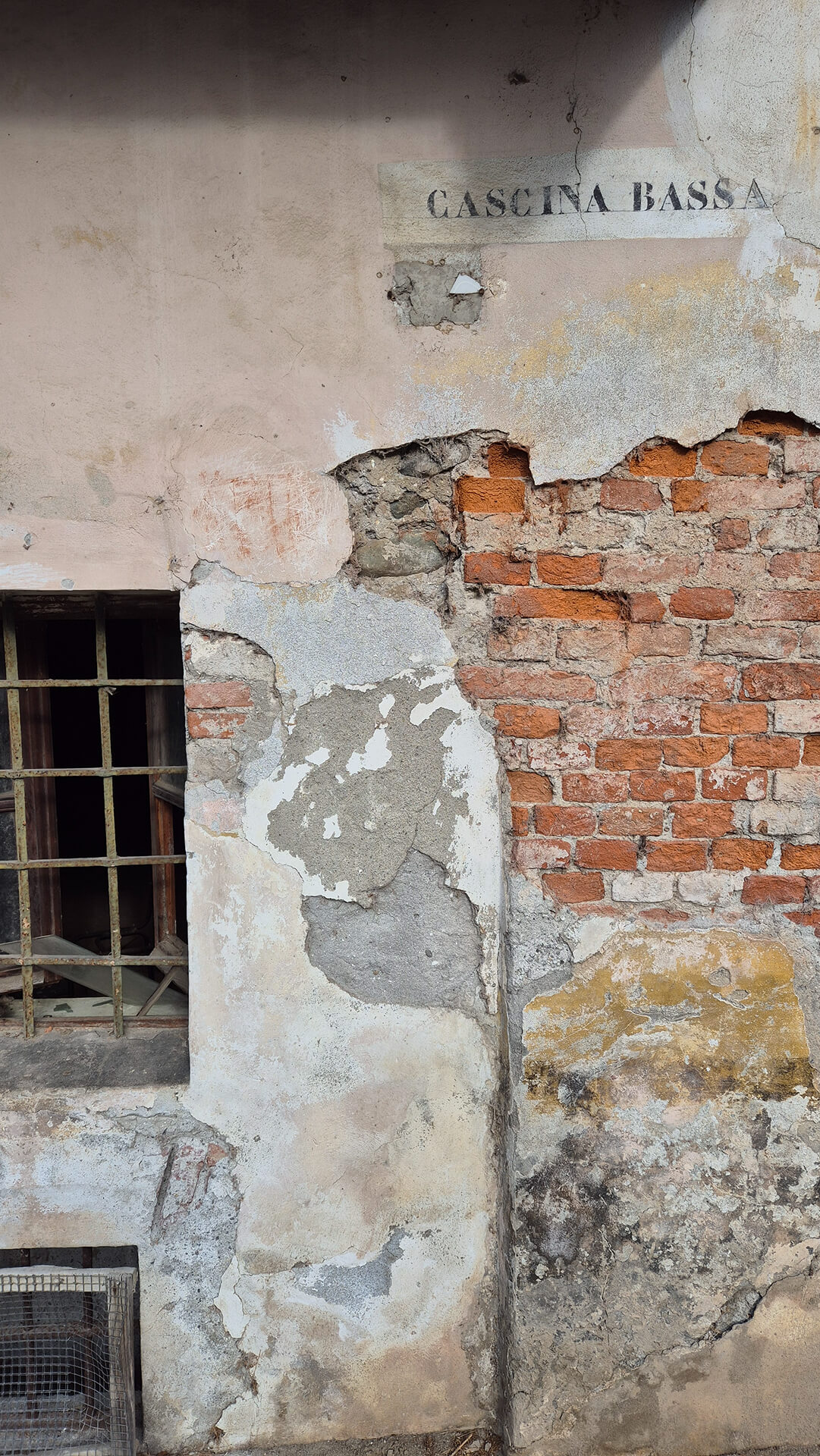
Close-up detail of the plastered masonry of the building known as "Cascina Bassa," with the toponymic inscription stenciled directly onto the partially deteriorated plaster clearly visible. The wall surface shows an advanced state of decay, with large gaps in the plaster, exposing the underlying structure of irregularly arranged solid bricks, bound with bedding mortar, now eroded in several places. On the left side, there is a small window with metal bars, set in a severely deteriorated plastered jamb, with detachments, cracks, and areas of repair made with mortars of varying composition and grain size. Below the window, a small ventilation opening protected by metal mesh can be seen, indicative of the presence of basement or utility rooms, consistent with the construction typology of traditional farmhouses. The masonry shows evident signs of rising damp, evident in the dark stains, efflorescence, and crumbling plaster in the lower layer, as well as surface deposits and discoloration indicating prolonged exposure to atmospheric agents. The discontinuity between the plastered and exposed brick sections clearly demonstrates the stratification of maintenance work carried out over time. The presence of the identifying sign "CASCINA BASSA" confirms the building's membership in the historic farmhouse system already documented in the previous images, highlighting the complex's rural character and its division into multiple buildings. The image is useful for analyzing the state of conservation of the wall surfaces, the deterioration of the plaster, and traditional brick construction techniques, providing important information for material surveys, diagnosis of deterioration, and evaluation of conservation interventions.

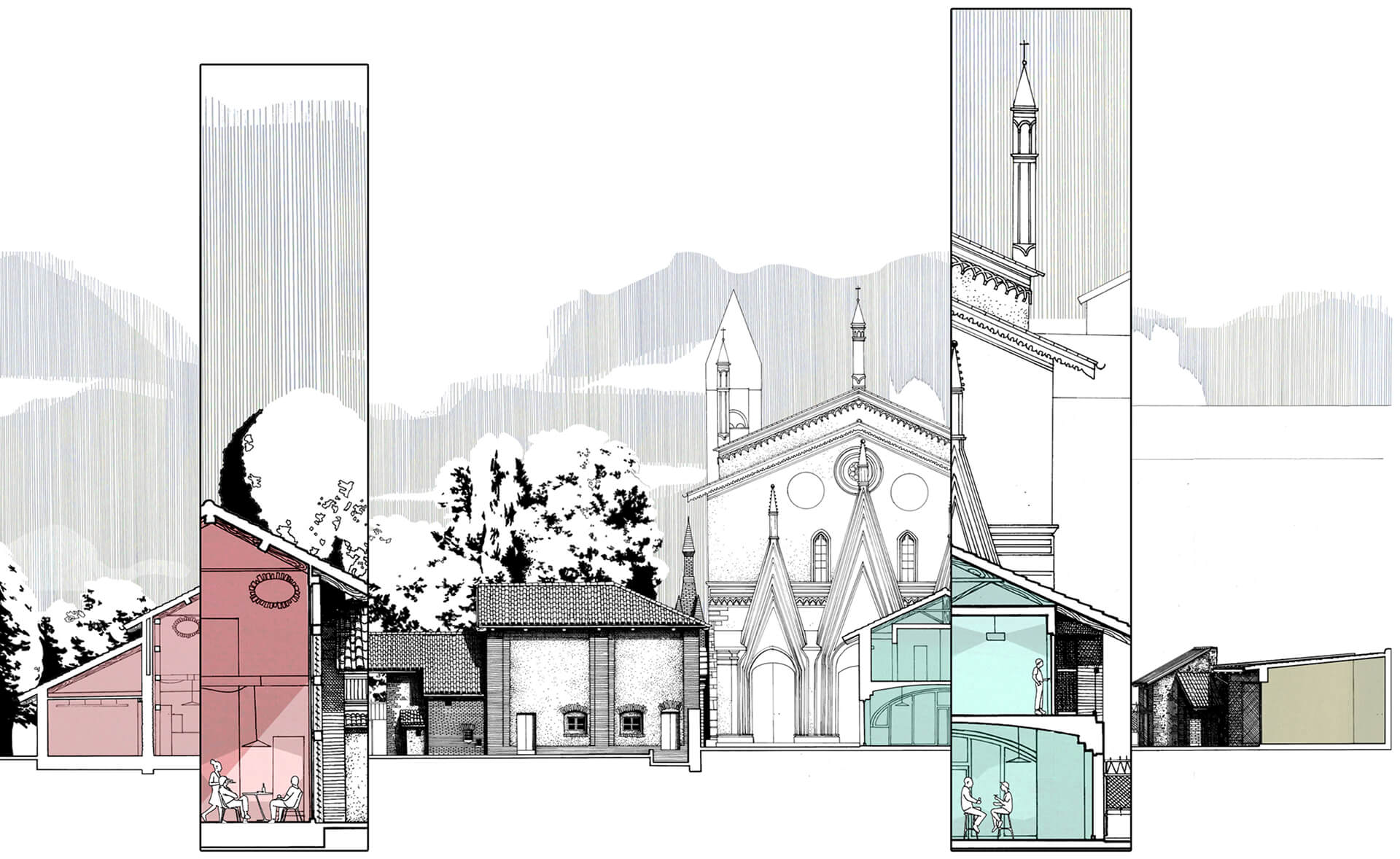
Longitudinal architectural section of the historic farmhouse complex with the addition of new contemporary volumes, represented by a black-and-white technical drawing with color fields to distinguish the project sections. The drawing shows the relationship between the existing rural buildings, the church with its neo-Gothic façade in the background, and the new architectural interventions inserted within the historic fabric. The original buildings are represented with a uniform, textured graphic style, highlighting the load-bearing walls, pitched roofs, and the typical farmhouse configuration, while the new volumes are indicated by translucent colored fields that clearly distinguish the existing and planned state. On the left, a new double-height vertical volume is visible, highlighted in red, inserted within an existing building while maintaining its masonry envelope. The main body of the farmhouse is depicted in the center, along with the service buildings and the façade of the church, which constitutes the urban and historical landmark of the complex. On the right, a second contemporary project appears, highlighted in blue, featuring multi-level interior spaces with double-height rooms and a sloping roof, inserted within the existing structure without altering its external profile. Further to the right is an additional project volume, indicated by a light background, intended as an extension of a secondary building. The drawing highlights the relationship between internal dimensions, room heights, wall thicknesses, and the contours of the land, allowing for a stratigraphic interpretation of the historic building and new additions. The presence of scaled human figures allows for an understanding of the size of the spaces and their intended use, while the background of trees and hills helps contextualize the complex within the surrounding rural landscape. The image is intended to facilitate an understanding of the reuse and refunctionalization project for the farmhouse complex, highlighting the intervention strategy based on the insertion of recognizable contemporary volumes that are compatible with the existing historic structure.