University College: Via Ormea

Interno di locale al piano terreno durante le fasi di demolizione e preparazione del cantiere nell’ambito di un intervento di recupero edilizio. Lo spazio presenta struttura portante in cemento armato con travi e pilastri a vista, tamponamenti parzialmente rimossi e superfici murarie con intonaci deteriorati. Sono visibili tracce delle demolizioni, materiali di risulta sul pavimento e attrezzature da cantiere, tra cui carriole e tavole provvisorie per il passaggio. Sul fondo si apre un varco verso l’esterno che consente l’accesso al cortile e alle aree di servizio. L’immagine documenta lo stato di fatto prima dell’intervento di rifunzionalizzazione, evidenziando le operazioni preliminari necessarie al consolidamento strutturale e alla successiva riorganizzazione degli spazi interni.

University College: Via Ormea

The redevelopment project for the former university cafeteria at Via Ormea 11 bis in Turin transforms a historic 1930s building into a modern university residence for the Renato Einaudi College. The project involves the creation of single and double rooms with private bathrooms, common areas for study and socializing, a communal kitchen, and new accessible facilities, with particular attention paid to the removal of architectural barriers. The project combines the enhancement of existing heritage, environmental sustainability, and energy efficiency, offering students a comfortable, inclusive environment that is fully integrated into the urban context.

Turin, 2021 – 2025
Cost of works: 1.500.000€
Architectural design: Alessandro Armando, Giovanni Durbiano, Stefano Toscano
Works management: Alessandro Armando, Stefano Toscano
Structural design: ICIS Srl
Systems design: MCM Ingegneria Srl
Safety: Francesco Fenoglio


Interior of a ground-floor space during structural interventions as part of a building renovation project. The space features a reinforced concrete load-bearing structure with exposed pillars and beams, partially demolished masonry surfaces, and deteriorated plaster. In the foreground, a temporary metal construction site fence demarcates the work area. Inside, a new floor slab has been installed with electro-welded mesh and formwork, ready for concrete pouring. Along the left side are metal-framed windows, while scaffolding and construction equipment are visible in the background. The image documents a phase of consolidation and reconstruction of the floors, preliminary to the functional reorganization of the interior spaces as part of the renovation of the existing building.

Detail of an interior wall during the demolition and system reconstruction phases, part of a building renovation project. The brickwork is partially peeling, with gaps left for the passage of new utility ducts. Electrical piping and service connections are visible within these gaps. Residues of plaster, insulating materials, and foam used to secure the pipes are present. The image documents an intermediate stage of construction, prior to the sealing of the gaps and the restoration of the finishes, highlighting the system upgrades necessary to repurpose the existing building.

Interior view of a space undergoing an advanced renovation, featuring the construction of new partitions using a lightweight structure of galvanized metal profiles for drywall. The image shows the installation of the vertical and horizontal steel framework for the subsequent installation of plasterboard paneling, with the integration of the ceiling systems within the accessible suspended ceiling. In the foreground, a difference in height between two floor levels is visible, delimited by a temporary wooden parapet protecting the stairwell or a structural opening, along with construction materials and system components currently being assembled. The space shows the distribution configuration currently being finalized, with existing reinforced concrete pillars integrated into the new lightweight partition system, highlighting the functional transformation of the original space through drywall construction techniques and system upgrades.

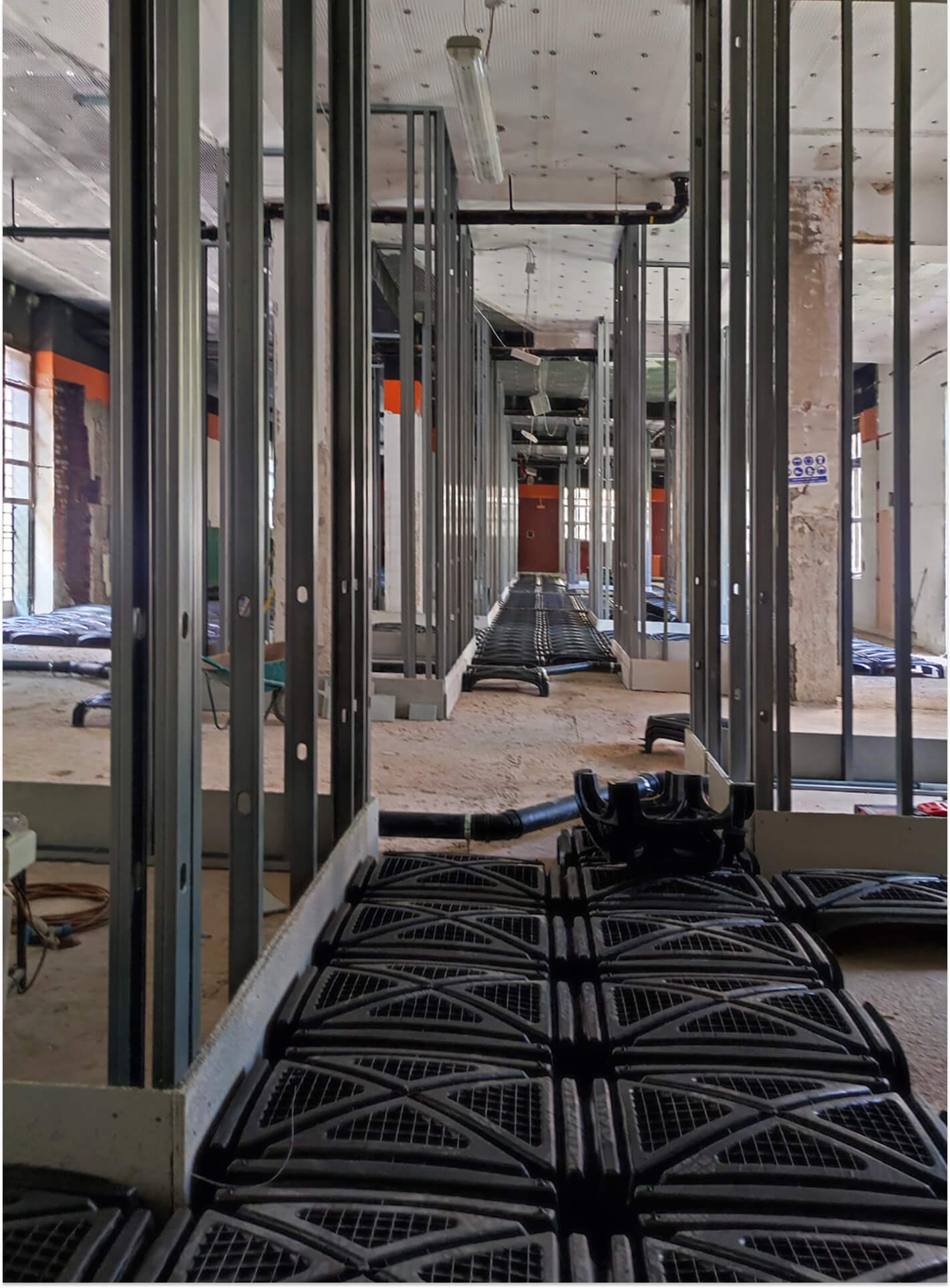
Interior view of a space undergoing renovation, with the construction of new distribution partitions using a lightweight metal structure for drywall systems. The image shows the galvanized frame secured to the floor and ceiling, ready for subsequent closure with plasterboard panels. On the ground, plastic modules for the creation of a ventilated crawl space and utility ducts integrated into the screed are visible. The utilities route runs along the central axis, with pipes and technical ducts installed before the subfloor was constructed, highlighting the coordination between construction and utility systems. The existing reinforced concrete pillars remain exposed and are incorporated into the new distribution structure, while the technical false ceiling allows for the passage of horizontal utility networks. The photograph documents an intermediate construction phase, in which the construction layers and the solutions adopted for the functional and technological adaptation of the existing building are visible.

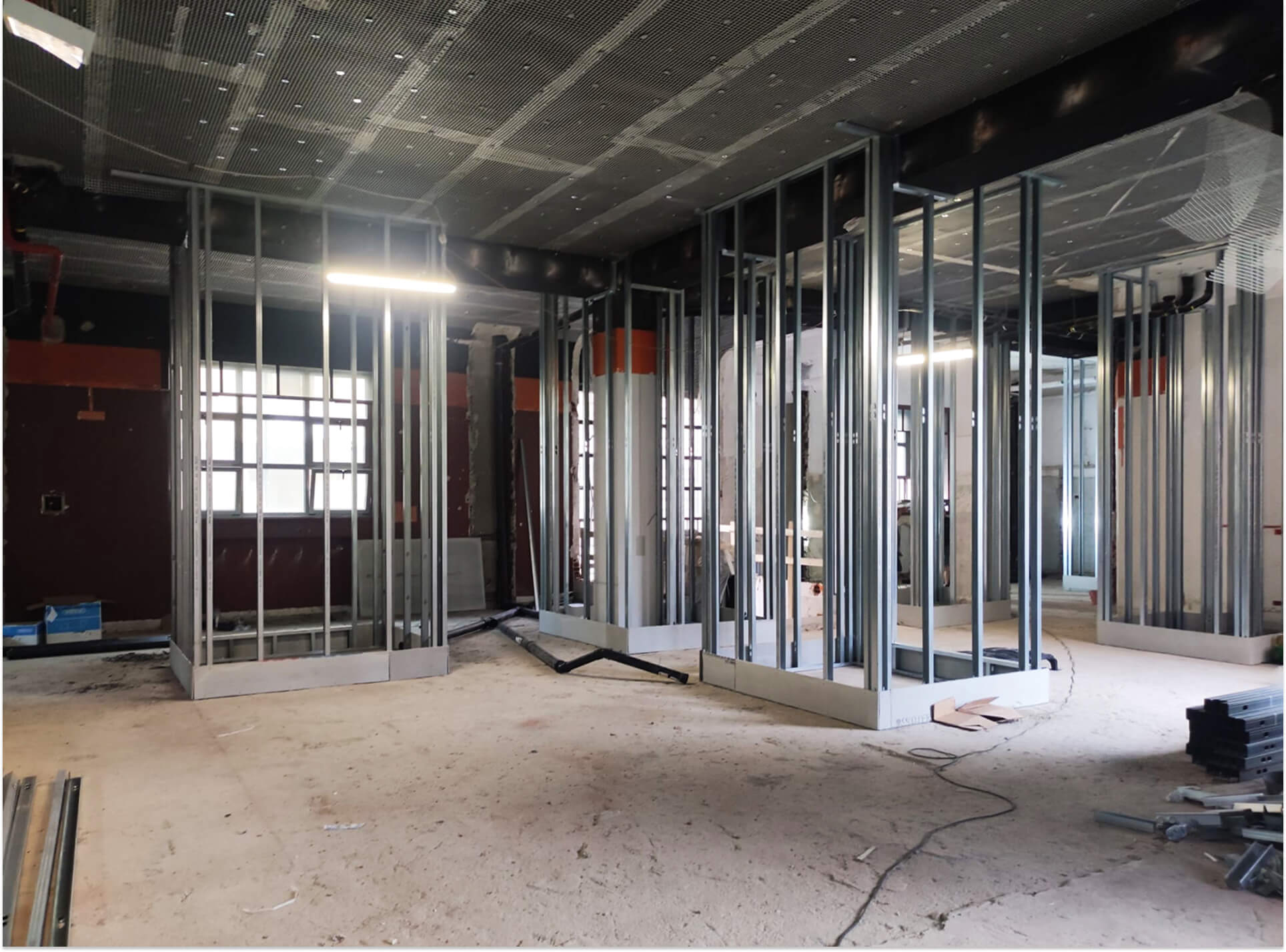
Interior view of a space undergoing renovation, with the spatial configuration being defined by installing new drywall partitions on a lightweight metal structure. Visible are the galvanized steel frames anchored to the ceiling and floor, ready for subsequent closure with plasterboard panels, which delineate the new spaces according to the layout plan. The ceiling is configured as a continuous technical false ceiling, with micro-perforated paneling and a suspended structure that accommodates the systems, including ducts, pipes, and temporary construction lighting fixtures. The existing reinforced concrete structural pillars remain exposed and are being integrated into the new interior layout, while the floor is still in its raw state, awaiting the installation of subfloors and finishes. The image documents an intermediate stage of the work, highlighting the coordination between construction works, drywall systems, and system upgrades as part of the building's redevelopment.

Interior view of a corridor undergoing renovation, with new partitions constructed using a dry-build system on a galvanized metal structure, partially infilled with plasterboard panels at the bottom. The technical false ceiling consists of a suspended structure with metal mesh and micro-perforated panels, designed to accommodate the electrical and lighting systems, with cables and light fixtures still being installed. Along the corridor, a group of technicians and visitors wearing safety helmets can be seen crossing the construction site during an inspection, indicating an advanced stage of the work in which the internal layout is now defined but the finishing touches are not yet complete. The existing concrete structural pillars are integrated into the new layout, while the floor is in its raw state, awaiting the installation of sub-floors and flooring. The image documents an intermediate stage of the construction process, highlighting the coordination between construction works, dry-build systems, and system upgrades as part of the building's redevelopment.

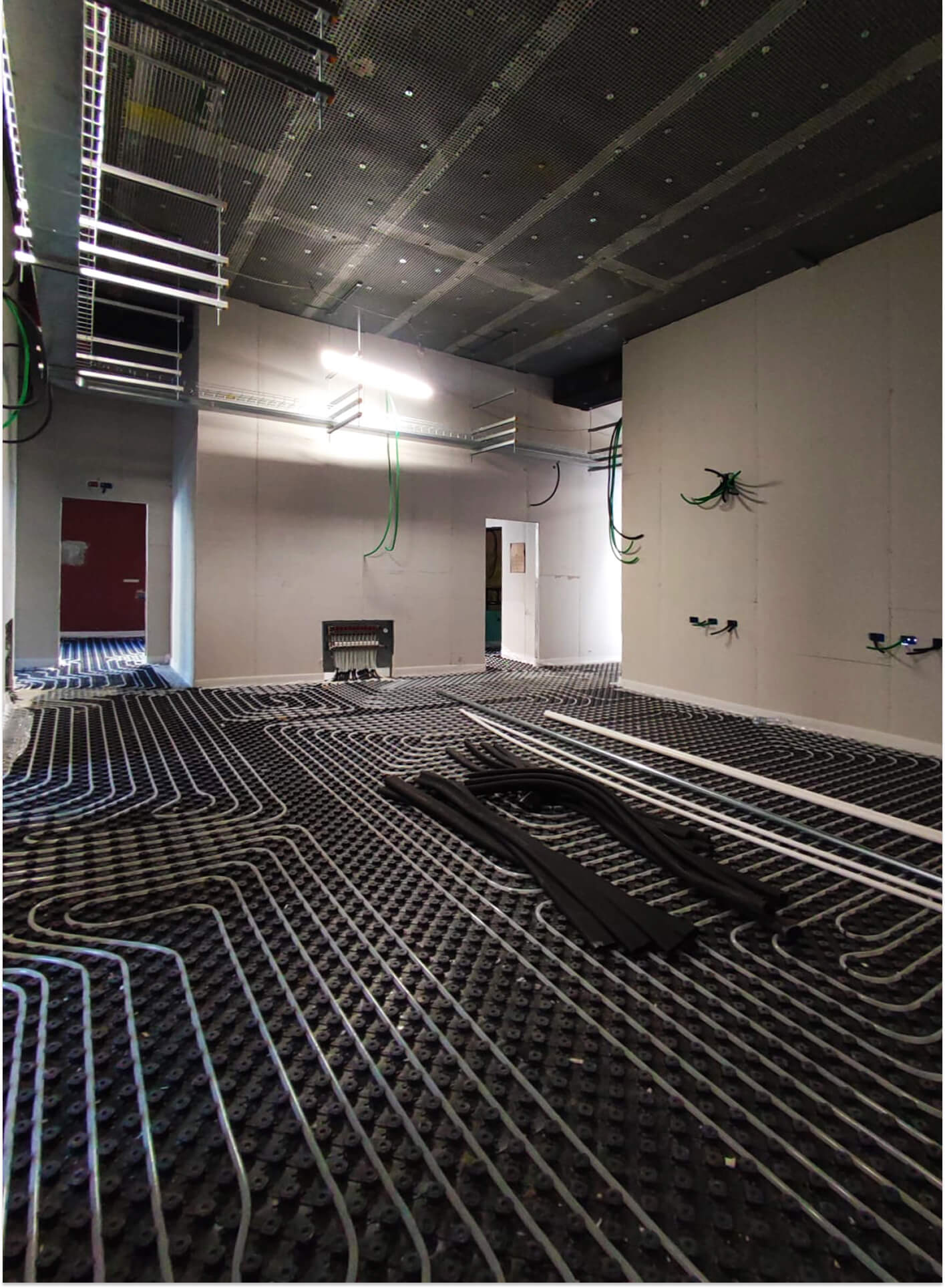
The interior is in an advanced stage of system upgrade, with the installation of an underfloor heating system using modular ashlar panels and plastic pipe coils for a radiant system embedded in the screed. The distribution of the pipes follows a regular path throughout the room, with a distribution manifold installed on the wall and supply pipes still being connected. The perimeter and partition walls are already closed with plasterboard panels on a metal frame, while the suspended technical false ceiling with micro-perforated paneling accommodates the system ducts, cable trays, and temporary construction lighting fixtures. The provisions for electrical and special systems are visible, with cable ducts emerging from the walls and ceiling. The floor is in the phase prior to the creation of the finishing screed that will incorporate the radiant system, documenting an intermediate construction phase in which the construction and system work aimed at the technological and functional adaptation of the building are coordinated.