Regional transport museum: former Porta Milano station

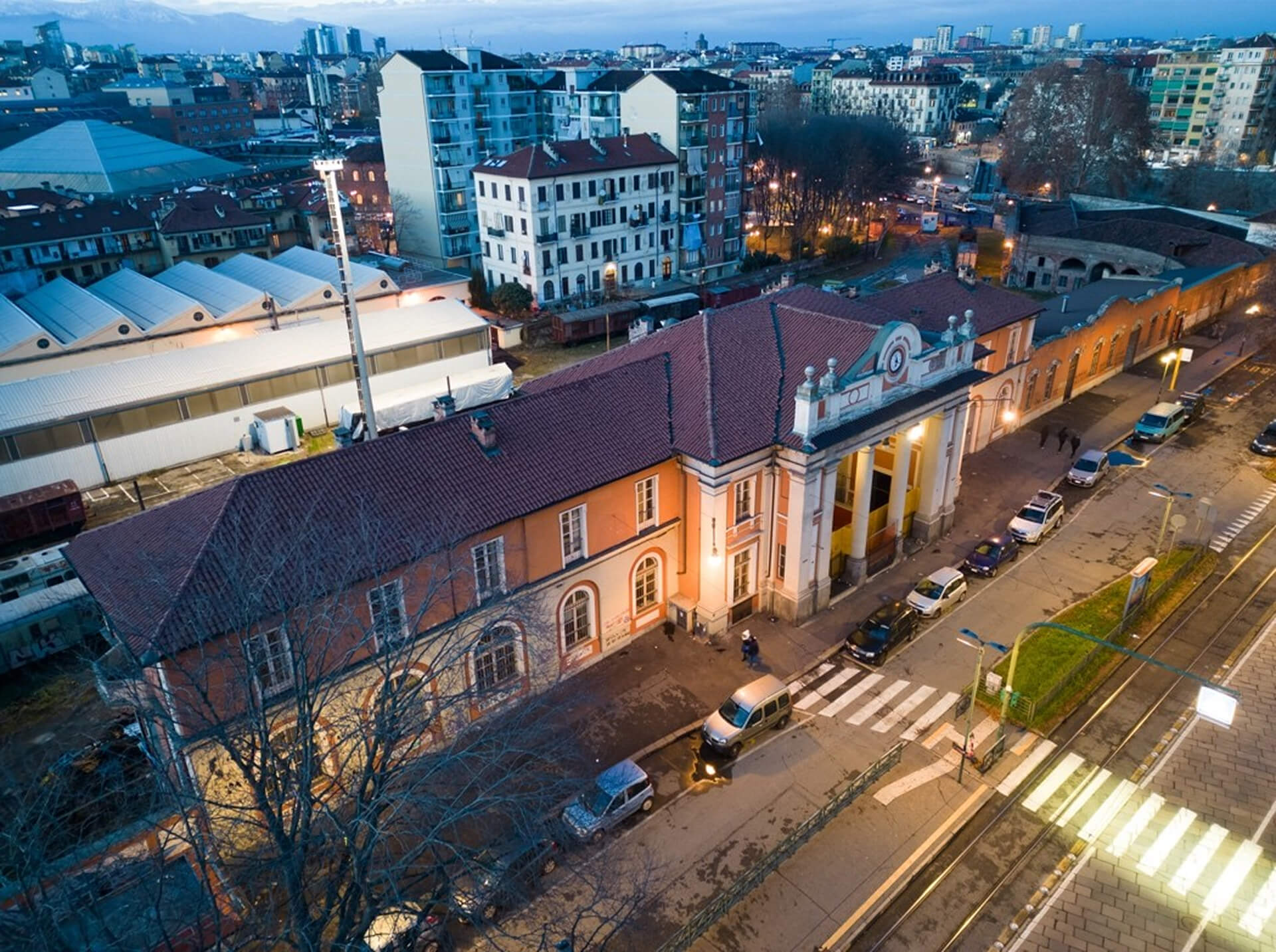
Vista aerea dell’edificio storico oggetto di intervento, inserito nel tessuto urbano consolidato e affacciato su un asse stradale principale. Il complesso si sviluppa longitudinalmente lungo il fronte strada ed è caratterizzato da una sequenza di volumi bassi con coperture a falda in laterizio, interrotti al centro da un corpo più monumentale con facciata simmetrica, timpano curvilineo e portico d’ingresso scandito da colonne. La posizione sopraelevata dello scatto consente di leggere chiaramente la relazione tra l’edificio e il contesto circostante, composto da isolati residenziali di diversa altezza, strutture industriali e spazi aperti. Sul lato opposto rispetto alla strada principale si riconoscono coperture a shed e fabbricati produttivi, testimonianza della precedente vocazione industriale dell’area. Il fronte urbano è definito da una strada carrabile con parcheggi, attraversamenti pedonali e linea tranviaria, elementi che sottolineano il carattere infrastrutturale dell’asse su cui si affaccia il complesso. L’illuminazione serale mette in evidenza l’ingresso principale, accentuando il ruolo rappresentativo del corpo centrale rispetto alle ali laterali più semplici e funzionali. L’immagine documenta il rapporto tra edificio storico e città contemporanea, mostrando la collocazione dell’intervento all’interno del sistema urbano e permettendo di comprendere la scala del complesso, la sua estensione longitudinale e il dialogo tra architettura storica, tessuto residenziale e strutture produttive circostanti.

Regional transport museum: former Porta Milano station

The project addresses the restoration and repurposing of the main building of the former Turin Porta Milano railway station, which will become the new Piedmont Railway Museum. As part of a broader area enhancement program, the project seeks to restore the property’s historic value while ensuring its contemporary use and accessibility.

SEE MORE

Turin, 2025 – Works in progress
Client: Regione Piemonte
Value of works: 1.500.000 €
Architectural project: Giovanni Durbiano e Umberto Montanari
Structural and building services engineering: MCM Ingegneria Srl
Building subject to protection under Legislative Decree no. 42/2004
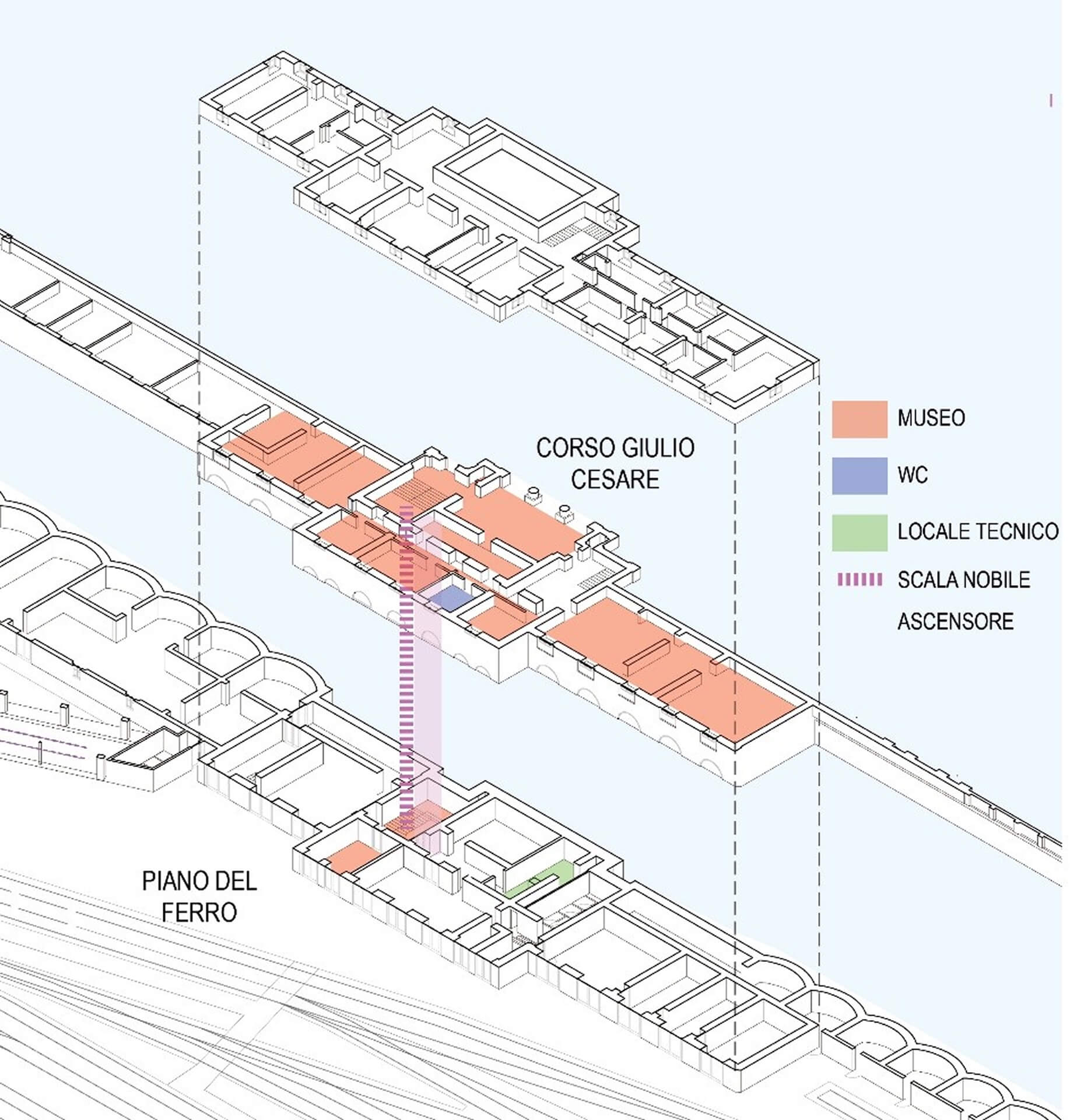
Exploded axonometric study illustrating the organization of the various levels of a historic architectural complex and the insertion of the new museum itinerary within the existing structure. The drawing shows the floors separated vertically to highlight the relationships between the spaces, the connections, and the functions distributed along the longitudinal axis of the building. The main level, overlooking Corso Giulio Cesare, is highlighted with an orange background and identifies the spaces intended for the museum, distributed sequentially along the central corridor and in the side rooms. In a central position is the vertical connection core, composed of the main staircase and elevator, depicted with a purple background, which connects the various floors and constitutes the distribution hub of the project. The lower level, designated as the iron floor, contains service spaces and technical rooms, highlighted in green, along with the restrooms, indicated in blue. The separation of the floors through an exploded view allows for a clear understanding of the vertical continuity between the functions and the way in which the new exhibition itinerary fits into the existing structure without altering its original layout. The dotted lines connect the different levels to indicate the correspondence of the parts and the position of the main distribution elements, while selective coloring allows for quick identification of the intended uses. The image documents a design scheme used to explain the integration between the historic building and the new museum layout, clarifying the distribution of functions, vertical connections, and spatial hierarchy.


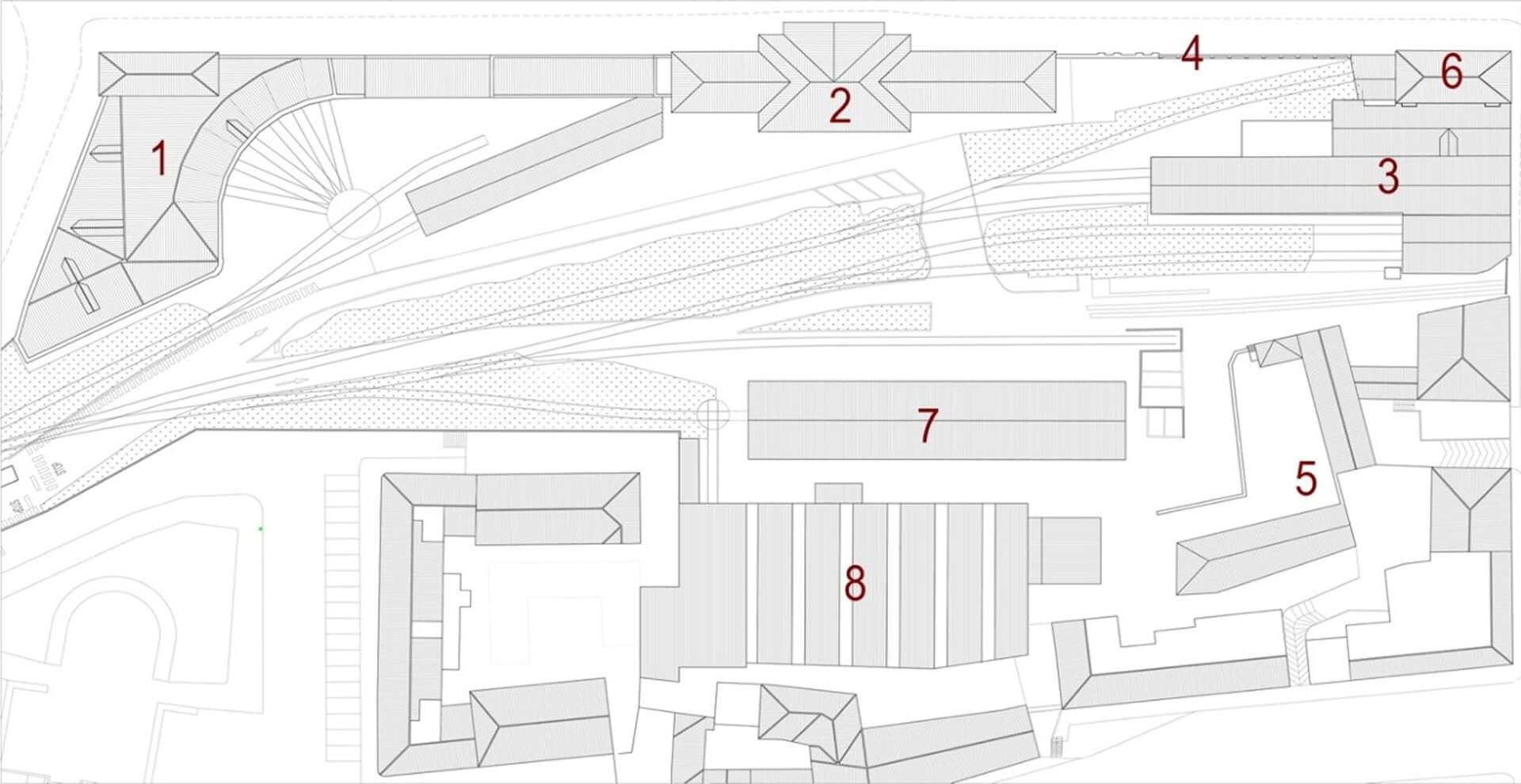
General plan of the project area, identifying the main buildings of the complex and the surrounding structures, represented in a bird's-eye view and marked with consecutive numbers. The drawing shows the spatial organization of the entire complex, extending longitudinally along the railway line, highlighting the relationship between the historic buildings, the service buildings, and the large industrial structures present on the lot. The upper side of the drawing shows the layout of the tracks and railway areas, which define the infrastructural edge of the site and determine its orientation. The numbered buildings are arranged parallel to this axis, configuring a linear system composed of buildings of varying sizes and types, including historic volumes with pitched roofs, large-span production pavilions, and secondary connecting structures. The numbering allows for the different elements of the complex to be distinguished: the main buildings facing the city, the central distribution buildings, the technical facilities, and the industrial warehouses behind them. In particular, the large central volume with a modular roof highlights the presence of a large production or exhibition space, while the smaller, more complex buildings indicate service functions, access, or connections between the different parts of the complex. The plan serves as an urban and functional framework and provides insight into the overall configuration of the area, the relationships between the various existing buildings, and the project's position within the broader system of the former railway-industrial complex.

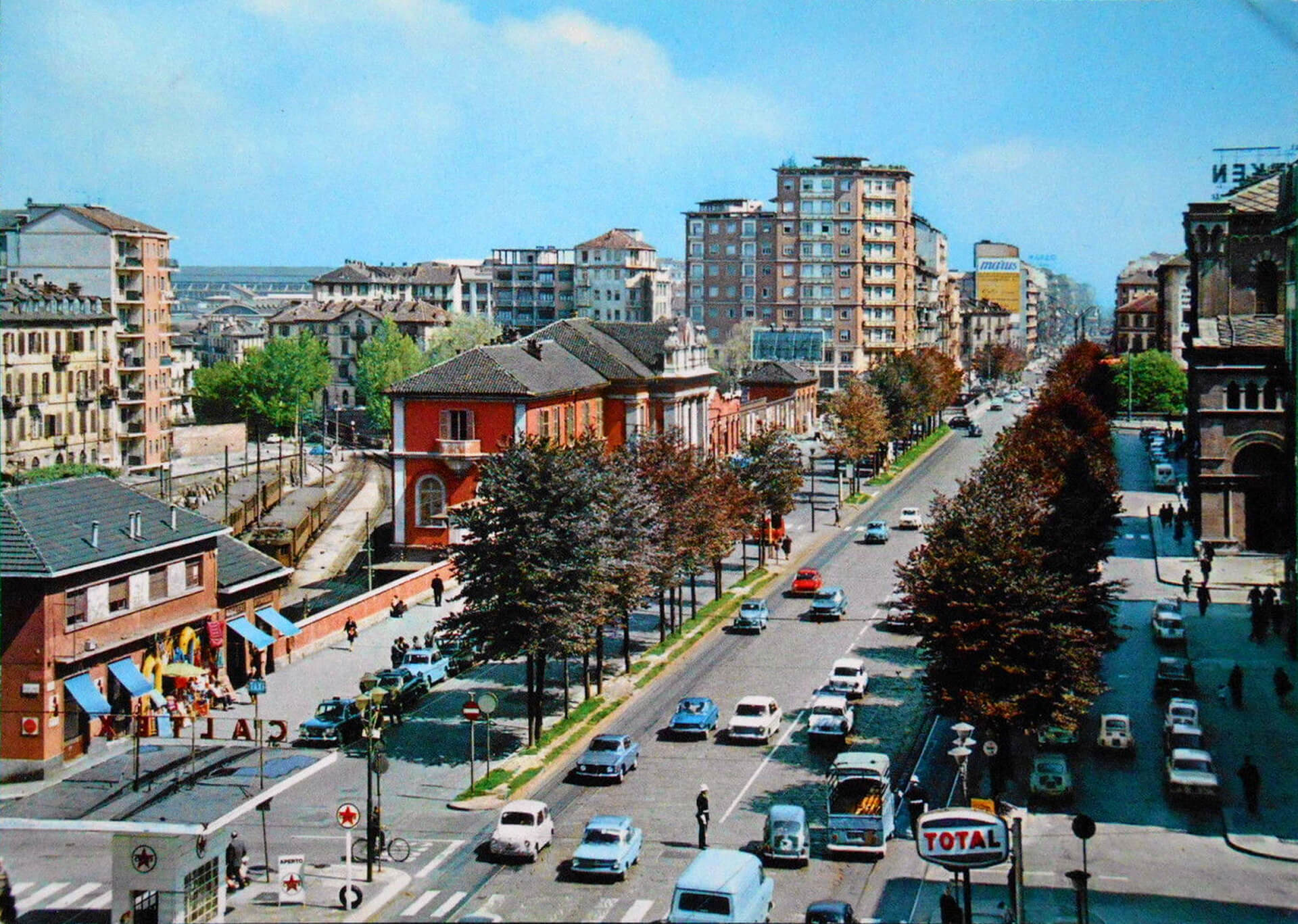
Historical color photograph of the urban area of ​​Corso Giulio Cesare in Turin, with a perspective view of the station complex on the Turin–Ciriè–Lanzo line, taken from an elevated position along the main road. The image documents the neighborhood's configuration during a phase of full use of the railway infrastructure, highlighting the direct relationship between the station, the surrounding residential fabric, and the urban road system. At the center of the composition is the historic station building, with its red plastered facades and a monumental central body with a decorated pediment, overlooking the tree-lined avenue. Next to the main building, the railway tracks and shelters are visible, running parallel to the road, confirming the station's presence as an integrated infrastructure within the urban system. The avenue is characterized by a wide section with a dual carriageway, a tree-lined central reservation, and heavy vehicular traffic, elements that testify to the neighborhood's transformation into an urban thoroughfare. Along the sides of the road are multi-story residential buildings constructed after World War II, forming a continuous building front that is higher than the historic station building, highlighting the area's progressive densification. In the foreground are commercial businesses, a gas station, parking lots, and pedestrian crossings, elements that contribute to describing the urban context of the economic boom years and the role of the railway complex as a still-active element, yet already integrated into a rapidly transforming city system. The image has historical and urban planning value, as it allows us to understand the evolution of the built environment, the relationship between the railway infrastructure and the city, and the progressive transformation of the urban landscape around the building in question.

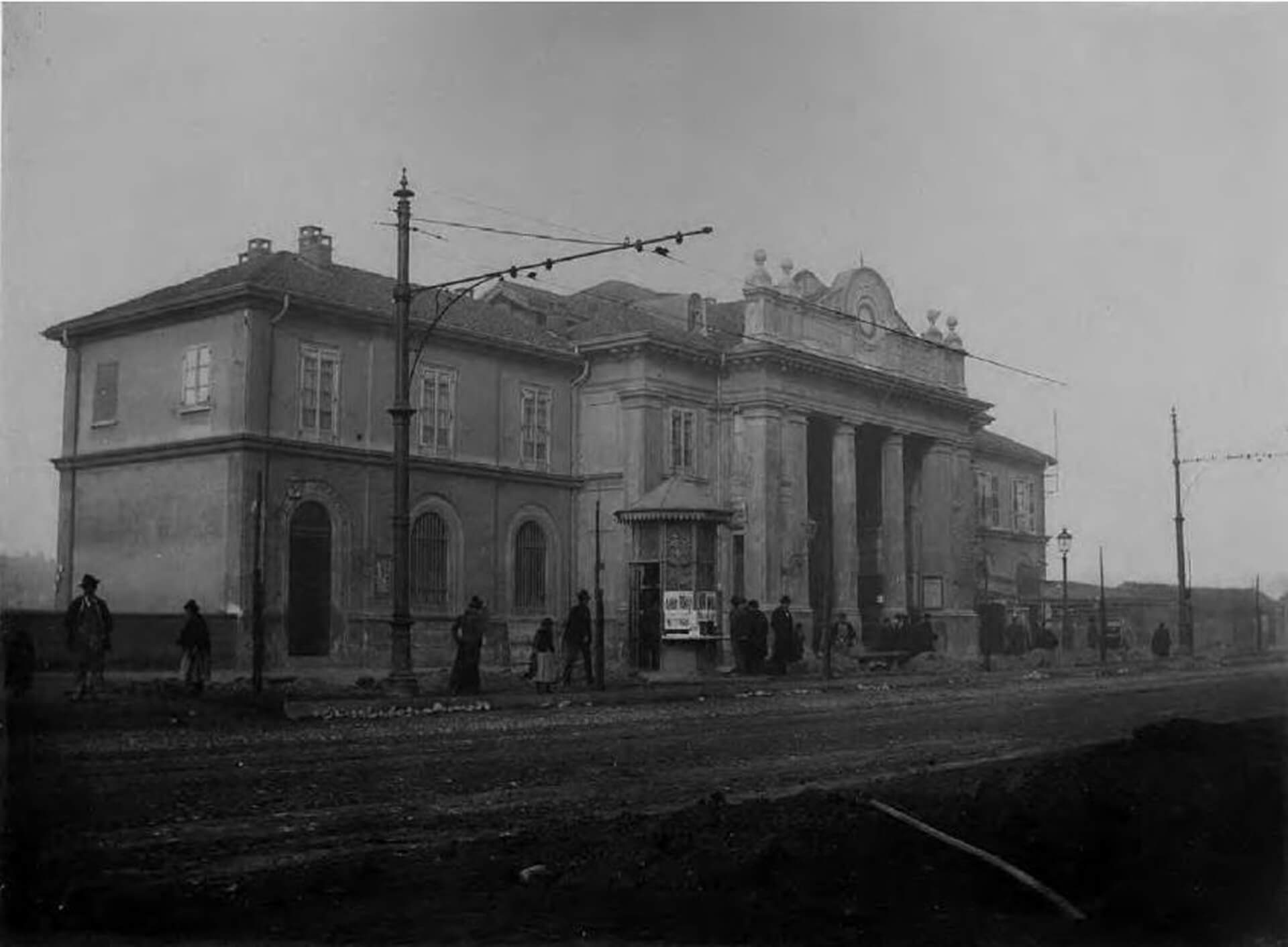
This historic black-and-white photograph of the Turin–Ciriè–Lanzo railway station building, taken from a frontal position along the street, documents a later phase compared to the previous image and shows the architecture in greater definition and detail. The building features a symmetrical composition with a monumental central body flanked by two two-story lateral wings, covered by a pitched roof and featuring regular openings with molded cornices. The main entrance is highlighted by a forepart with a tetrastyle portico supported by classical columns, surmounted by a pediment decorated with sculptural elements and a curvilinear tympanum, giving the building a representative character typical of late-19th-century railway architecture. The ground floor is punctuated by arched openings, while the upper floor features rectangular windows aligned according to a rigorous, symmetrical pattern. In the foreground, the street in front of the station is visible, with its uneven pavement, tram poles, and a few people waiting or moving about, elements that testify to the intense relationship between the building and the urban public space. The presence of overhead cables and streetlights highlights the station's insertion into the city's transportation system, confirming its role as an infrastructural hub and access point to the city. The image has documentary value for the historical reconstruction of the complex, as it allows us to precisely recognize the original features of the main façade, the configuration of the space in front, and the appearance of the building before the transformations that took place during the twentieth century.

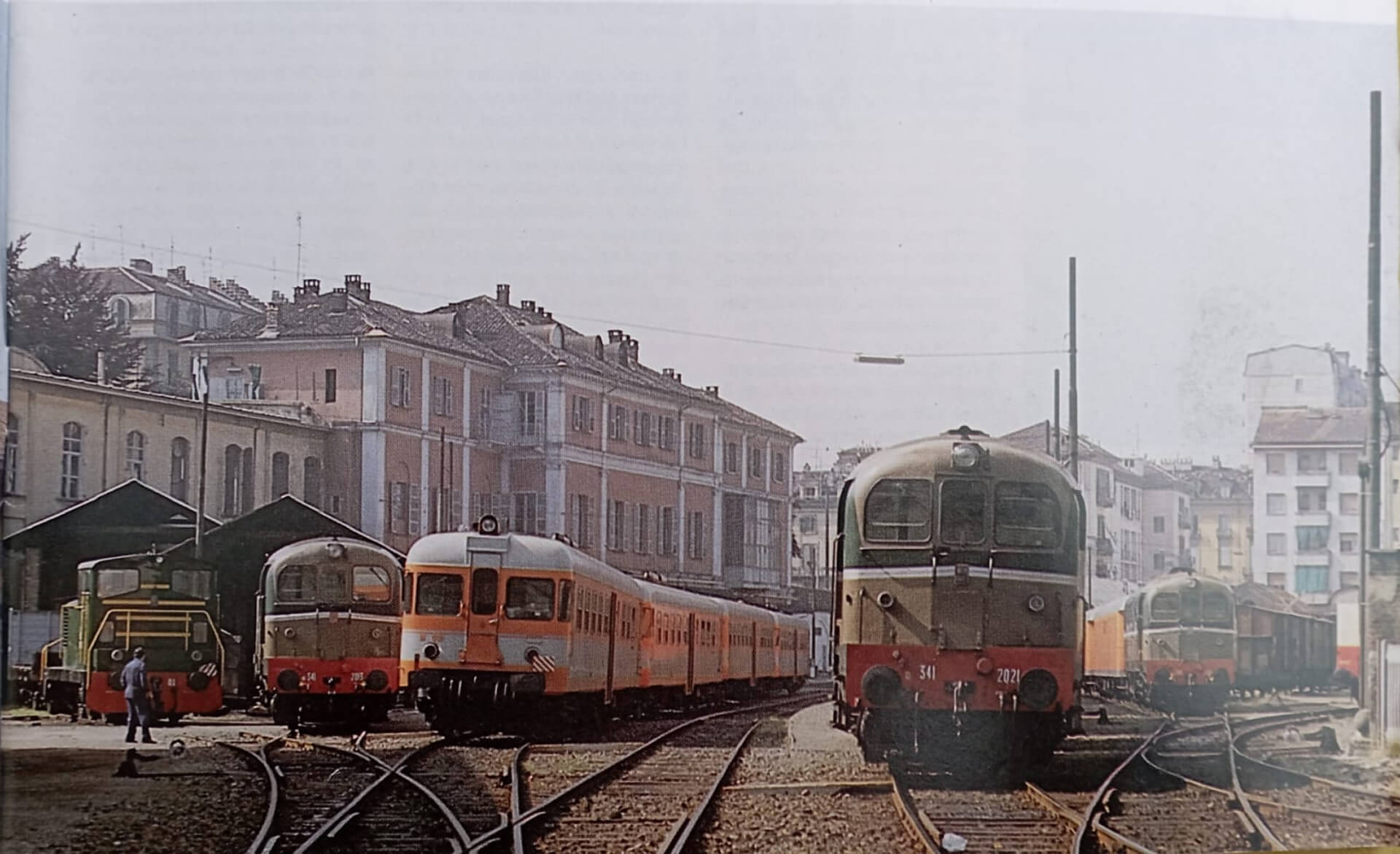
Historic color photograph of the railway area adjacent to the Turin–Ciriè–Lanzo station, documenting a phase of the complex's use as an operational hub and rolling stock depot. The image, taken from inside the railway yard, shows several trains stationary on the shunting tracks, highlighting the infrastructure's configuration and the direct relationship between the station buildings and the track system. In the foreground, several locomotives and railcars are visible on diverging tracks, converging toward the central section, defining a complex geometry of switches and connections typical of depot and maintenance areas. The rolling stock, belonging to various eras and types, testifies to the railway system's prolonged use and its function as a terminus and service point for the line. In the background, the station's historic building facade is visible, with multi-story buildings characterized by plastered facades, regular windows, and pitched roofs, flanked by lower structures intended for technical functions and warehouses. The proximity of urban buildings to the railway area highlights the original integration between infrastructure and urban fabric, typical of late 19th- and early 20th-century stations. The image has documentary value for the historical reconstruction of the site, as it shows the layout of the railway yard before subsequent transformations and allows us to understand the extent of the service areas, the layout of the tracks, and the complex's role as an active railway infrastructure within the city.

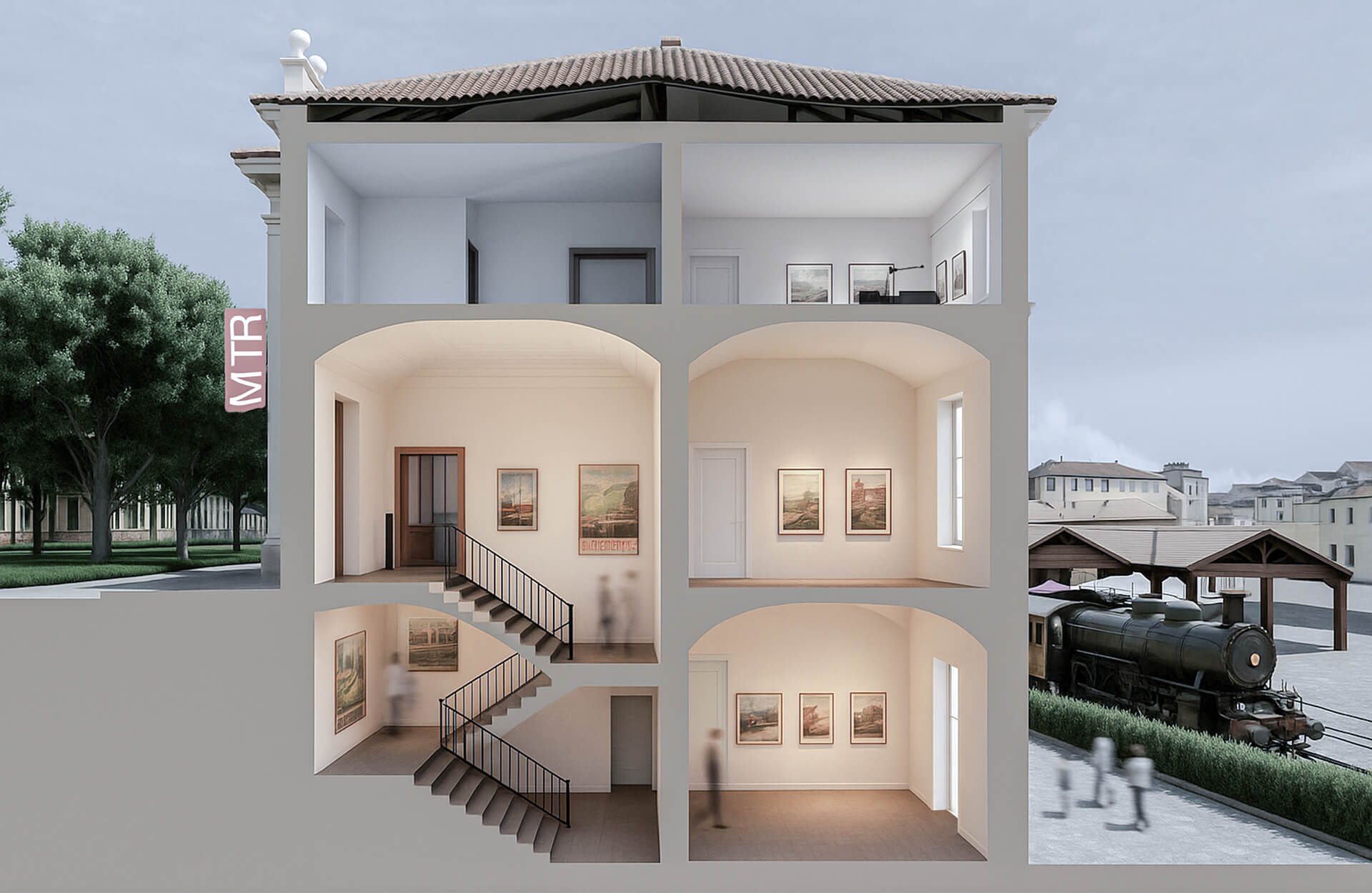
Perspective section of the historic building undergoing restoration, illustrating the new interior museum layout, showing the vertical distribution of spaces and the relationship between the different levels. The drawing, produced as an axonometric section, highlights the existing masonry structure and the insertion of new functions within the original volume, while maintaining the legibility of the historic architectural layout. The building is divided into multiple floors connected by a system of centrally located internal staircases, ensuring the continuity of the exhibition route. The spaces are represented as museum halls intended for exhibitions, with walls equipped for paintings and panels, diffused lighting, and open spaces for public use. The ground floor and first floor house the main exhibition spaces, while the upper level is intended for complementary functions, such as offices, support rooms, or service areas. The section also highlights the wooden-framed pitched roof, preserved and left exposed in the upper part of the building, underscoring the historic character of the structure. The arched openings and thick walls indicate the original nature of the railway building, while the new exhibition is inserted reversibly, without altering the existing structural configuration. The right side of the image depicts the external context with the tracks and a historic locomotive, an element that recalls the complex's original function and strengthens the connection between the new museum and the site's railway heritage. The drawing therefore serves to illustrate the reuse project, showing how the building is being transformed into an exhibition space while maintaining its recognizable historical architectural features and its relationship with the railway infrastructure.

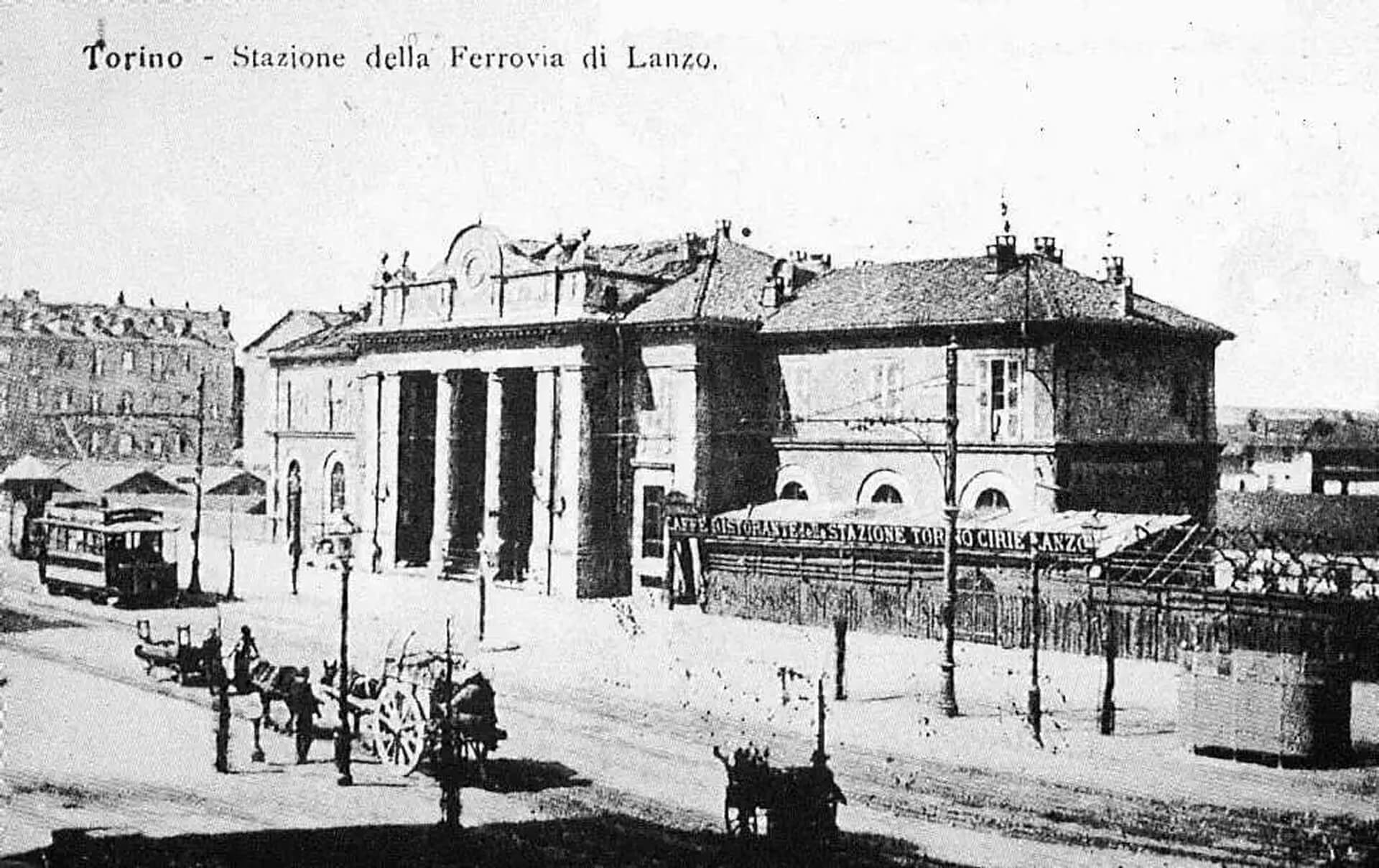
A historic black-and-white photograph of the Ferrovia di Lanzo station in Turin, dating back to the early 20th century, documenting the building's original appearance before subsequent transformations. The image shows the main facade of the railway building, characterized by a symmetrical composition with a monumental central body and lower lateral wings, set on a compact volume with a pitched roof. The main entrance is highlighted by a portico with classical columns supporting a decorated pediment, an architectural element that gives the building a representative and institutional character, typical of late-19th-century railway architecture. The arched openings on the ground floor and the regular windows on the upper floor define an orderly and rhythmic façade, constructed according to academic compositional criteria. In the foreground, the urban space in front of the station is visible, with a dirt road, horse-drawn carriages, streetlights, and a few people waiting—elements that testify to the urban context of the time and the station's role as a hub of exchange between the city and the railway. A tram appears on the left side, while in the background are residential buildings and service structures related to the railway infrastructure. The photograph has documentary value and allows us to recognize the original features of the historic building undergoing restoration, highlighting its initial architectural configuration, its relationship with the public space, and the station's importance in Turin's transport system.