Mineral Museum Exhibition Design: Department of Environment, Land and Infrastructure Engineering, Politecnico di Torino

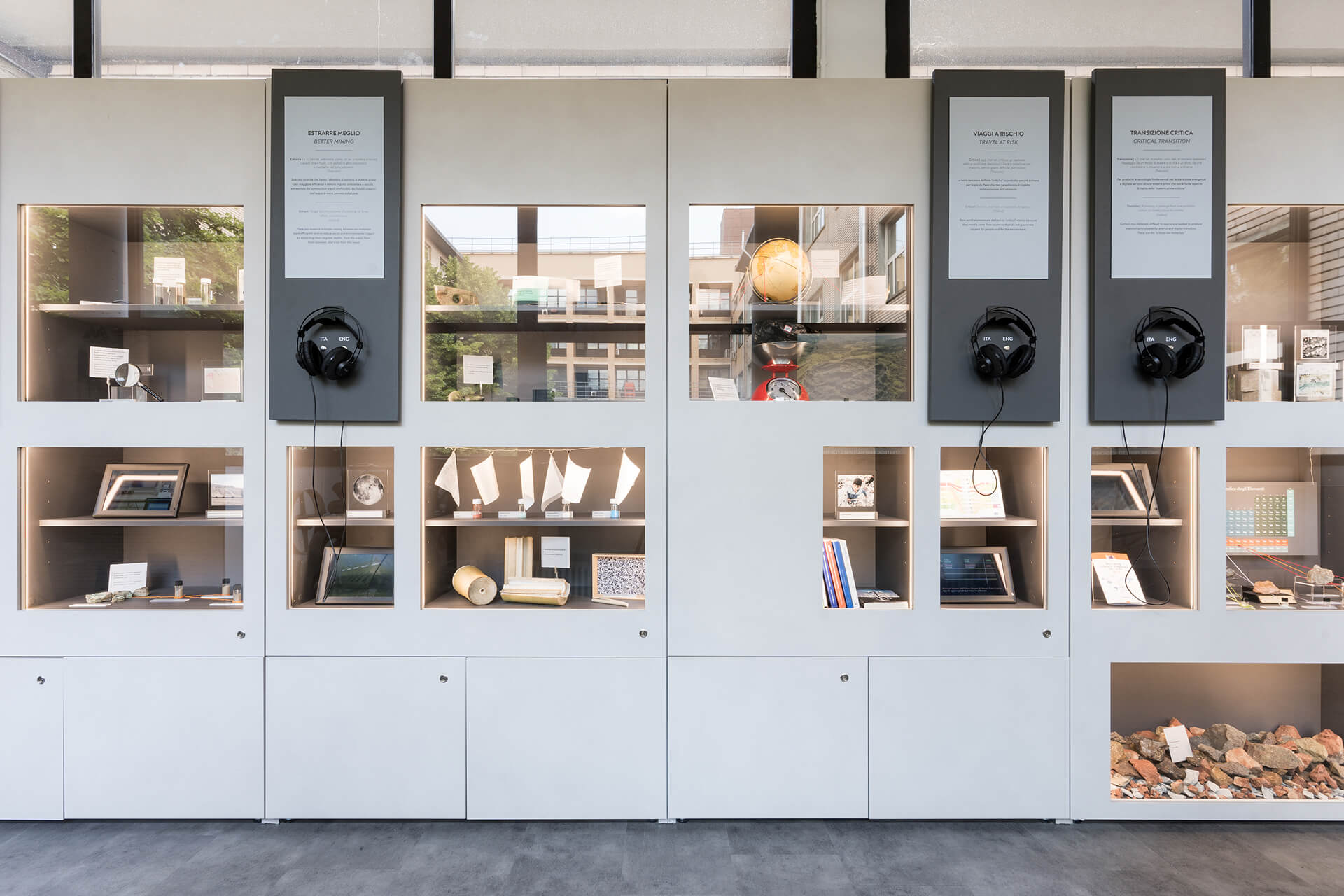
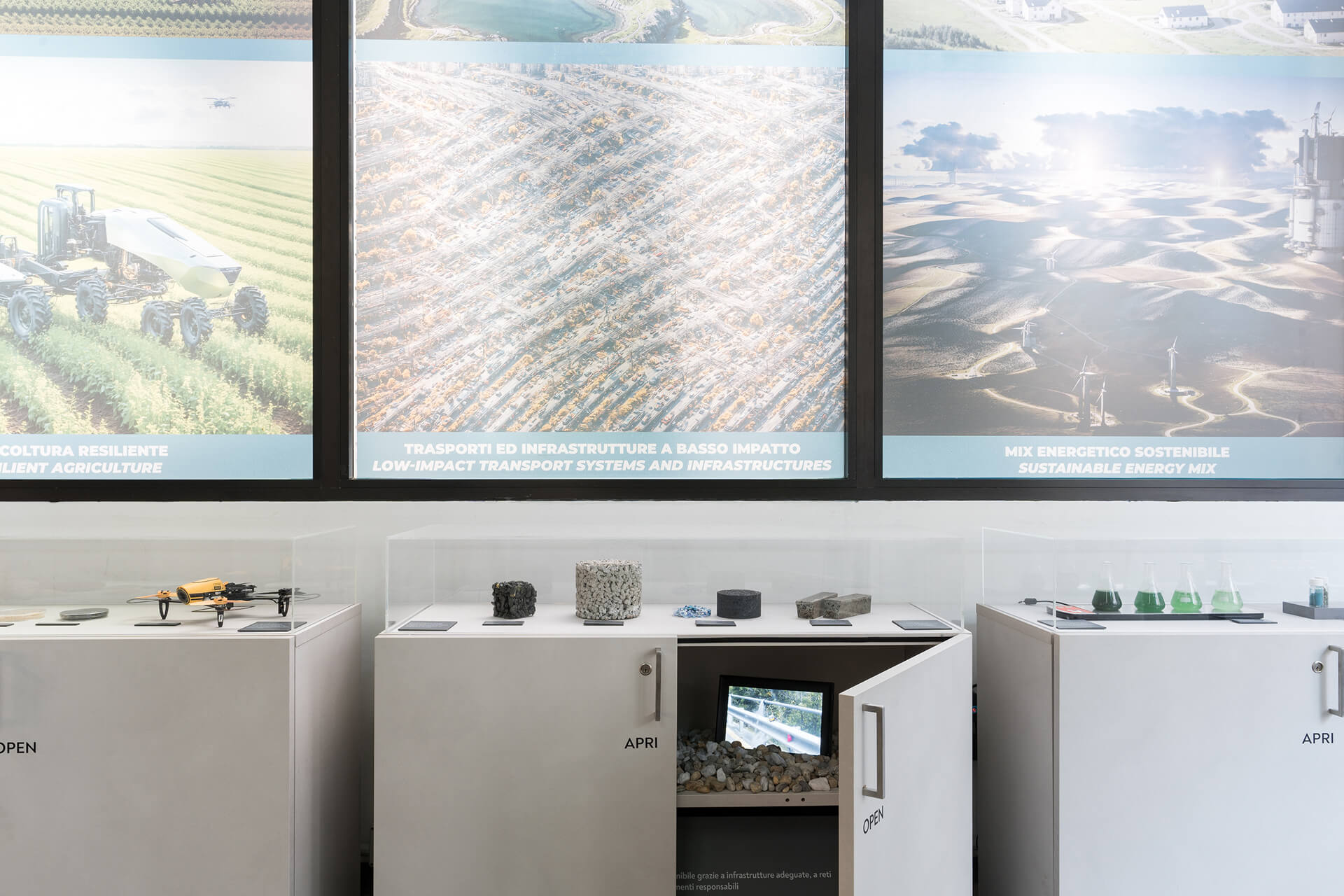
Allestimento espositivo interno costituito da una serie di teche museali con struttura in pannelli bianchi e copertura trasparente, contenenti campioni di materiali, modelli e dispositivi dimostrativi legati ai temi della sostenibilità ambientale e dell’innovazione tecnologica. All’interno delle vetrine sono visibili campioni inerti, materiali compositi, modelli in scala e strumenti scientifici, disposti su supporti espositivi con etichette descrittive. Sullo sfondo, grandi pannelli grafici retroilluminati illustrano scenari legati alla transizione ecologica, tra cui agricoltura resiliente, sistemi di trasporto a basso impatto e mix energetico sostenibile, con immagini di infrastrutture, paesaggi produttivi e impianti per energie rinnovabili. Una delle teche presenta uno sportello apribile con indicazione bilingue “APRI / OPEN”, che consente l’interazione diretta con il contenuto espositivo, evidenziando il carattere didattico e divulgativo dell’allestimento. L’immagine documenta uno spazio museale o centro di ricerca allestito con finalità informative, in cui elementi espositivi, grafica e dispositivi interattivi sono integrati in un sistema unitario di comunicazione scientifica.

Mineral Museum Exhibition Design: Department of Environment, Land and Infrastructure Engineering, Politecnico di Torino

The project aims to enhance and make more accessible the geo-mineralogical collections of the Department of Environmental, Territorial and Infrastructure Engineering of the Polytechnic University of Turin (DIATI), promoting their historical and scientific value and opening them to the academic community and the public. The collections, consisting of rocks, minerals, and historical machinery related to mining activities, have their origins dating back to the early decades of the 19th century.

The project has created a continuous exhibition path along the corridors of the department, covering a total area of approximately 516 square meters. The aim is to reconstruct the spatial uniformity of what are now fragmented spaces, defining a clear and legible itinerary through the introduction of fitted walls, new flooring, suspended ceilings, and an integrated lighting system.

SEE MORE

Turin, 2024
Cost of works: 200.000 €
Architectural design: Giovanni Durbiano and Nicola Ricci
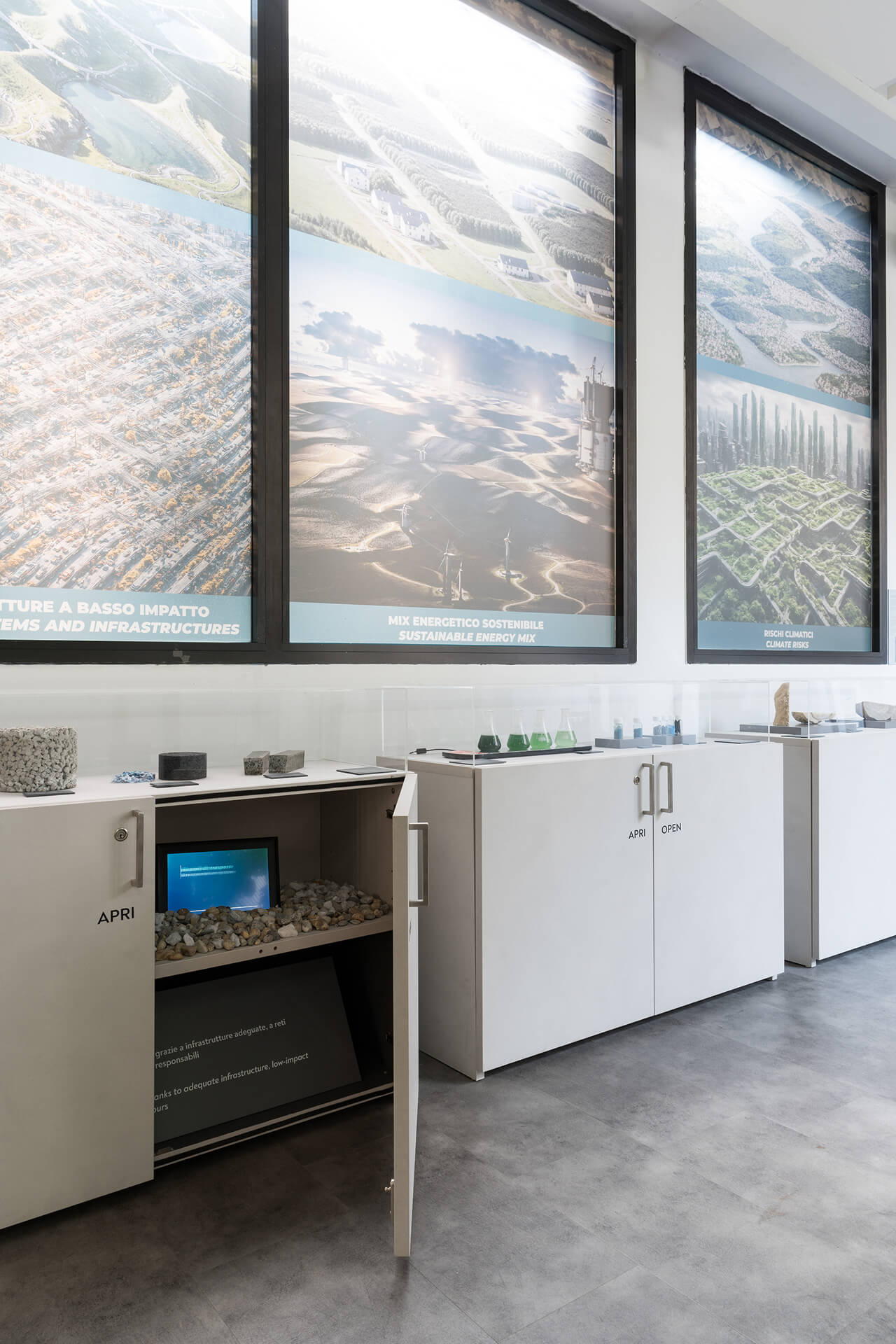
The museum's interior layout consists of a sequence of linear display modules with white lacquered panels and upper display cases made of transparent material, designed to showcase samples, models, and devices related to environmental sustainability and technological innovation. The display cases feature hinged doors marked with the bilingual "APRI / OPEN" sign, allowing direct interaction with the contents, including information displays, inert materials, and technical samples used for educational purposes. The back wall features large backlit graphic panels set in metal frames, depicting scenarios related to low-impact infrastructure, a sustainable energy mix, and climate risks, along with images of production landscapes, energy plants, and urban systems. The layout is completed by a continuous resilient flooring and diffused lighting, creating a scientific and educational exhibition space where graphic elements, interactive display cases, and multimedia support contribute to the creation of a unified informational journey.

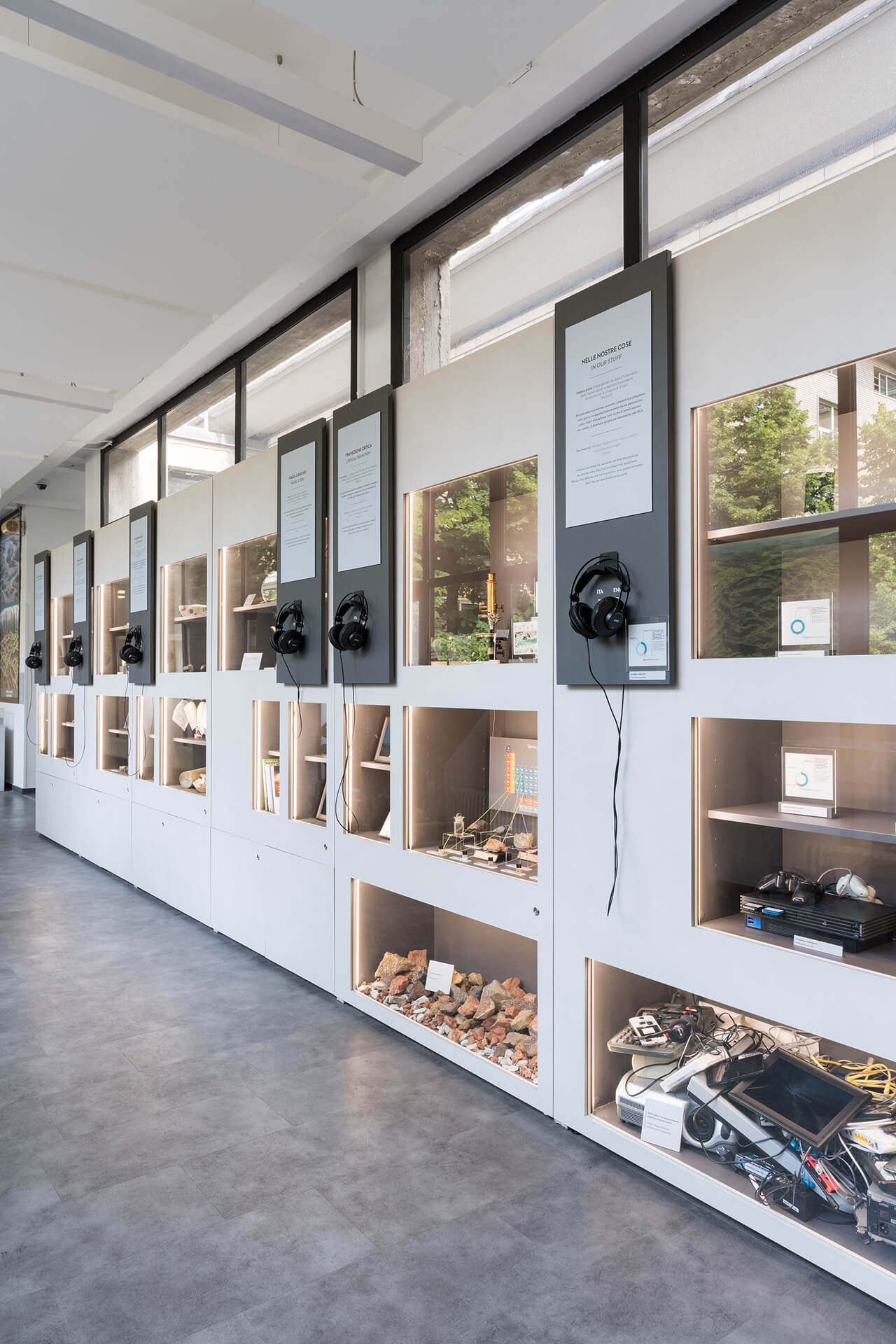
A modular exhibition system consisting of a wall equipped with continuous light-finish panels, integrated with illuminated niches and recessed display cases for the display of objects, samples, and documentary materials. The compartments house models, scientific instruments, stone samples, technological devices, and multimedia media, organized according to a thematic, educational, and scientific itinerary. Vertical information panels with bilingual texts and audio stations with headphones allow for the use of in-depth audio content. Backlit display cases and shelves are integrated into the structure of the exhibition, while the lower section features service doors for inspection and maintenance. The overall concept creates an interactive museum display, designed to disseminate content related to science, the environment, and innovation, in which graphic elements, audiovisual media, and exhibits are coordinated in a unified communication system.

Perspective view of an exhibition wall within a museum or science outreach center, consisting of a continuous modular system of light-lacquered panels with illuminated niches and recessed display cases for displaying objects, samples, and technological devices. The display cases, integrated into the structure of the furniture, house stone materials, electronic instruments, models, multimedia supports, and technical documentation, organized according to a thematic, educational itinerary. The upper section features vertical information panels with bilingual texts and audio stations equipped with headphones for listening to in-depth content, mounted on metal brackets attached to the wall. The upper section of the space is characterized by continuous windows with dark frames and opaline glass surfaces that provide diffused natural lighting, while the continuous, neutral-colored flooring contributes to the unified reading of the space. The image documents a permanent exhibition designed for scientific and environmental communication, in which graphic elements, interactive display cases, and audiovisual devices are coordinated in an integrated display system.

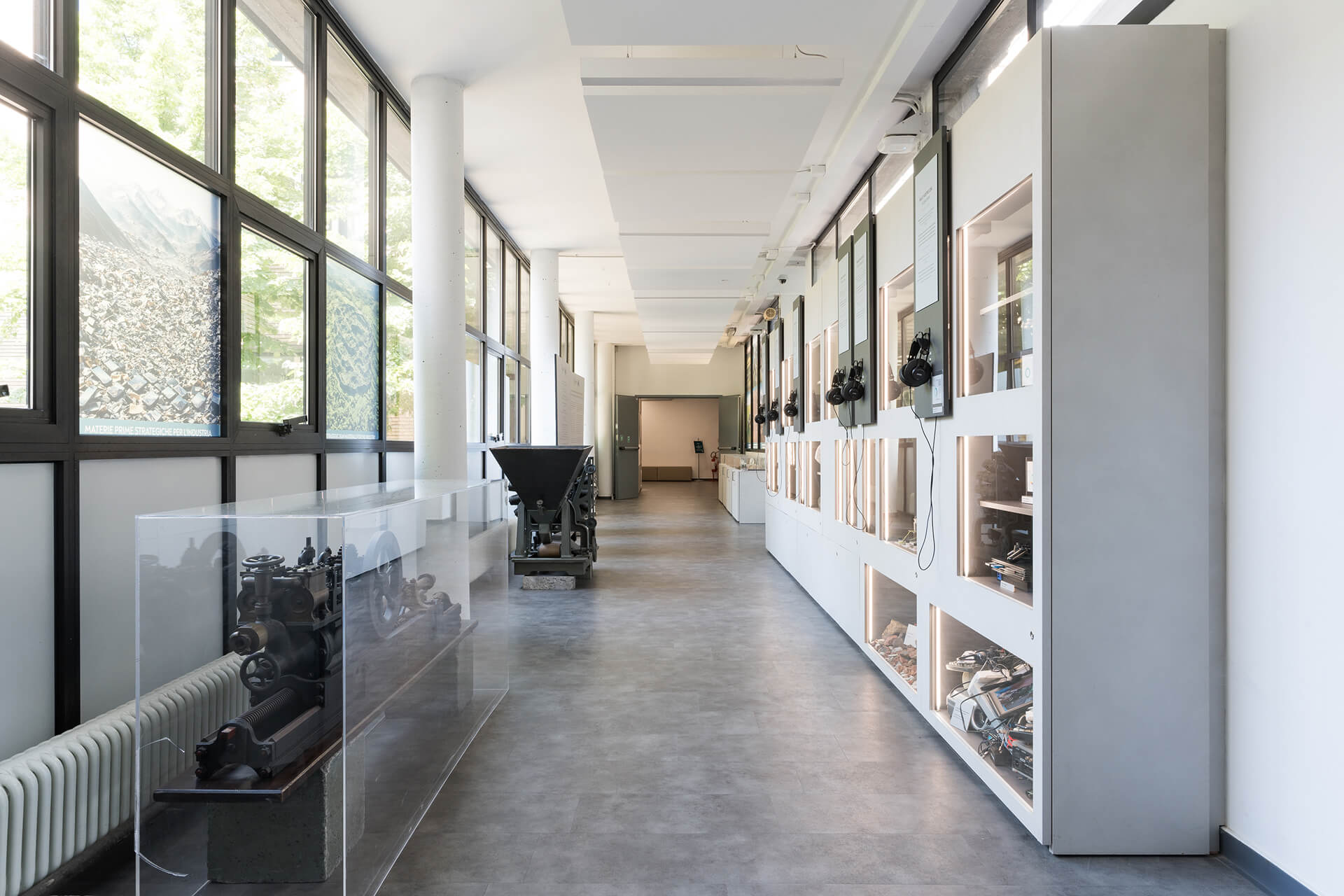
Longitudinal view of the interior exhibition space organized as a museum corridor, featuring a continuous system of integrated furnishings along the right wall. The display cases feature display modules with illuminated niches, recessed display cases, and vertical information panels equipped with audio stations and headphones for listening to multimedia content. The display cases house samples, technical instruments, electronic devices, and documentary materials related to scientific research, industry, and technological innovation, arranged in a sequential educational path. On the opposite side, a series of large continuous windows with dark metal frames provide diffused natural lighting and connect the interior space with the tree-lined exterior. At the center of the path are historic machinery and industrial equipment protected by transparent display cases, used as exhibition elements. The ceiling features low linear suspended ceilings that integrate the lighting and systems, while the continuous flooring made of neutral-colored resilient material contributes to the unified reading of the space. The image documents a permanent museum installation, designed for the dissemination of science and technology, in which furnishings, graphics, interactive devices and artifacts are coordinated in an integrated exhibition system.

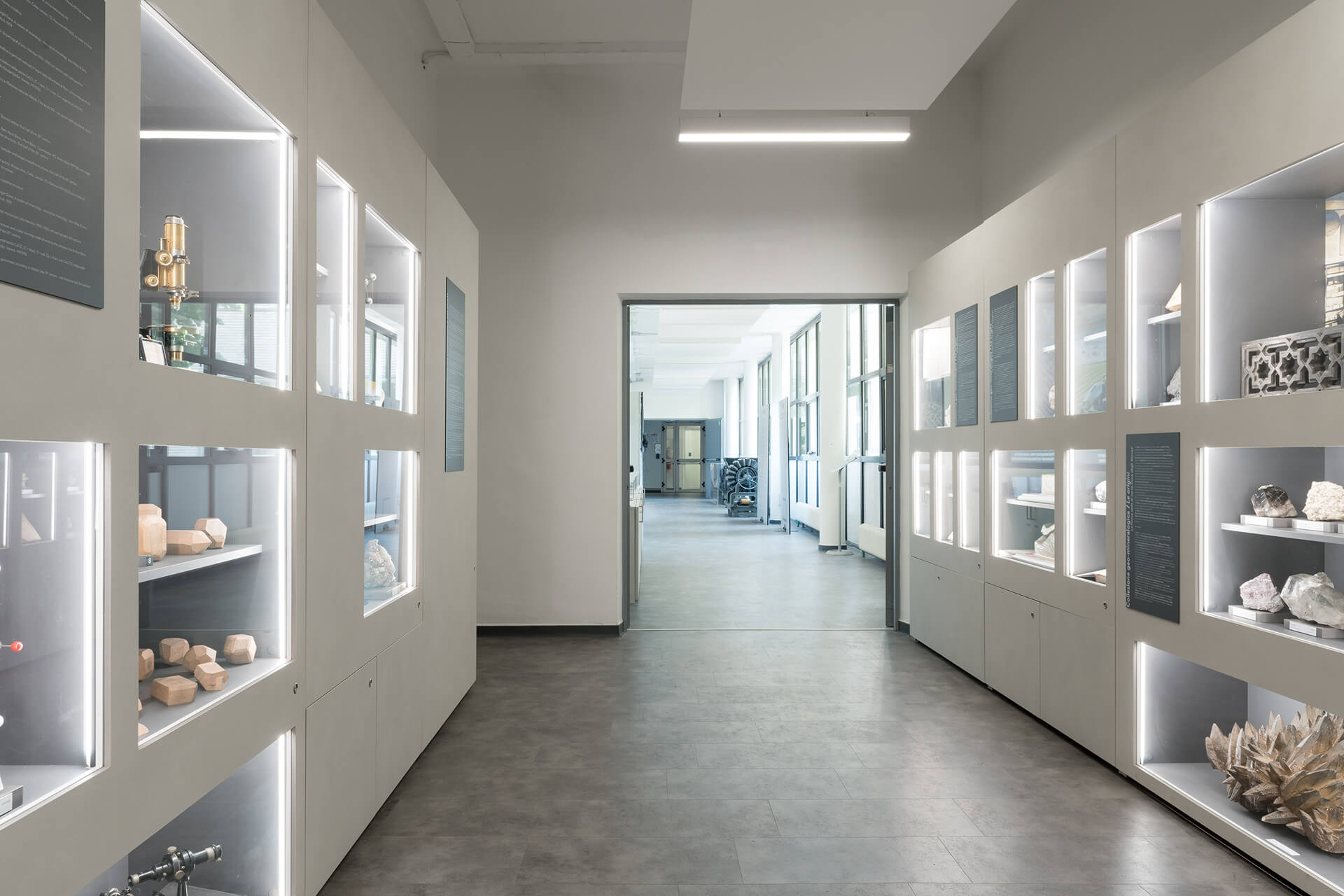
Interior view of an exhibition space organized as a museum passageway, characterized by walls equipped on both sides with display modules integrated into continuous light-colored panels. The surfaces are punctuated by recessed, illuminated niches containing mineralogical samples, geometric models, technical instruments, and scientific specimens, arranged on stands with descriptive labels according to a thematic educational path. Vertical information panels with in-depth texts are installed next to the display cases, inserted into a coordinated graphic system. The display case lighting is integrated into the structure of the exhibition using linear light profiles, while the ceiling features lowered false ceilings housing the main lighting fixtures and systems. The continuous, neutral-colored resilient flooring contributes to the uniform reading of the space, which opens towards a larger room in the background where additional machinery is visible. The image documents a permanent museum exhibition designed for the dissemination of science and technology, in which furnishings, graphics, and lighting systems are integrated into a single, coherent display device.

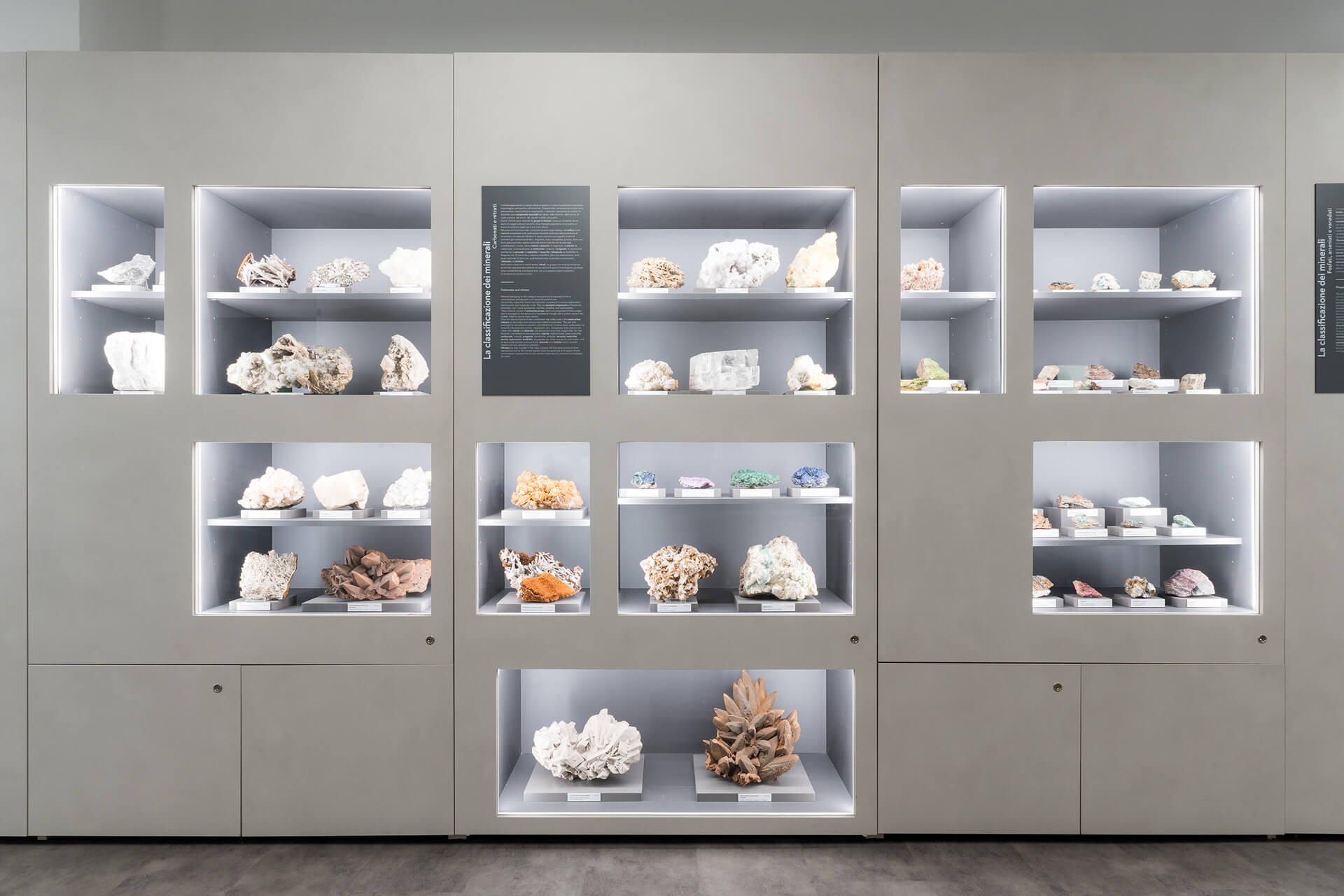
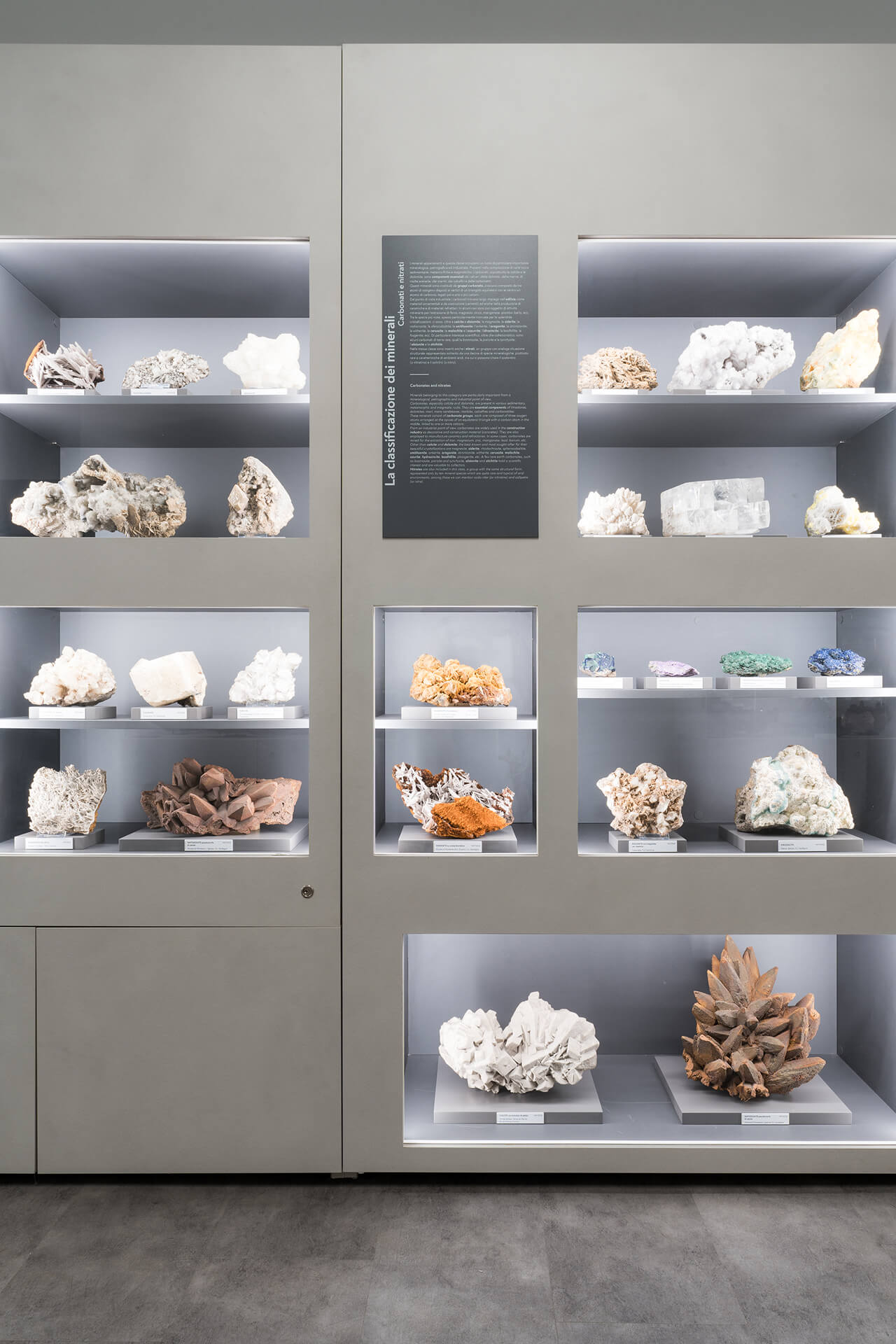
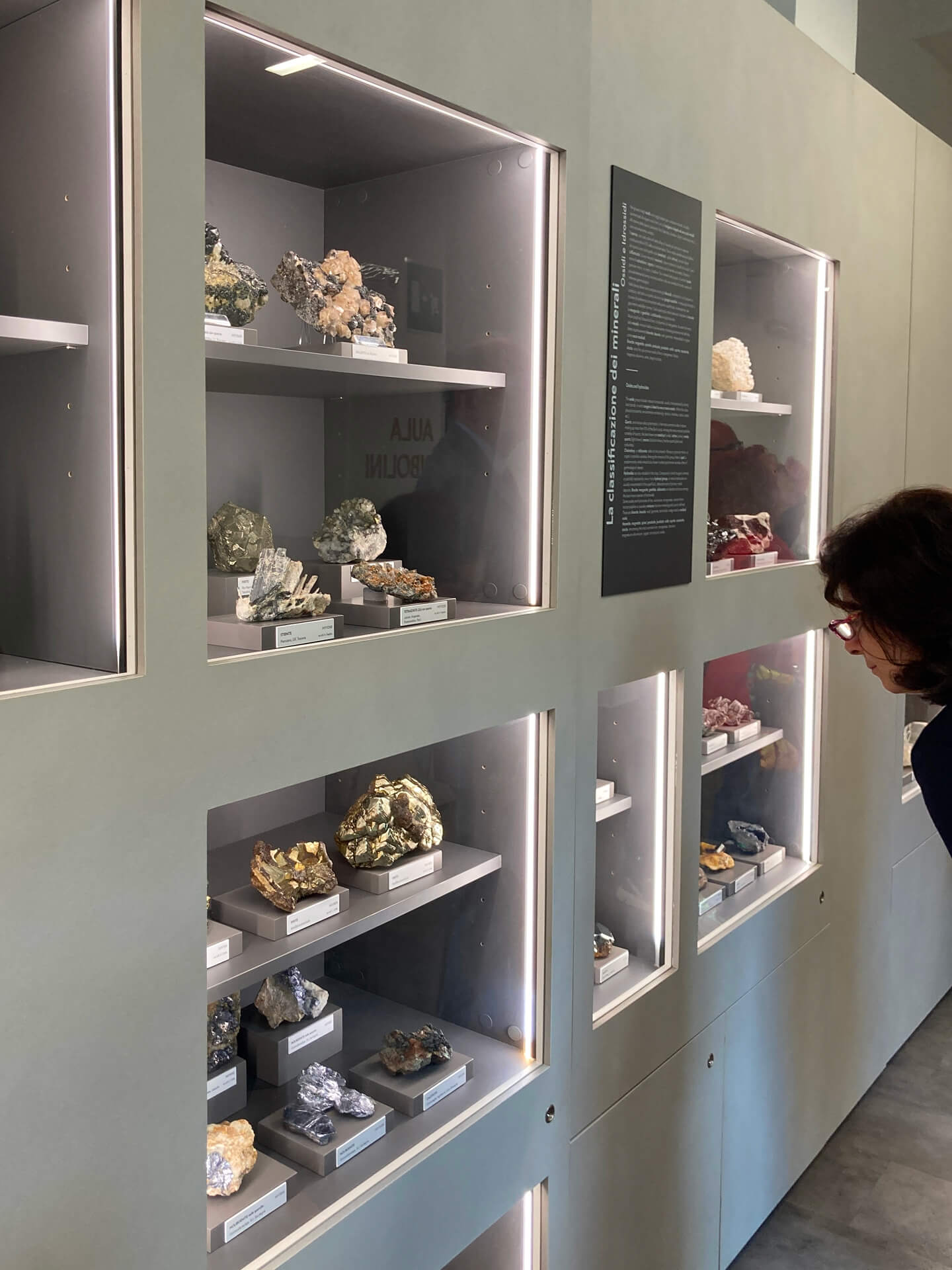
Front view of a museum exhibition module consisting of a continuous wall of neutral-colored panels, within which are recessed illuminated niches for the display of mineralogical samples. The display cases, of varying sizes and arranged in a regular grid, house classified rocks and crystals, placed on labeled stands and organized by type and mineralogical characteristics. Lighting is integrated into the display spaces through perimeter lighting profiles that provide diffused and uniform light, highlighting the texture, color, and morphology of the samples. Vertical information panels with explanatory texts relating to the classification of minerals are inserted between the modules and are integrated into the display's graphic design. The lower section of the wall consists of flush-fitting technical doors concealing service areas and utilities, while the continuous flooring made of neutral-toned resilient material contributes to the orderly and educational nature of the space. The image documents a permanent museum installation designed for scientific dissemination, in which furnishings, lighting, and information systems are integrated into a single modular exhibition system.

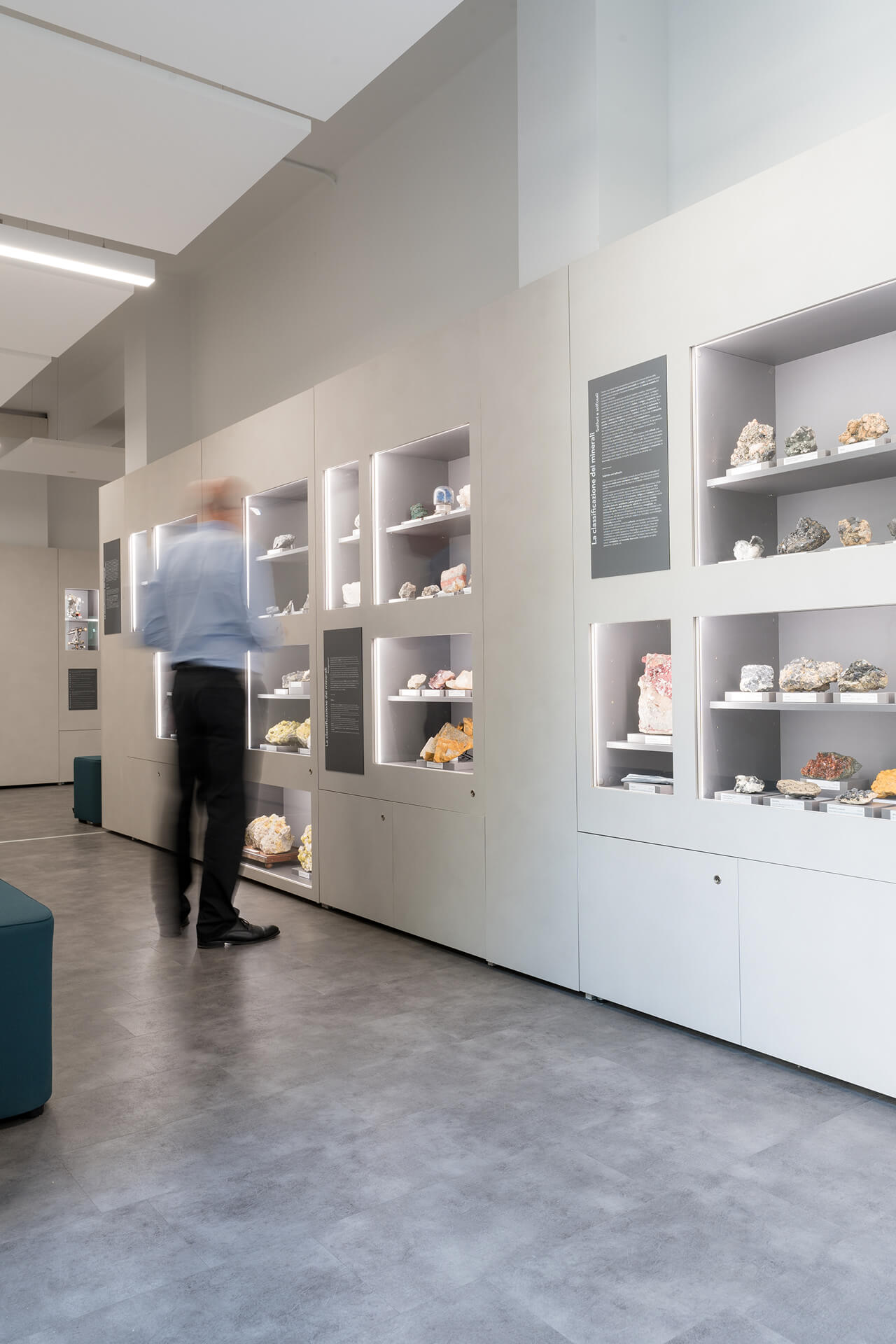
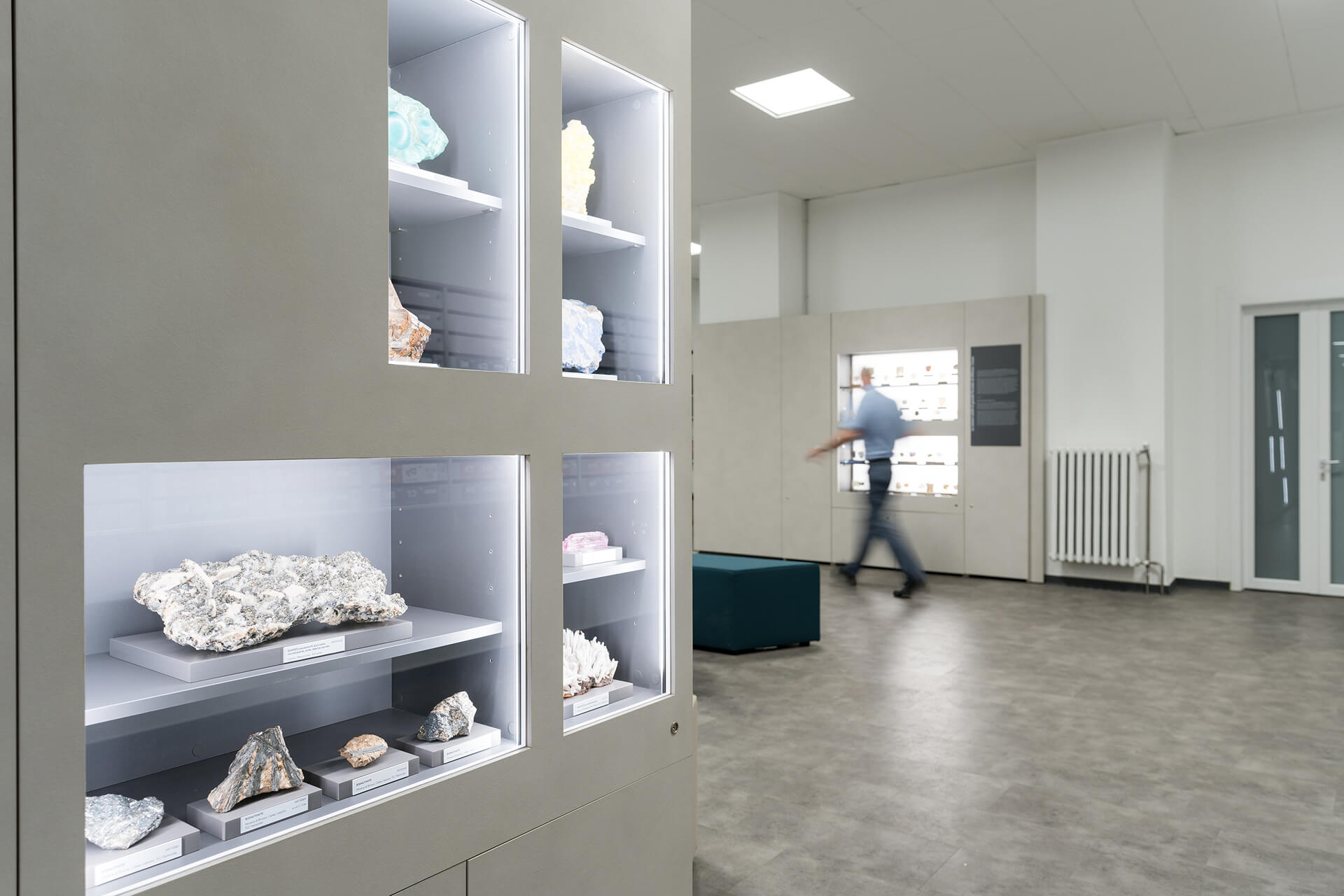
Interior view of a museum exhibition space with a continuous wall displaying mineralogical specimens, constructed using light-colored modular panels integrated with recessed illuminated niches. The display cases display classified minerals and rocks, arranged on labeled stands and organized according to scientific criteria. They are accompanied by vertical information panels with explanatory texts relating to the classification and properties of the materials. The display cases are illuminated by linear light profiles integrated into the edges of the compartments, while the ceiling features lowered elements and suspended linear light fixtures that contribute to a uniform distribution of light throughout the space. The continuous flooring, made of a resilient, neutral-toned material, creates an orderly and easily navigable environment. The image shows a visitor moving in front of the display cases, highlighting the use of the space and the scale of the exhibition. The overall configuration documents a permanent museum installation designed for scientific dissemination, in which exhibition furnishings, information graphics and lighting systems are integrated into a coherent, unitary system.

Front view of a museum exhibition module dedicated to mineral classification, consisting of a modular wall of continuous, neutral-colored panels with recessed illuminated niches. The display cases house mineralogical samples of various sizes, individually labeled and organized according to scientific and typological criteria. The specimens, characterized by different crystalline morphologies and color variations, are arranged on multiple levels to allow for a comparative reading of their physical and structural properties. At the center of the composition is a vertical information panel with explanatory text relating to mineral classification, integrated into the display's graphic design and aligned with the modular grid of the display cases. The interior lighting of the display compartments is achieved through perimeter linear lighting profiles that provide diffused, controlled light, suitable for showcasing the specimens without casting harsh shadows. The lower section of the wall consists of flush-fitting technical doors concealing service areas and systems, while the continuous gray resilient flooring contributes to the perception of uniformity and order in the space. The image documents a permanent exhibition system designed for scientific dissemination, in which furnishings, graphics, and lighting are integrated into a single modular museographic device.

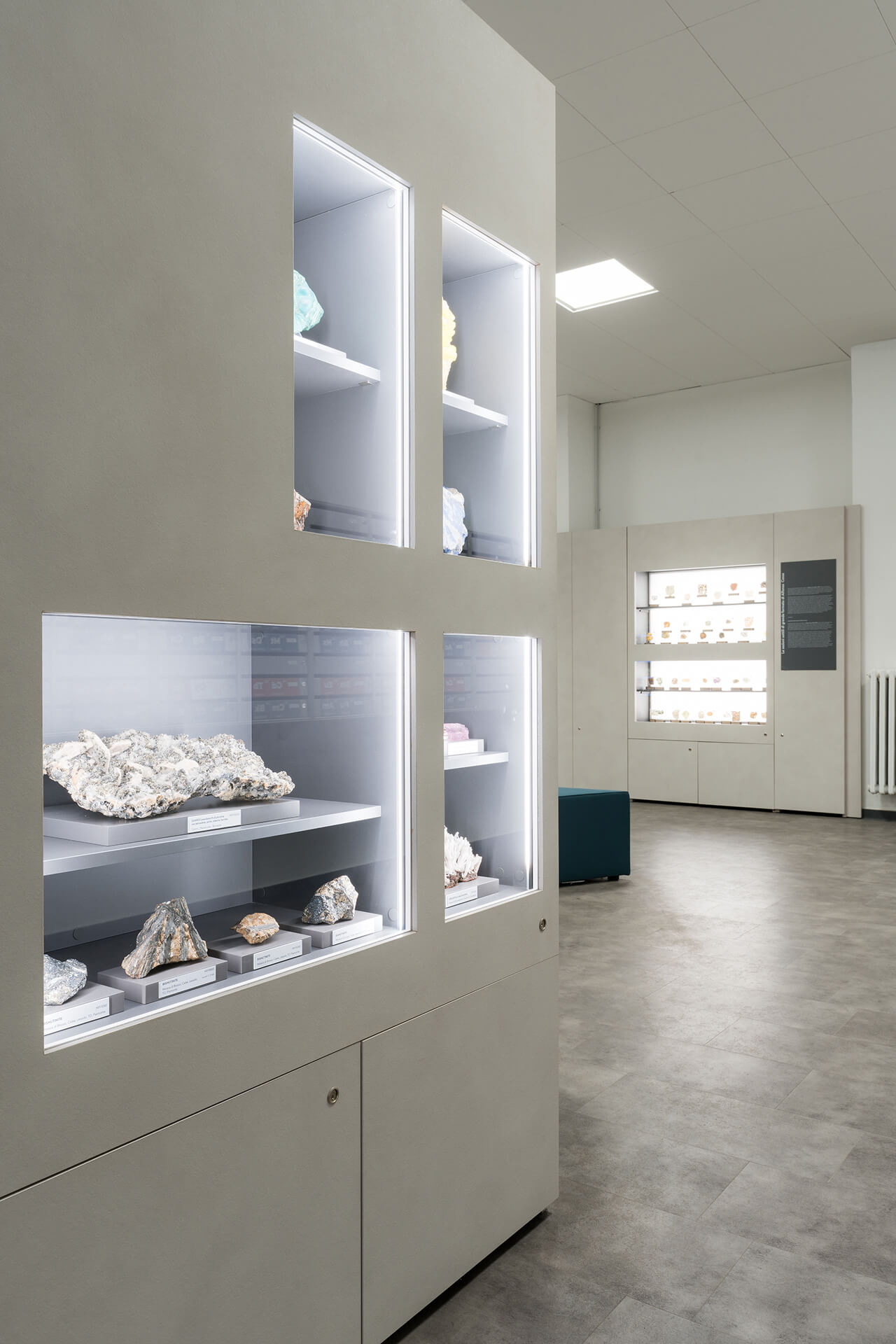
Interior view of a museum space with modular display walls for the display of mineralogical samples, constructed from continuous, light-colored panels with recessed, illuminated niches. The display cases, of varying sizes and arranged on multiple levels, contain classified rocks and minerals, placed on individual supports with identification labels and organized according to scientific criteria. Integrated perimeter lighting provides diffused, uniform light throughout the spaces, highlighting the morphological and chromatic characteristics of the samples. In the foreground, a corner display module defines the layout of the space and introduces the sequence of display walls, while in the background, another system of illuminated display cases can be glimpsed along the opposite wall. The ceiling is composed of a modular suspended ceiling with recessed lighting, while the continuous, neutral-toned, resilient flooring contributes to the perception of order and continuity within the space. The image documents a permanent museum installation designed for scientific dissemination, featuring an integrated modular display system that combines furnishings, lighting, and information devices into a single, coherent structure, designed to ensure legibility, preservation of the exhibits, and ease of use by visitors.

Interior view of a museum space with modular display walls for the display of mineralogical specimens, constructed using continuous panels with recessed illuminated niches. In the foreground, a display module is visible, featuring display cases of various sizes containing classified rocks and minerals, arranged on individual stands with identification labels and organized according to scientific criteria. Integrated perimeter lighting around the display cases provides uniform and controlled light, enhancing the material and color characteristics of the specimens. The space opens onto a larger room, paved with a continuous surface of resilient material in neutral tones and covered by a modular false ceiling with recessed lighting fixtures. In the background, another illuminated display system is visible, flanked by information panels and furnishings for visitors to relax in. The presence of a moving figure highlights the scale of the space and the way the museum is experienced. The image documents a permanent museum installation designed for scientific dissemination, featuring an integrated modular display system that combines furnishings, lighting, and information devices in a single device, designed to ensure legibility, conservation of the artifacts, and perceptual continuity of the exhibition space.

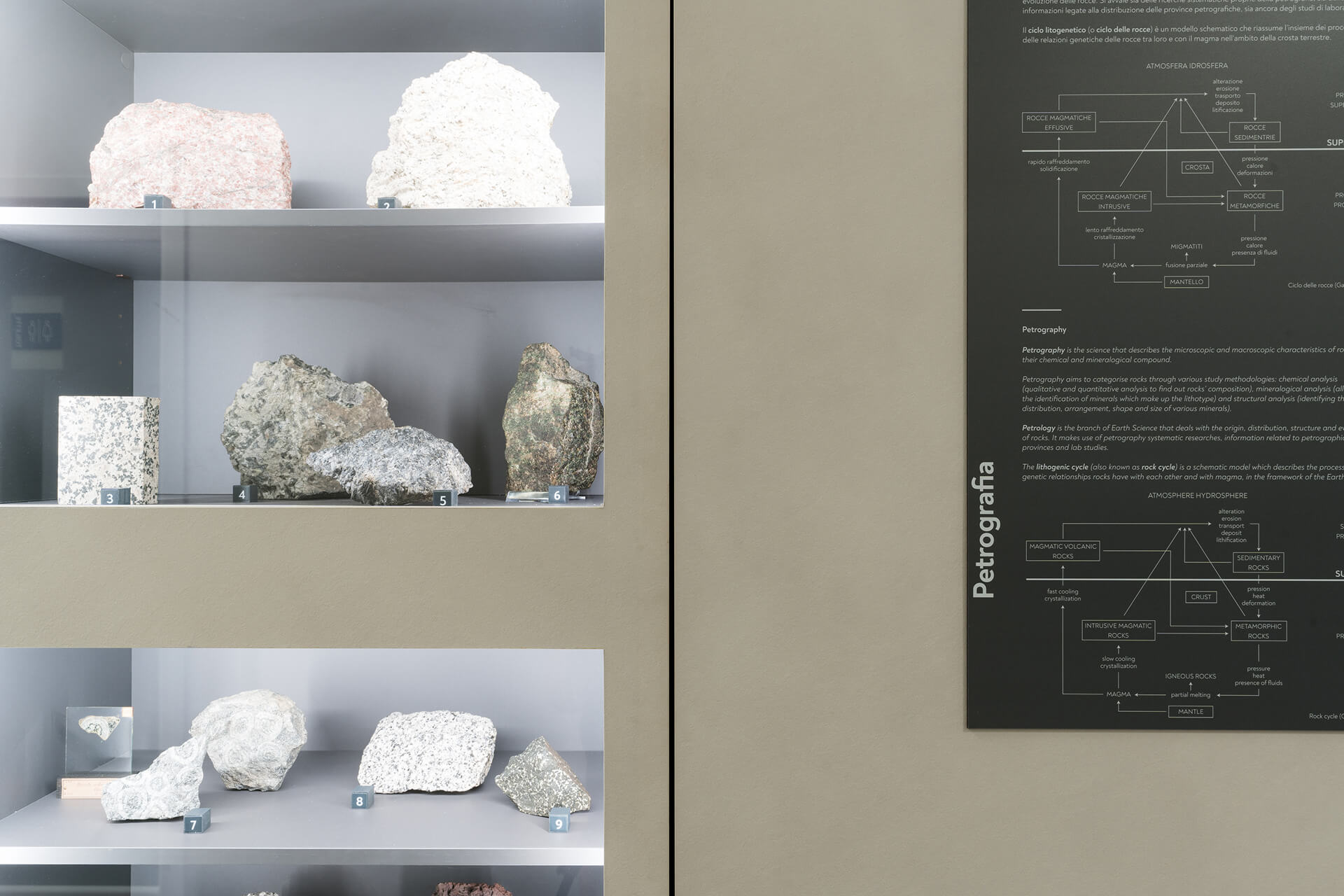
Detail of a museum display module with an illuminated display case embedded within a wall unit, containing classified rock samples arranged on horizontal shelves with numbered supports for identification. The specimens, characterized by different compositions and textures, are organized according to petrographic criteria and presented in an educational sequence that allows for visual comparison between the different lithological typologies. Integrated perimeter lighting around the display case provides diffused, uniform light, allowing for proper interpretation of the sample surfaces and structures. Next to the display case is a vertical information panel with graphics and explanatory texts relating to petrography and the lithogenic cycle, integrated into the coordinated graphic system of the exhibition and designed to accompany observation of the exhibits. The continuous, neutral-colored paneling integrates the display cases and information supports into a single modular element, while the darker interior surfaces of the niches enhance the perception of the samples. The image documents a permanent museum installation dedicated to the dissemination of Earth sciences, in which exhibition furnishings, teaching equipment, and technical lighting are designed as a unitary system to ensure clarity of display, preservation of artifacts, and ease of use.

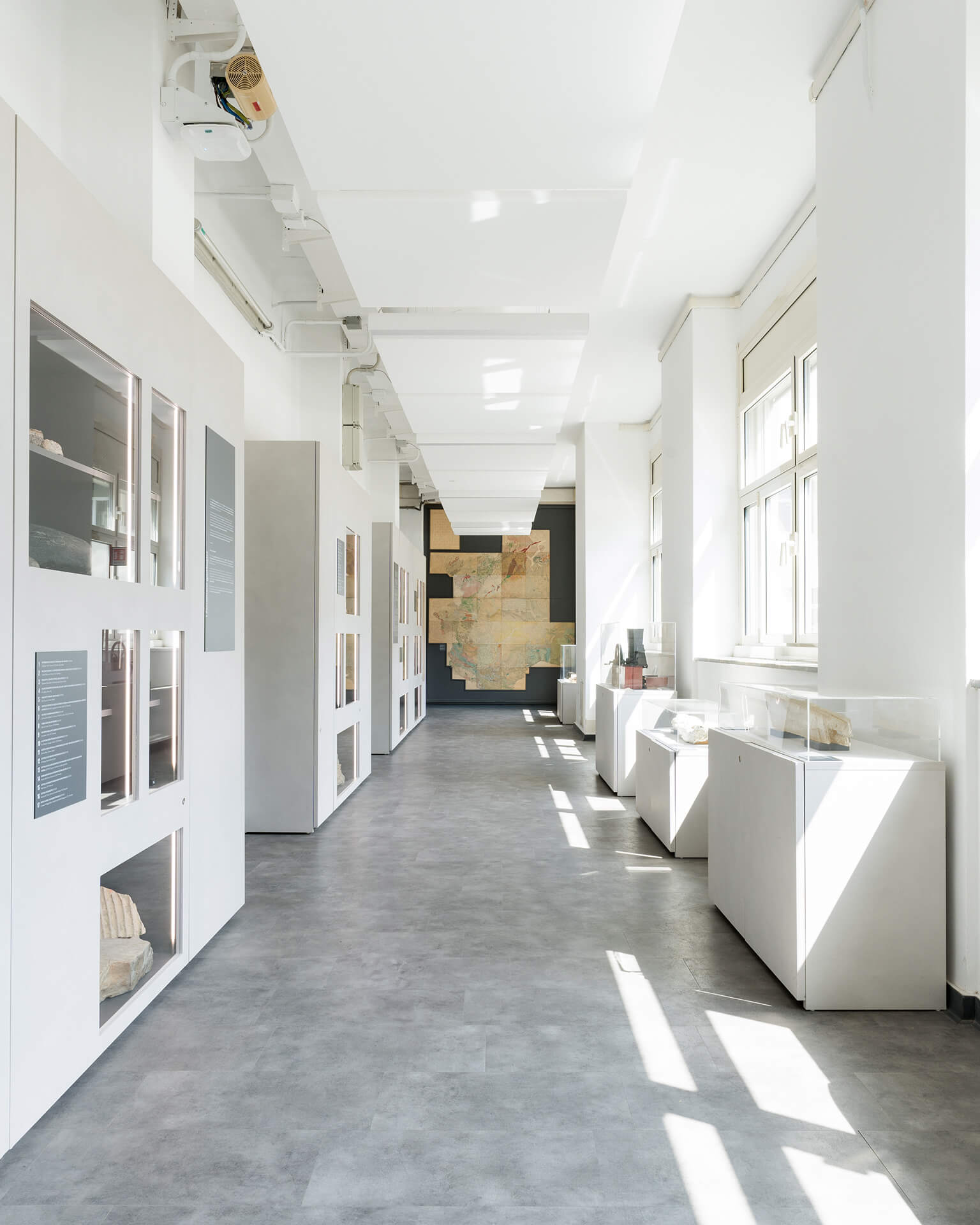
Perspective view of an exhibition corridor within a museum space, characterized by a longitudinal path defined by modular fitted walls with recessed illuminated display cases on the left side and a sequence of display bases with display cases on the right side, positioned at the window openings. Niches integrated into the paneling contain lithological samples and scientific specimens accompanied by vertical information panels, inserted into a coordinated graphic system intended to disseminate Earth sciences. The space is illuminated both by natural light from the side windows and by artificial lighting integrated into the false ceiling, consisting of lowered linear elements that conceal technical systems and ductwork, partially exposed in the upper section. The continuous resilient flooring in gray contributes to the uniform reading of the space and the continuity of the museum route. At the end of the corridor, a large wall-mounted cartographic graphic display is visible, serving as the final element of the exhibition route and as an educational aid. The image documents a permanent museum installation designed as an integrated system of furnishings, lighting, and information devices, aimed at ensuring clarity of display, conservation of artifacts, and seamless visitor experience.

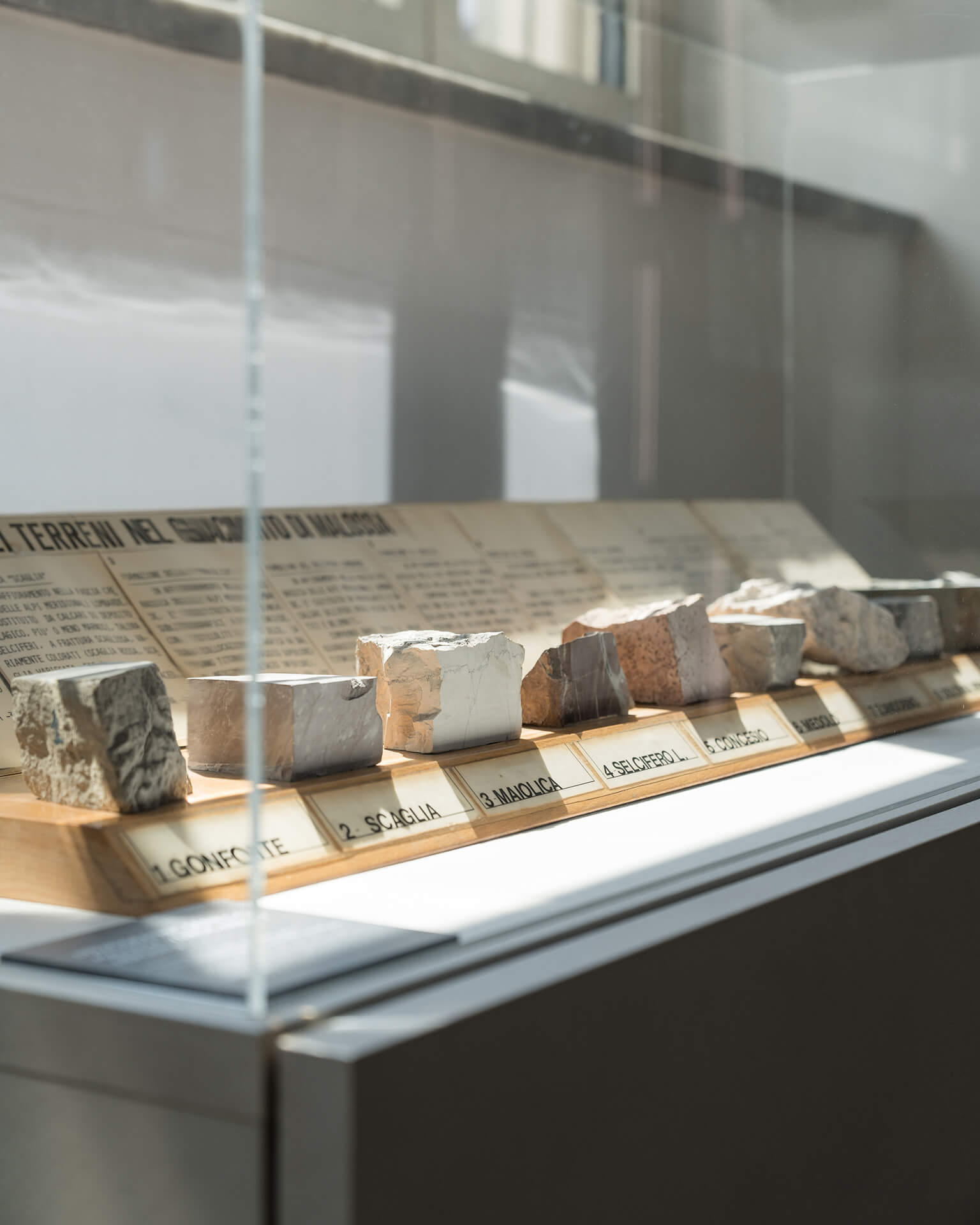
Detail of a museum display case containing lithological samples arranged sequentially on a tilted support, inside a protective glass case. The rock fragments, cut into blocks of regular size, are aligned on a wooden base with numbered identification labels and lithological names, organized according to stratigraphic and educational criteria. The back panel features an explanatory table relating to the classification of soils in the local geological context, used as a support for interpreting the exhibited samples. Natural lighting from the side highlights the different textures, grain sizes, and colors of the rocks, while the glass case ensures the artifacts are protected while also ensuring their proper visibility. The display case is mounted on a base integrated into the exhibition system, consistent with the other museum elements in the space. The image documents an educational exhibition device intended for the dissemination of Earth sciences, designed to allow direct comparison between samples and information supports, within a permanent museum installation characterized by modular solutions and controlled lighting.

Detail of a museum display wall equipped with recessed illuminated niches, within which mineralogical samples are displayed on individual holders with identification labels. The display cases, integrated into a continuous, neutral-colored paneling, are illuminated by perimeter lighting profiles that provide diffused, controlled light, suitable for accurately interpreting the crystallographic, chromatic, and structural characteristics of the minerals on display. The samples are organized according to scientific classification criteria and accompanied by vertical information panels with explanatory texts relating to the mineral classification, integrated into the coordinated graphic system of the exhibition. The lower section of the wall is made up of flush-mounted doors that conceal technical compartments and systems, contributing to the overall cleanliness of the overall design. The image shows a visitor closely examining one of the display cases, a feature that highlights the scale of the exhibition and the close-up approach envisioned by the museum design. The image documents a permanent museum installation designed as an integrated modular system, in which furnishings, lighting, and educational equipment contribute to defining an orderly, legible exhibition space functional for scientific dissemination.

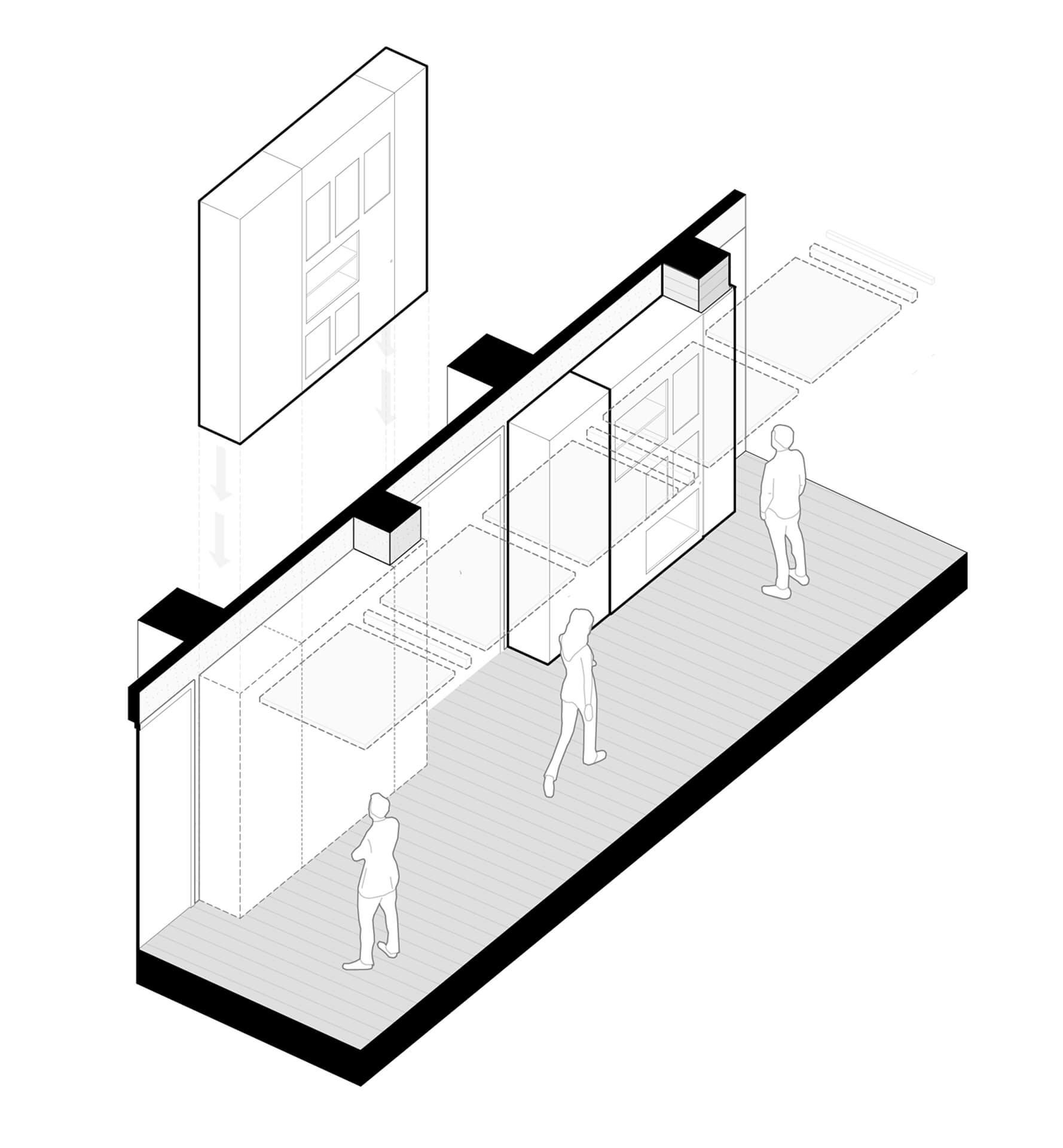
Axonometric study diagram of the modular exhibition system designed for the museum exhibition, represented by a simplified black-and-white technical drawing. The view shows a fitted wall composed of vertical panels integrated with recessed display cases and display modules, flanked by freestanding elements positioned at the back, designed to contain display cases or informational displays. The drawing highlights the exhibition's structural structure through an exploded view, in which some components are shown in a recessed or suspended position to illustrate the assembly system and the stratigraphy of the elements. The front cladding, internal storage volumes, display case supports, and upper panels intended to accommodate the lighting systems are clearly visible. The presence of stylized human figures allows for a clear understanding of the scale of the project and the visitor experience along the exhibition route. The flooring is depicted with a linear texture to indicate the continuity of the walking surface, while the wall behind it defines the architectural boundary within which the modular system is inserted. The image documents a design scheme used to define the construction and functional organization of the museum display, aimed at coordinating furnishings, display cases, information panels, and systems into a single integrated device.


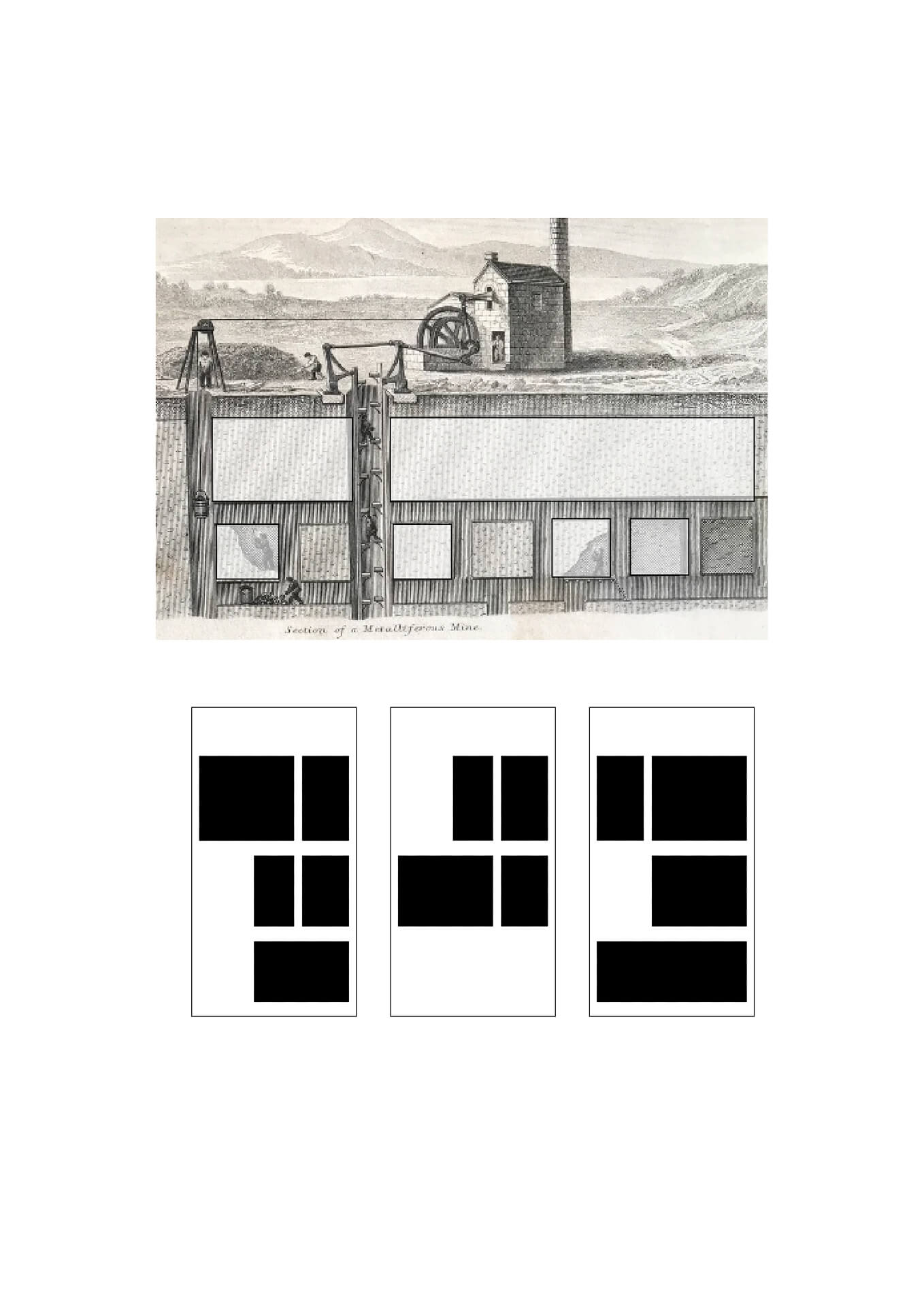
A graphic study board for the exhibition layout, consisting of a historical engraving depicting a cross-section of a metal mine, accompanied by diagrammatic diagrams used to define the layout of the information panels. The upper section features a historical technical illustration showing the operation of a mining facility, with a surface building, a mechanical wheel, and a vertical shaft that passes through the various subsurface layers, represented in stratigraphic section. The image highlights the relationship between industrial infrastructure and geological structure, a central theme of the exhibition. The lower section features three simplified compositional schemes, consisting of black rectangles on a light background, used to study the arrangement of text, images, and graphics within the educational panels. The diagrams illustrate different layout configurations, varying the position of the information blocks to assess visual balance, content hierarchy, and readability. The image documents a design phase of the museum exhibition, aimed at defining the graphic layout of the exhibition media and the integration of historical iconography, scientific content and visual communication system.


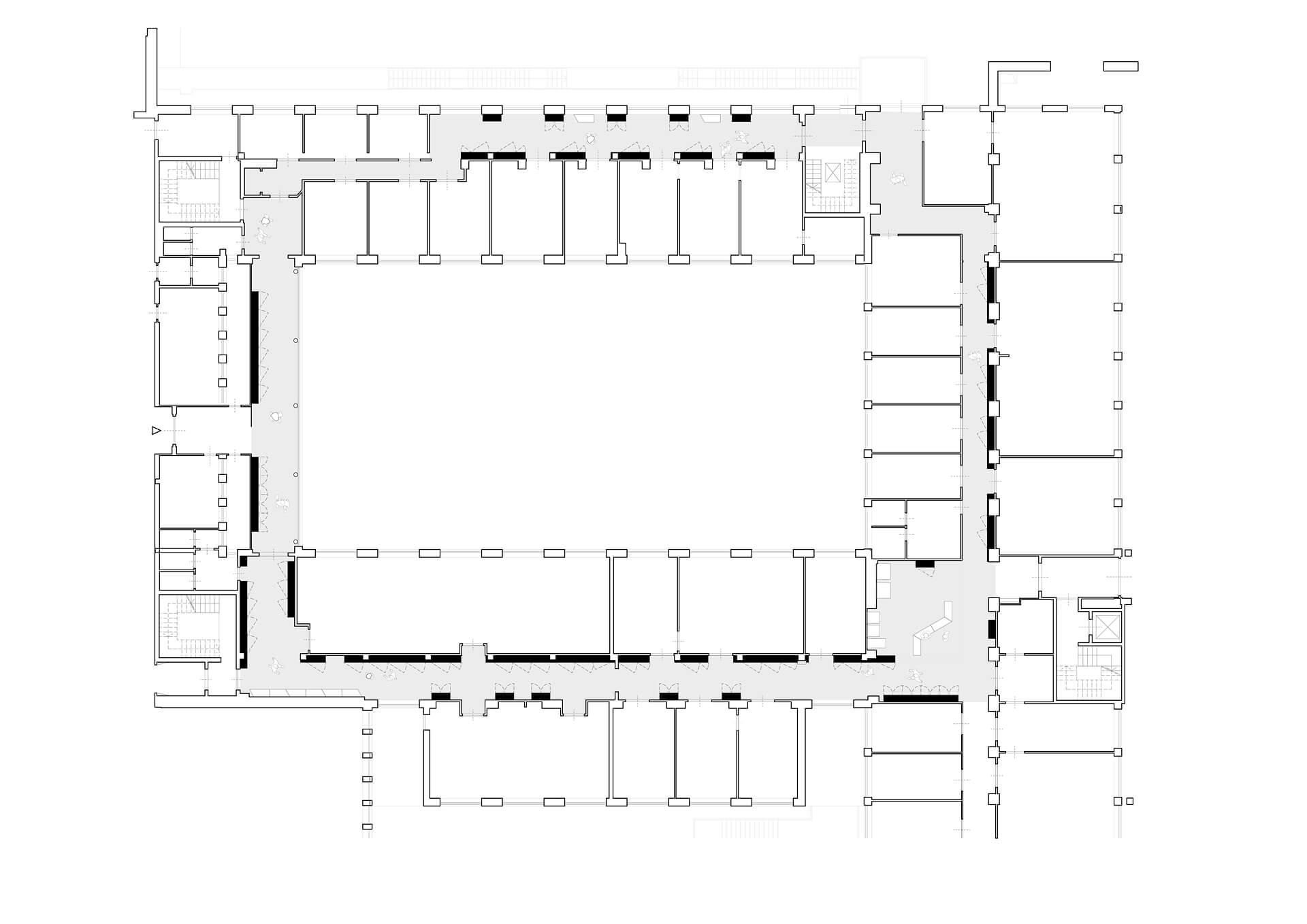
Architectural plan of the building undergoing renovation, represented by a scaled technical drawing, used as the basis for the museum exhibition design. The drawing shows a courtyard layout with a large central rectangular space surrounded by perimeter rooms distributed along all sides, connected by a continuous system of corridors and openings. The drawing highlights the existing wall structure, pillars, internal partitions, and the main vertical connections, including stairs and passageways, allowing for a clear understanding of the building's functional organization. The darker areas along some walls indicate the areas affected by the exhibition renovation, where the new installation elements, paneling, and integrated display systems have been inserted. The large central space, left free, serves as a distribution hub and a connecting area between the various spaces, while the rooms along the perimeter host the museum's thematic itinerary. The plan documents the coordination phase between the existing architecture and the exhibition design, useful for defining the positioning of furnishings, display supports, and systems, ensuring continuity of the flow and legibility of the spaces. The image therefore constitutes a project document used to study the functional distribution and the integration between the building's historic structure and the new museographic system.


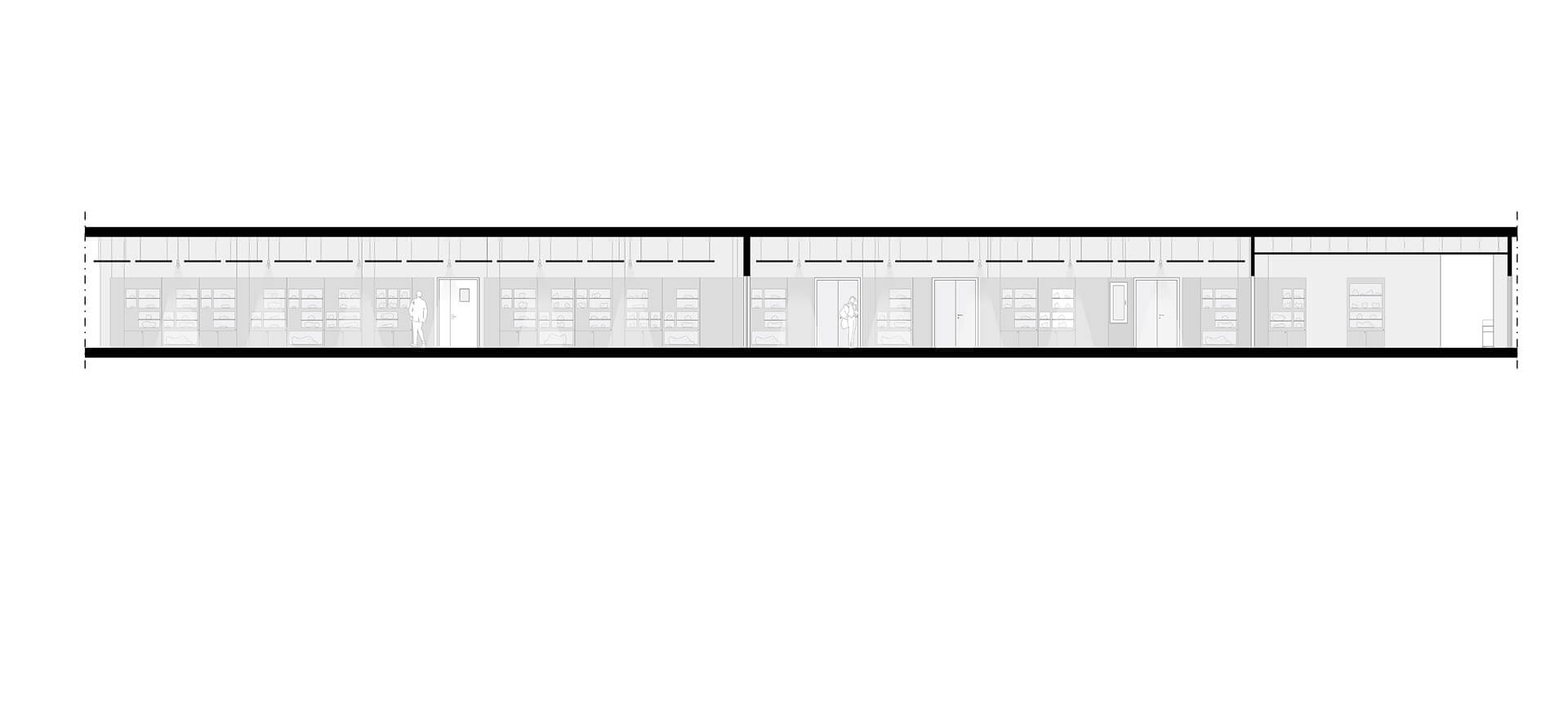
Longitudinal section of the museum exhibition design, represented by a simplified technical drawing showing the linear development of one of the exhibition galleries along the perimeter of the building. The drawing highlights the relationship between the existing architectural space, the technical suspended ceiling system, and the equipped wall intended for the display of mineralogical samples. The integrated exhibition modules, consisting of continuous panels with recessed, illuminated display cases, are depicted along the wall, arranged in a regular pattern between the openings and connecting passages. The suspended suspended ceiling, continuous along the entire length of the room, integrates the linear lighting system and helps define a technical band that unifies the space and conceals the utility ducts. The presence of stylized human figures allows for an appreciation of the scale of the elements and the usable height of the rooms, illustrating the relationship between the visitor, the display cases, and the information panels. The doors and passages between the various rooms articulate the museum journey, highlighting the succession of spaces and the continuity of the exhibition throughout the corridor. The drawing documents an executive definition phase of the project, useful for coordinating architecture, museum furnishings, and systems, verifying the alignment of the exhibition modules, the height of the display cases, the position of the lights, and the integration of the system within the existing structure.